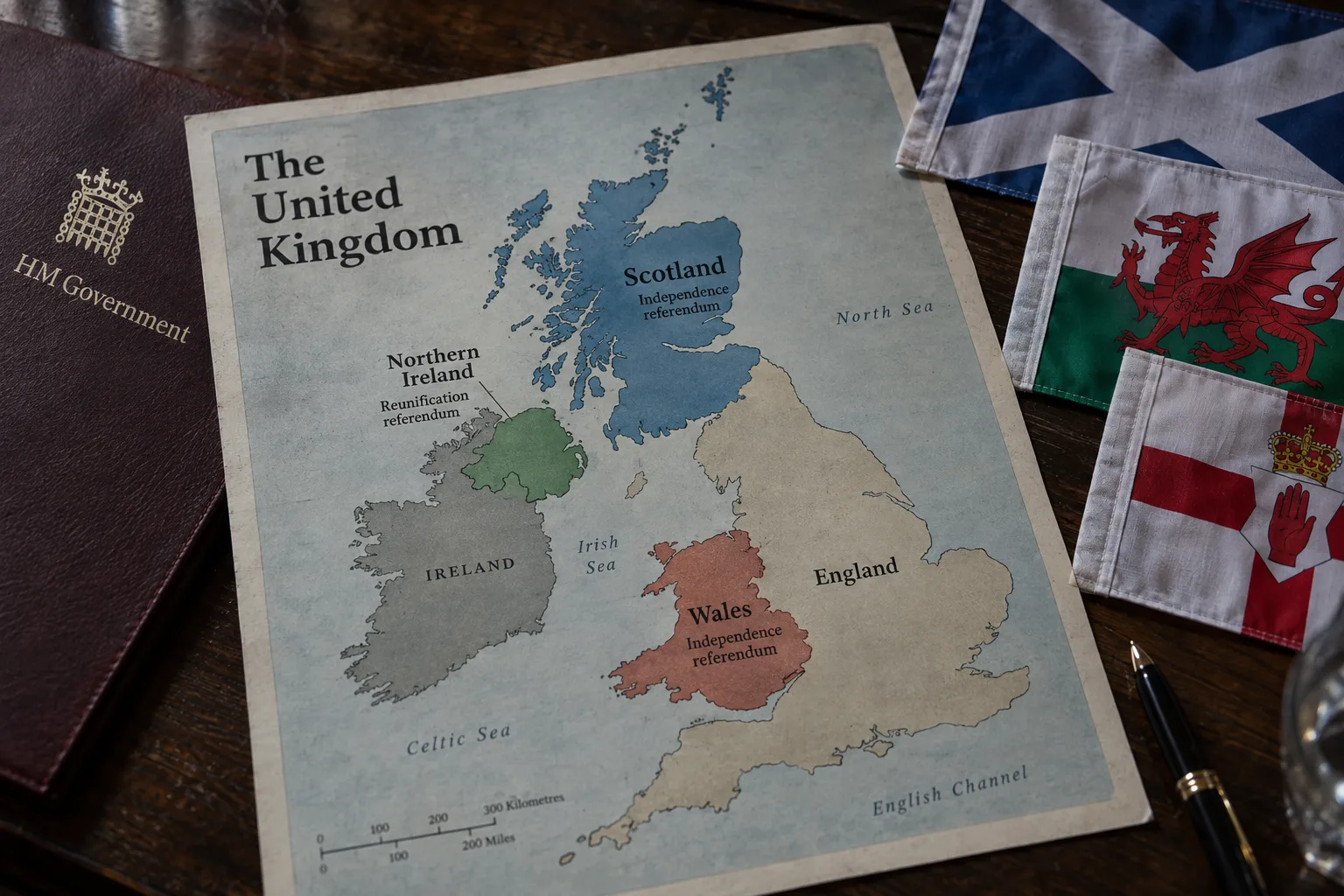
Andy Burnham cannot stop the United Kingdom breaking up, Sinn Féin said on Monday after nationalist leaders from Scotland, Wales and Northern Ireland signed a joint memorandum in Cardiff declaring that Westminster has no right to block their nations’ “self-determination”.
The agreement was signed in Cardiff by John Swinney for the SNP, Rhun ap Iorwerth for Plaid Cymru and Michelle O’Neill for Sinn Féin, with Mary Lou McDonald also attending, with the four taking part in their capacities as party leaders. The document says “Westminster’s time is coming to an end” and calls on the British government to “prepare for, plan and facilitate constitutional change in each jurisdiction”.
At the joint press conference, O’Neill said Burnham “will not be able to hold back the tide” and argued that constitutional change across the three nations was now moving beyond Westminster’s control. She said their “common cause” was the view that Westminster “does not and will never serve our people well”, and insisted each nation had the right to decide its own future.
O’Neill also said Irish reunification was “very much” part of the live political debate after Donald Trump said at the weekend that he would “love” to see a united Ireland. Her response was that the issue was now being discussed far beyond Irish politics. Trump’s intervention gave the nationalists a political opening, but it changes nothing about the constitutional mechanisms governing Irish reunification under the Good Friday Agreement.
The language of the pact is blunt. It states that “no Westminster government has the right to block democracy” and says each nation will determine its future “in its own way and in its own time”. It also commits the parties to closer co-operation on the economy, energy and Europe, and says “the future of our nations belongs in the European Union”. That position may prove politically complicated in Wales, which voted to leave the EU in 2016, while any future Welsh independence and EU accession debate would also raise questions about the economic relationship with England.
There is, however, an important difference between nationalist momentum and an agreed legal route to deliver it. Northern Ireland has a defined mechanism for a border poll under the Good Friday Agreement if it appears likely that a majority would vote to leave the UK. Scotland does not have an equivalent automatic pathway, and Plaid Cymru has ruled out a Welsh independence referendum before the next Senedd election in 2030. Rhun ap Iorwerth declined on Monday to set any timetable for such a vote in Wales.
That matters because the Cardiff show of unity was politically striking, but it did not erase the very different positions of the three movements. The SNP wants another referendum after losing in 2014. Plaid is still trying to build support in a country where independence remains a minority position. Sinn Féin has the clearest constitutional mechanism available, but only if the conditions for a border poll are judged to have been met. A shared stage is not the same thing as a shared road map.
Swinney nevertheless used the moment to make the biggest claim of the day, saying Burnham would be “the last prime minister of the United Kingdom”. He argued that Scots would vote for independence if given the choice. It was an arresting line, though not one supported by settled fact. The 2014 Scottish independence referendum produced a 55 to 45 vote to remain in the UK, and while support for independence has remained substantial, the question is still contested.
The immediate trigger for the latest clash was Burnham’s handling of the referendum question at Prime Minister’s Questions. He appeared to suggest that a referendum in Scotland could be justified if there were clear majority support for a vote, comparing the situation to Northern Ireland. He then clarified that another Scottish referendum remained “off limits”. Nationalist leaders seized on the apparent contradiction.
Claire Bullivant, CEO of the Great British PAC, said:
“Nationalists are very fond of the phrase ‘self-determination’, but self-determination also means respecting people when they vote to remain part of the United Kingdom.
“Scotland was asked, and Scotland voted to stay. Northern Ireland’s constitutional position is governed by the principle of consent. You cannot champion democracy only when you think it will deliver the answer you want.
“The Union should never be taken for granted, but nor should its break-up be treated as some inevitable tide that nobody has the right to resist. Millions of people in Scotland, Wales and Northern Ireland are proud to be part of our United Kingdom, and their voices matter too.
“Burnham’s muddled response has given the nationalists exactly the opening they wanted. Britain needs a Prime Minister prepared to make the positive, unapologetic case for our Union, not one who leaves the door ajar while those determined to dismantle it march through.
“The United Kingdom is worth defending, and those of us who believe in it should say so loudly.”
Downing Street responded by insisting the Prime Minister “believes strongly in the Union” and would focus on household finances and economic security rather than “constitutional debates or further referendums”. That is the government’s line for now. But Cardiff was a reminder that the Union’s opponents are no longer operating in isolation. For the first time in the devolution era, nationalist first ministers are in place in Scotland, Wales and Northern Ireland at the same time. That does not mean the end of the UK is imminent. It does mean the pressure is now organised, public and increasingly confident.