
Let us stop pretending.
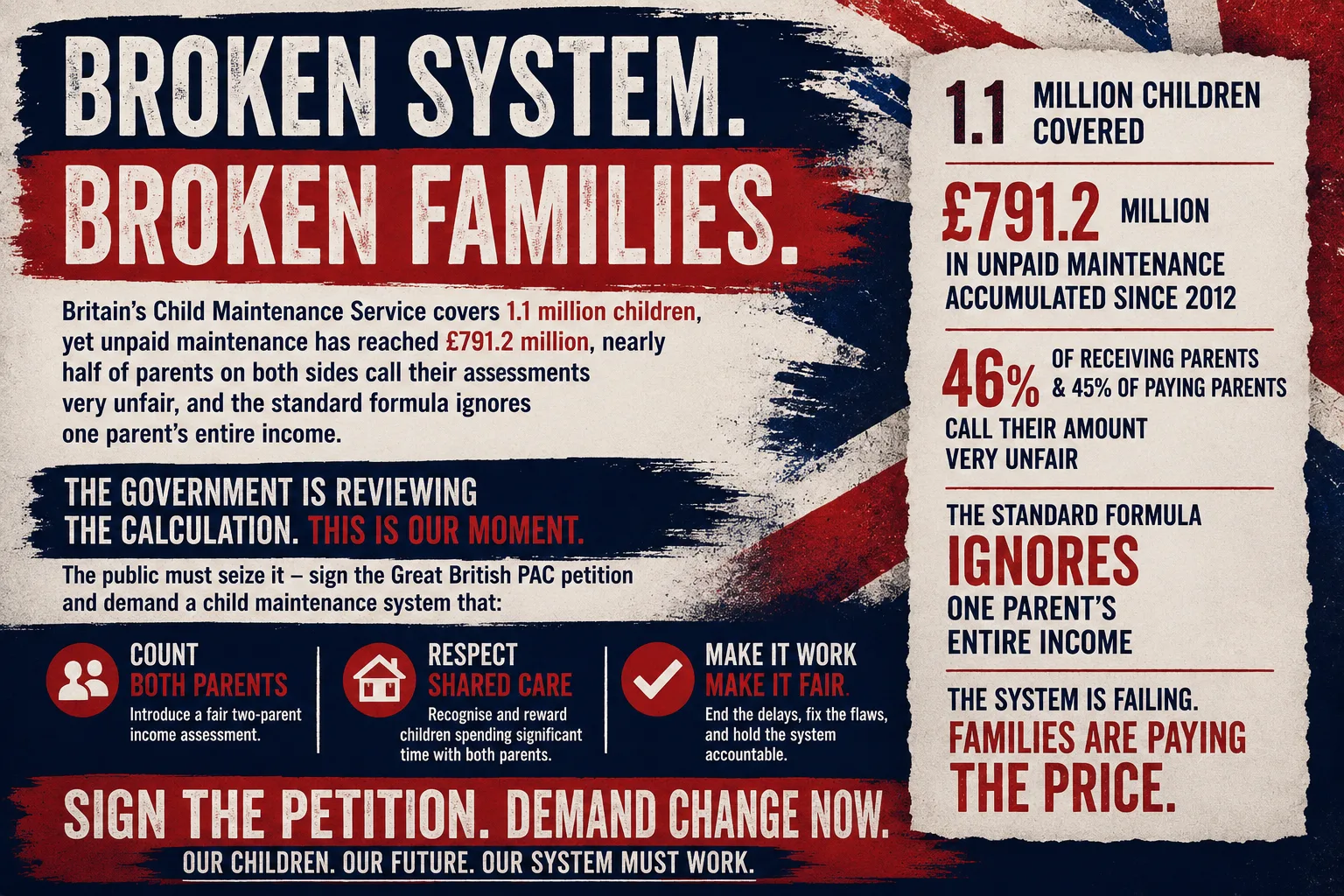
Britain’s Child Maintenance Service is not experiencing teething problems. It is not a good system let down by a few difficult cases. It is a failing institution, operating at enormous scale, sitting between millions of separated parents and the children they share, and it is losing the confidence of the very people it was built to serve. That is why the Great British PAC has launched its campaign to reform the Child Maintenance Service, and why every parent, every grandparent, every voter who believes in fairness should sign the petition today. Source
This is not a crusade against child maintenance. Let that be said clearly, because defenders of the status quo will try to blur it. Children must be supported. Both parents are responsible for the costs of raising their children, as the government’s own Child Maintenance Service pages correctly state. Nobody serious disputes that. What is disputed, loudly, angrily, and increasingly with evidence, is whether the machine built to deliver that principle is fit for purpose. The answer, on the government’s own numbers, is no. Source
A giant system, drowning in grievance
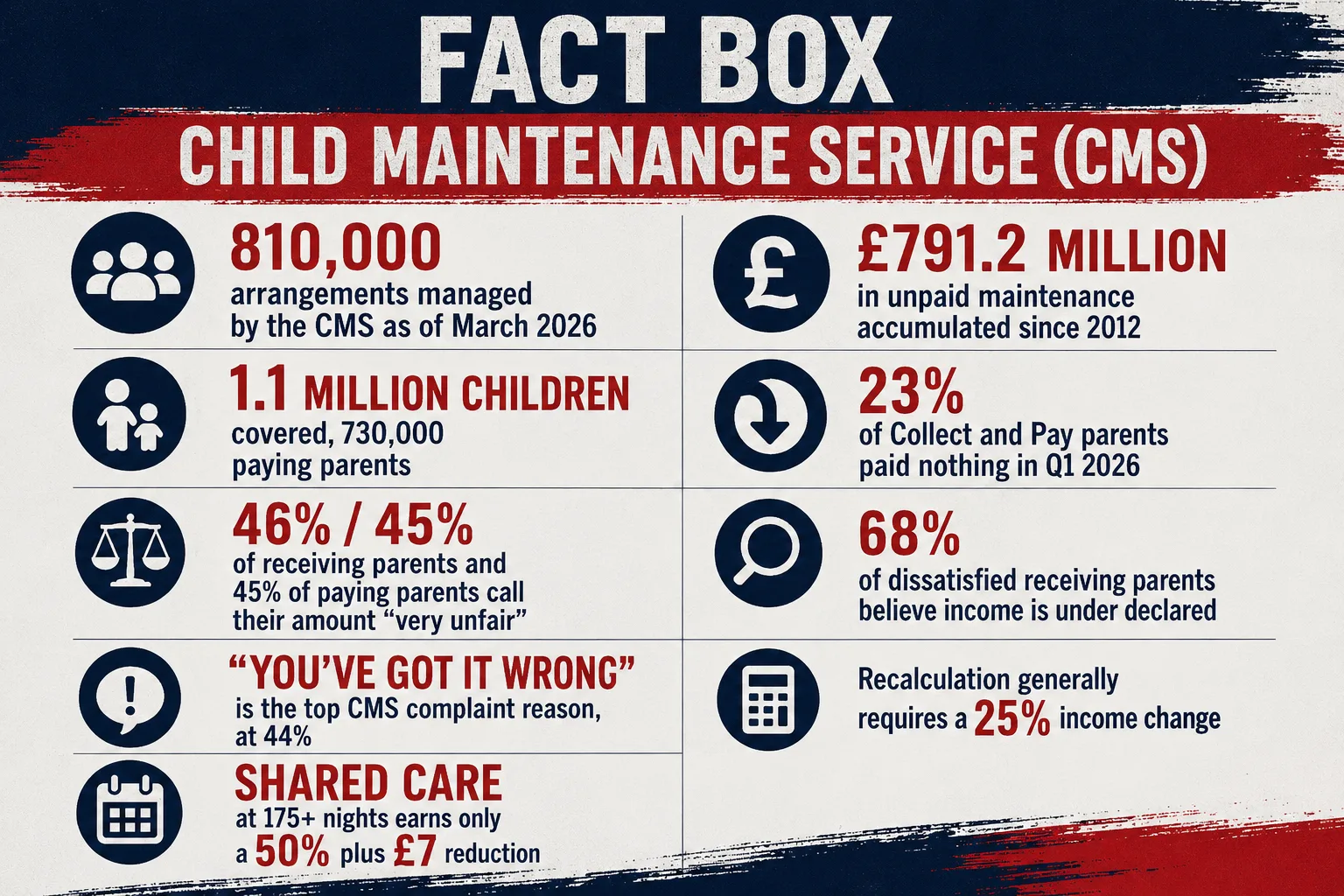
Start with the scale, because scale is what makes failure unforgivable. According to the official CMS statistics to March 2026, the service was managing 810,000 arrangements for 730,000 paying parents, covering 1.1 million children. In one quarter alone, £405.1 million was due to flow through it. And since 2012, a staggering £791.2 million in unpaid maintenance has accumulated, roughly 7 per cent of everything ever owed. Source
Read that again. Nearly eight hundred million pounds meant for children, never delivered. That is not a rounding error. That is not an administrative wrinkle. That is a national debt owed to children, stacking up year after year while ministers issue press releases.
On the Collect and Pay side, where the state itself collects the money, 23 per cent of paying parents, some 57,000 people, paid nothing at all in the quarter ending March 2026. Source
A system can survive criticism. It cannot survive indifference to results like these.
One income counted. One ignored. How is that fair?
Now to the design flaw at the heart of it all. As the official guide to how child maintenance is worked outmakes plain, the CMS bases its calculation on the paying parent’s gross income, drawn from HMRC. The receiving parent’s income does not enter the standard calculation at all. Source
Pause on that. In a modern Britain of two income households, the state assesses a child’s financial world by measuring only one of the two households that child lives between. One parent’s earnings are audited down to the pound. The other household’s resources might as well not exist. Whatever your view of individual cases, that is not a neutral formula. It is a structural choice, and it is producing outcomes that thousands of parents, on both sides of arrangements, experience as profoundly unfair.
The Great British PAC petition demands exactly what common sense demands, that the income and financial circumstances of both parents be taken into account. This is not a demand to pay less. It is a demand to pay the right amount, calculated from the full picture, not half of it. Source
The 25 per cent cliff edge, a rule from another era
Then there is the rule that would be comical if families were not living with its consequences. Under the official change of circumstances guidance, a paying parent’s income change generally only triggers recalculation if it moves by 25 per cent or more. Below that threshold, an assessment can rest on money a parent no longer earns, or miss money they have started earning. Source
Think about what 25 per cent means in real life. A father whose hours are cut by a fifth, scrambling to cover rent, still assessed on the old figure. A mother who knows her former partner’s income has climbed substantially, watching her child go without while the system shrugs because the threshold has not been crossed. Both injustices are built into the same rule. Both are wrong. And both are completely avoidable in an era of real time HMRC data.
The petition calls for that arbitrary tolerance to be scrapped and replaced with a system that responds to material change, backed by accurate, up to date income information. If you believe tax data should reflect reality rather than a twelve month old snapshot, add your name.
Shared care that the system barely believes in
Britain has embraced shared parenting in principle. The CMS has not followed. Under the current rules, a child staying 156 to 174 nights a year with the paying parent earns that parent a reduction of 42.86 per cent. At 175 nights or more, effectively half the year, the reduction is 50 per cent plus £7 a week, and payments still cannot fall below £7 a week. Source
Picture what 175 nights actually means. Two homes kept warm. Two sets of school shoes. Two bedrooms, both of them the child’s own. Food, transport, birthdays, uniforms, all duplicated across two households. The parent providing nearly half of that care is still treated, in law’s arithmetic, as an absent contributor. The petition’s demand is straightforward, where genuine shared care of 156 nights or more is established, routine CMS payments should ordinarily cease unless exceptional circumstances apply. Shared parenting should mean something. Right now, in the calculation, it means too little. Source
The government’s own research condemns it
You do not have to take a campaign’s word for any of this. Take the government’s. The DWP’s own child maintenance calculation research found that parents’ understanding of the formula was “mixed and often limited,” that CMS communications were described as unclear, and that confusion was actively feeding mistrust between parents. Source
The headline findings should be nailed to the door of every ministerial office. Nearly half of receiving parents, 46 per cent, and nearly half of paying parents, 45 per cent, said the amount being paid or received was “very unfair.” Among receiving parents who considered the calculation unfair, 68 per centbelieved the paying parent earned more than declared. One parent quoted in the research put it with brutal simplicity, “they don’t give you a breakdown as to how they come to this conclusion.” Source
That pairing tells the whole story. One side cannot follow the arithmetic. The other does not trust the income figure the arithmetic is built on. That is not a war between parents. It is a failure of the institution sitting between them, and it manufactures precisely the conflict a child maintenance system exists to defuse.
Complaints data hammer the point home. In the DWP complaints statistics to December 2025, the single most common reason for a closed CMS complaint was “You’ve got it wrong,” at 44 per cent. When the dominant message from your customers is that your decisions are simply incorrect, you do not have a communications problem. You have a competence problem. Source
And behind the numbers, real suffering
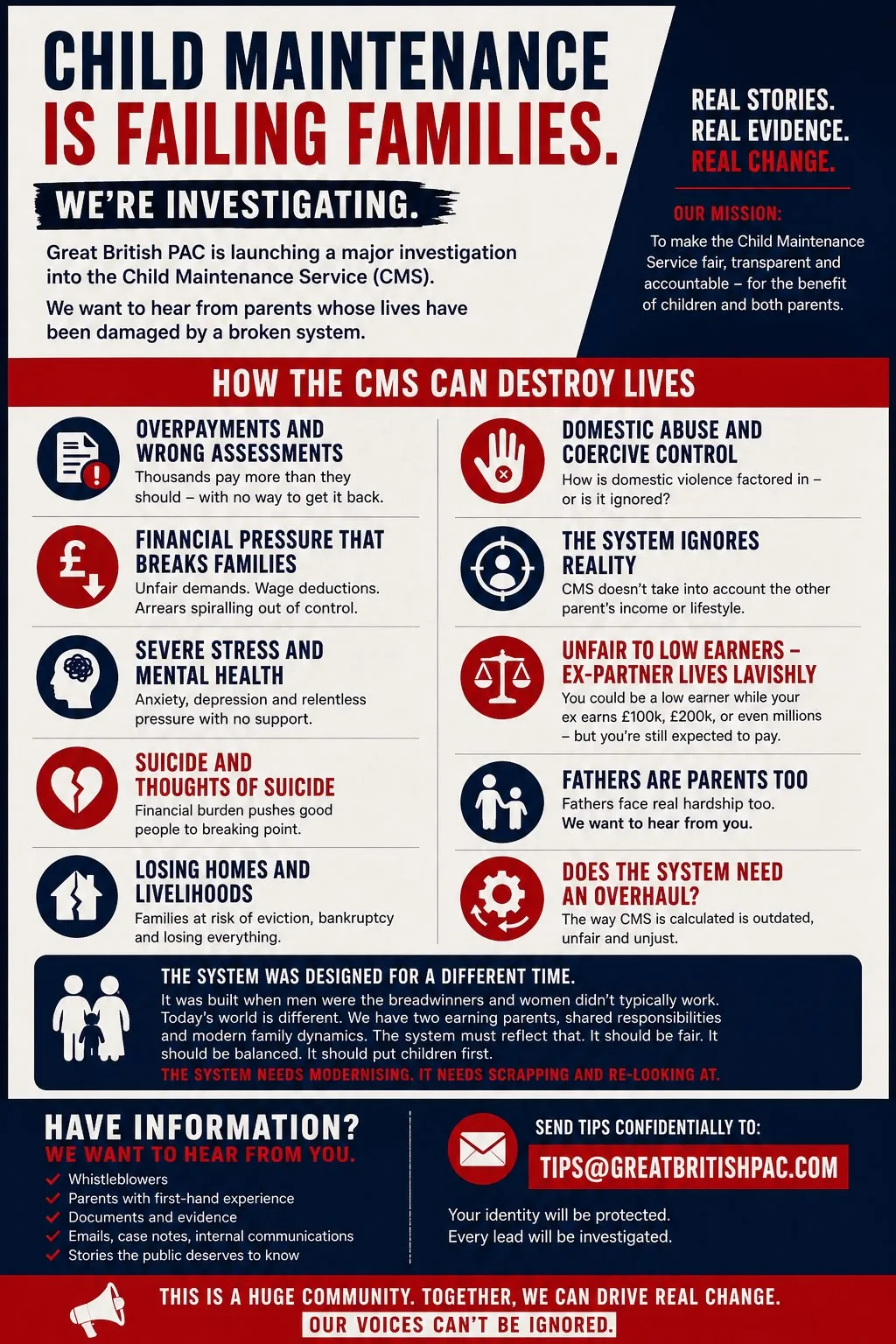
This is where the argument stops being technical and starts being urgent. The Great British PAC is launching a major investigation into the CMS, and it is asking the public for evidence of the harms the official statistics cannot capture, financial hardship and debt, stress, mental health struggles and suicide linked to financial pressure, domestic abuse and coercive control, families losing their homes, and unfair assessments that ignore the other parent’s income. Source
None of that is speculative. The government itself has admitted that child maintenance can be weaponised. Its own announcement on clamping down on domestic abuse acknowledged that abusive ex partners can use the payment system as a tool of ongoing financial control, and introduced measures so survivors can have payments collected without an abuser’s consent. That concession, welcome as it is, is an admission of how high the stakes are. A broken CMS is not just unfair. For some families, it is dangerous. Source
If you have lived any of this, whether you are a mother fighting for what your child is owed or a father crushed by an assessment that bears no relation to your real income, the campaign wants to hear from you. Send your story to tips@greatbritishpac.com. Real stories. Real evidence. Real change.
The window is open. Do not let it close.
Here is what makes this moment different from every previous complaint cycle. The system is, at last, under formal review. The government has commissioned research into the calculation itself. The House of Lords Public Services Committee has examined reform of the CMS, with its report debated by peers in June 2026. The evidence is on the table. The conclusions have not been written yet. Source
That means the next few months will decide whether Britain gets a child maintenance system fit for modern families, or another decade of the same formula, the same cliff edges, the same £791 million debt mountain growing quietly in the background. History tells us what happens when the public stays silent at moments like this. Nothing changes. The review concludes, the report is shelved, and families go back to being told the computer says no.
Do not let that happen. Sign the petition to reform the Child Maintenance Service. Share it with every parent you know who has been through this system. It does not matter which side of an arrangement you are on, because a fairer, more transparent, more accurate CMS is better for receiving parents, better for paying parents, and above all better for the 1.1 million children whose security is the entire point of it.
Children deserve financial security. Parents deserve fairness. Both are achievable. But only if the public makes this impossible to ignore.
Sign it. Share it. Tell your story. The time for quiet endurance is over. Source