
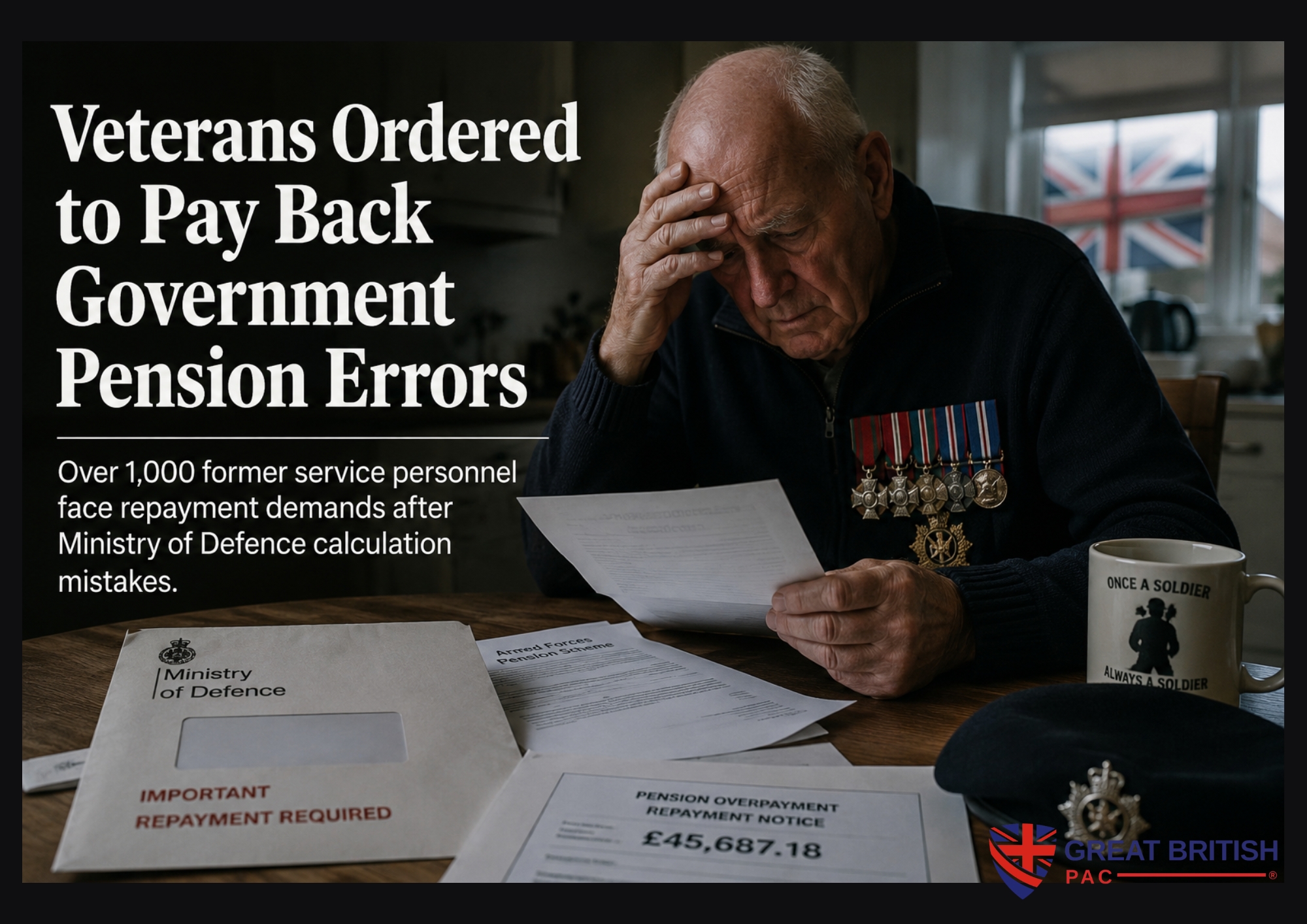
The Ministry of Defence has a problem, and rather than solving it themselves, they have chosen to make it someone else's catastrophe. More than 1,000 retired military personnel are now facing the indignity of repaying tens of thousands of pounds they never should have received in the first place, not because they committed fraud, not because they were negligent, but because the government's own pension administrators made fundamental errors in calculation.
This is not merely a bureaucratic inconvenience. This is a profound betrayal of the social contract that binds the nation to those who have sacrificed their youth, their health, and sometimes their very lives in service to the Crown.
The Scale of the Fiasco
The numbers tell a stark story. An estimated £5.1 million in overpayments has been distributed across final-salary pension schemes designed to provide guaranteed incomes for life to approximately 432,000 retired troops. In some cases, individual veterans have been overpaid by more than £100,000 over several years. These are not small errors that can be dismissed as rounding mistakes. These are systemic failures that went undetected for years, embedded in the very mechanics of how pensions were calculated and adjusted.
The Ministry of Defence first identified these problems in November 2024. Yet pensioners did not receive notification until 2025, months during which affected veterans continued to budget and plan their lives based on income they believed to be rightfully theirs. One can only wonder what administrative paralysis could justify such a delay in communicating bad news of such magnitude.
„The British establishment never seems short of money when it's funding failure, but somehow it always finds the courage to claw back cash from the very people who defended this country. Veterans should never be expected to pay the price for government incompetence. Accountability belongs with those who made the mistakes, not those who served Britain with distinction.“ - Richard Thomson, Former Royal Marine and National Director Great British PAC
The Real Burden Falls on Those Who Already Gave Everything
What makes this situation particularly egregious is not the error itself, systems are imperfect, and mistakes happen in complex bureaucracies. What makes it unforgivable is the decision about who bears the cost of correcting that mistake. Treasury rules, we are told, demand that public bodies recover all excess payments of taxpayer money, regardless of where fault lies. This is presented as though it were handed down from heaven, an immovable law of nature rather than a policy choice made by people with the power to make different choices.
Consider the actual victims of this policy. James Uncles, a former warrant officer who served 35 years as a naval aircraft engineer, was informed on 27 February that he owed £45,687. His monthly pension was slashed by over £1,000, nearly 25 percent of his income, with an additional £750 deducted every month for five years. He and his wife cancelled their 50th wedding anniversary celebrations. At 71 years old, with limited earning capacity and fixed life circumstances, Mr. Uncles has been forced to completely restructure his retirement.
Michael Evans, a retired Navy captain who survived a helicopter crash that claimed his friend's life, now faces a £414 monthly cut and must repay £16,000. His statement encapsulates the visceral sense of betrayal: "I can't put into words what it feels like when the dead arm of the state appears from this end of the telescope to be defending its contractors' errors rather than supporting its veterans."
These are not abstract figures in an accountancy ledger. These are elderly men and women whose life plans have been shattered through no fault of their own.
A Failure of Leadership at Every Level
Major General Neil Marshall, chief executive of the Forces Pension Society, rightly described this as "a failure of leadership, oversight, process and quality assurance." That assessment is almost gentle in its understatement. What we are witnessing is a comprehensive failure of institutional responsibility across multiple layers of government.
The errors themselves stem from "incorrect application of national insurance modification rules," and in some cases, the inflation adjustment for final-salary pensions appears to have been calculated twice in certain years. Whether this represents human error or technological failure remains unclear, a lack of transparency that only compounds the original transgression.
More troubling still is the fact that pension sharing arrangements on divorce, early departure payments, guaranteed minimum payments, and guaranteed income payments have all been subject to similar miscalculations. This is not an isolated glitch. This suggests systemic dysfunction in how the Armed Forces pension scheme is administered.
The Perversion of Principle
The government's position rests on what appears, at first glance, to be a defensible principle: that taxpayers' money must be recovered when overpaid. Few would disagree with that principle in the abstract. But principle divorced from context becomes cruelty, and context matters enormously here.
These veterans did not knowingly take money that was not theirs. They received pension payments in good faith from an official government system. They adjusted their living standards, made financial commitments, and planned their remaining years based on income they had every reason to believe was correct. To demand repayment from individuals who acted in perfect good faith, following instructions from official pension statements, while simultaneously allowing the administrators and contractors responsible for the actual errors to escape consequence, this is not principle. It is a profound inversion of justice.
Equiniti, the payroll agent contracted to administer these pensions, insists that members will receive "appropriate support throughout" the recovery process. What constitutes "appropriate support" for a 71-year-old whose pension has been cut by 25 percent? The phrasing is corporate speak designed to obscure the harsh reality of what is being done to vulnerable people.
Where Should Responsibility Truly Lie?
The Forces Pension Society has made a compelling argument that deserves serious consideration: the requirement to refund the public purse should lie with Veterans UK and Equiniti, the organisations that made the errors, not with the veterans themselves.
This is not a radical proposition. It is basic accountability. When a bank miscalculates a customer's account balance and the customer spends money based on what they were told they had, the bank does not demand repayment from the customer. The bank corrects its own mistake. Why should the relationship between government and veterans be fundamentally different, particularly when those veterans have already given their prime working years to the service of the nation?
The Ministry of Defence claims it will recover funds "in a sensitive and proportionate way," including through "tailored repayment plans and one-to-one financial and welfare support." Cutting someone's pension by £1,750 monthly and still calling it "sensitive" and "proportionate" stretches the meaning of both words beyond recognition.
The Broader Injustice
What disturbs most profoundly is what this reveals about how the state treats those who have served it most faithfully. Veterans are supposed to be honoured, supported, and afforded security in their final years, a recognition of what they have contributed and sacrificed. Instead, they are being treated as debtor class, pursued for recovery of sums they never asked for and had no reason to believe were incorrect.
This is not merely an administrative matter. It is a statement about national priorities and values. It says that when there is a choice between holding administrators accountable and placing burden on vulnerable elderly people, the government will choose the latter. It says that the social contract, while it demanded service from veterans when they were young and strong, has no corresponding obligation when they are old and vulnerable.
Conclusion: A Choice Remains Available
The Treasury's inflexible position on overpayment recovery is presented as though it were inevitable, automatic, beyond question. But policies are made by people, and people can unmake them. Parliament has the power to write off these overpayments. The government has the power to decide that those who administer pensions should bear the cost of their own errors, not those who trusted the system.
The question before the nation now is not whether this problem can be solved differently. It is whether we believe that brave service members of the British military deserve better treatment than they are currently receiving. Whether those who gave their strength to the service of this nation should be treated as villains in a morality tale rather than as the victims of institutional failure that they are.
The answer should be obvious. The only question is whether Parliament will have the courage to make it so.
Graphic and AI-generated illustration by Great British PAC. Created for editorial and illustrative purposes.