A polemic anchored in primary data, written in service of a civic question that too few politicians will touch.
It is mid-summer 2026, and the most consequential debate in Western politics is, of all things, the indoor thermostat. France's minister for the ecological transition, Agnès Pannier-Runacher, publicly rebuked café owners for installing air-conditioning during a record June heatwave, asking whether "artificial cooling" would, in any meaningful sense, prevent forest fires or dying crops (Le Monde, June 2026). The European Commission ordered the AC switched off on floors one to seven of the Berlaymont in Brussels, while commissioners on the upper six remained comfortably conditioned (Politico Europe). In New York, the newly elected socialist mayor Zohran Mamdani urged residents on X to "set your AC to 78 degrees," even as his own administration issued weather warnings advising the use of air conditioning to save lives (NY1, July 2026). And in Britain, householders are being told that the very units they installed to survive a heating climate now violate net-zero building regulations, as the Telegraph has reported (The Telegraph).
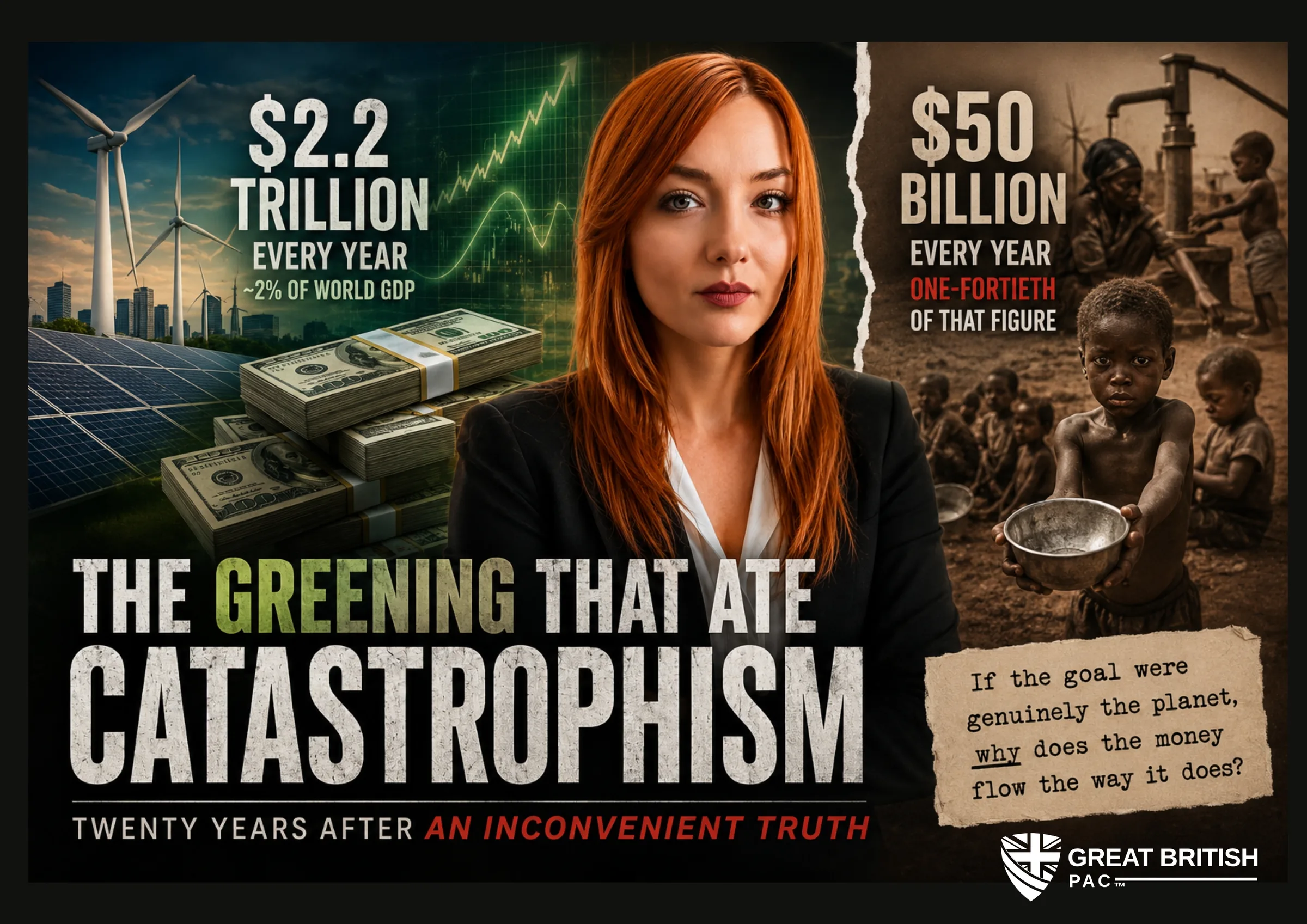
How did something as banal as indoor temperature become a moral offence, and how did the management of CO₂ emissions come to override the management of every other pressing human concern? These are not idle questions, because around $2.2 trillion a year, roughly two per cent of world GDP, now flows into the so-called clean-energy transition, with cumulative spending since An Inconvenient Truth released in 2006 already in the order of $10 trillion to $15 trillion, according to the International Energy Agency's World Energy Investment 2025 report. To meet net zero by 2050, the IEA argues that figure must nearly triple to around $4 trillion annually. Every dollar of that is a dollar unavailable for the things the same activists claim to prioritise, ranging from ocean plastic and overfishing to animal welfare, mental health, and the sanitation crises that still kill a child every thirty-nine seconds (UN Water).
So the first question is unavoidable. Why is it that a movement that styles itself the custodian of the planet has, on its own accounting, lavished trillions on intermittent electricity while leaving common-sense causes, including clean oceans, factory farming, wildlife trafficking, and child labour in cobalt mines, almost unfunded? The answer, as Naomi Klein set it out baldly in This Changes Everything (2014), is that the point was never the planet. The point was capitalism.
An Inconvenient Anniversary, an Even More Inconvenient Decade
When Al Gore's documentary premiered in May 2006 (Yale Climate Connections), it converted a marginal climate-science debate into a partisan religion. That is not in dispute. What is in dispute is whether the underlying predictions survived contact with reality. The IPCC's Sixth Assessment Report (AR6, 2021) estimates global mean surface temperature has risen approximately 1.09°C, with a likely range of 0.95°C to 1.20°C, above the 1850–1900 baseline (IPCC AR6 SPM). By 2024, the World Meteorological Organization confirmed that single year had reached 1.55°C above that baseline, the first calendar year past the symbolic 1.5°C Paris threshold (WMO, January 2025). A measured, anthropogenic contribution to that warming is, in scientific terms, real, and the writer of this piece takes no issue with that fact.
What this essay does take issue with is the distance between that measured finding and the apocalyptic narrative that has been erected on top of it, a narrative whose predictions, taken together, are systematically anti-correlated with the data now in hand.
The Greening the Cameras Did Not Show
The headline of Gore's film, repeated at every UN climate summit since, was that anthropogenic CO₂ would produce a net-browning planet: expanding deserts, collapsing yields, dying rainforests, and mass starvation. By 2016, that prediction had already been falsified in plain sight. A NASA-led study using satellite data from 1982 to 2015 found that between a quarter and a half of the Earth's vegetated land surface had significantly greened, with roughly seventy per cent of the effect attributable to CO₂ fertilisation, the fertilising effect of additional atmospheric CO₂ on plant growth, (NASA Goddard, 2016). The added leaf area corresponds to an expanse roughly twice the size of the continental United States.
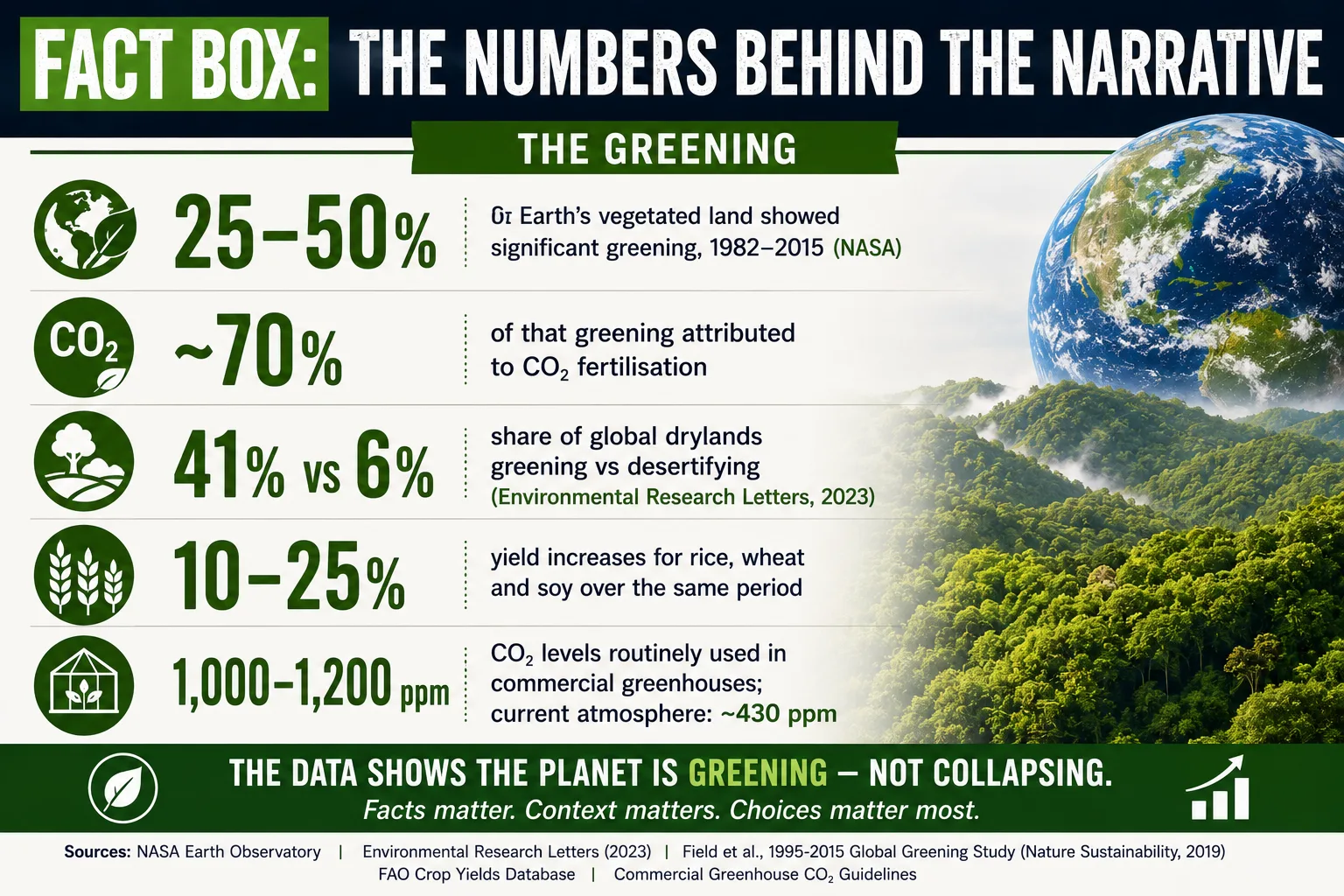
THE GREENING
25–50% of Earth's vegetated land showed significant greening, 1982–2015 (NASA)
~70% of that greening attributed to CO₂ fertilisation
41% vs 6% – share of global drylands greening vs desertifying (Environmental Research Letters, 2023)
10–25% – yield increases for rice, wheat and soy over the same period
1,000–1,200 ppm – CO₂ levels routinely used in commercial greenhouses; current atmosphere: ~430 ppm
A 2023 follow-up in Environmental Research Letters examined drylands specifically and found that vegetation productivity had grown across approximately 41 per cent of the global dryland area analysed, while desertification had advanced over only about 6 per cent (IOP Science, 2023). The Sahel, the textbook case for two generations of doomsayers, is re-greening. Staple-crop yields for rice, wheat, and soy have risen by roughly ten to twenty-five per cent over the same period, enough to feed several hundred million additional people. Commercial greenhouse operators, those closest to the underlying biology, routinely enrich their air to 1,000–1,200 parts per million CO₂ (Royal Horticultural Society). The plants, plainly, are voting.
This is what statisticians call an anti-truth: not merely a wrong forecast, but a forecast so uniformly, and so durably, wrong that it can no longer be explained by uncertainty. It was wrong in the late 1970s, when the Club of Rome and Paul Ehrlich forecast planetary famine; it was wrong throughout the 1990s, when every model said the Sahara would swallow the Sahel; and it is wrong now, when the same authors continue to insist, against multi-decadal satellite evidence, that catastrophe is just around the corner.
Belief and Its Bill
Worth noting, the same decade that delivered the greening data delivered an even more damning signal in the polling. Gallup's 2025 climate update found that 68 per cent of Democrats, but only 12 per cent of Republicans, said they expected global warming to threaten their personal way of life, a partisan gap that is now wider than at any point in the history of the survey (Gallup, 2025). On the question of whether to prioritise the environment or economic growth, 78 per cent of Democrats versus 20 per cent of Republicans chose the environment (Gallup Climate Topic). Belief in an existential climate threat is, today, less a scientific position than a tribal badge. That is a sociological fact about the West, and it deserves to be named.
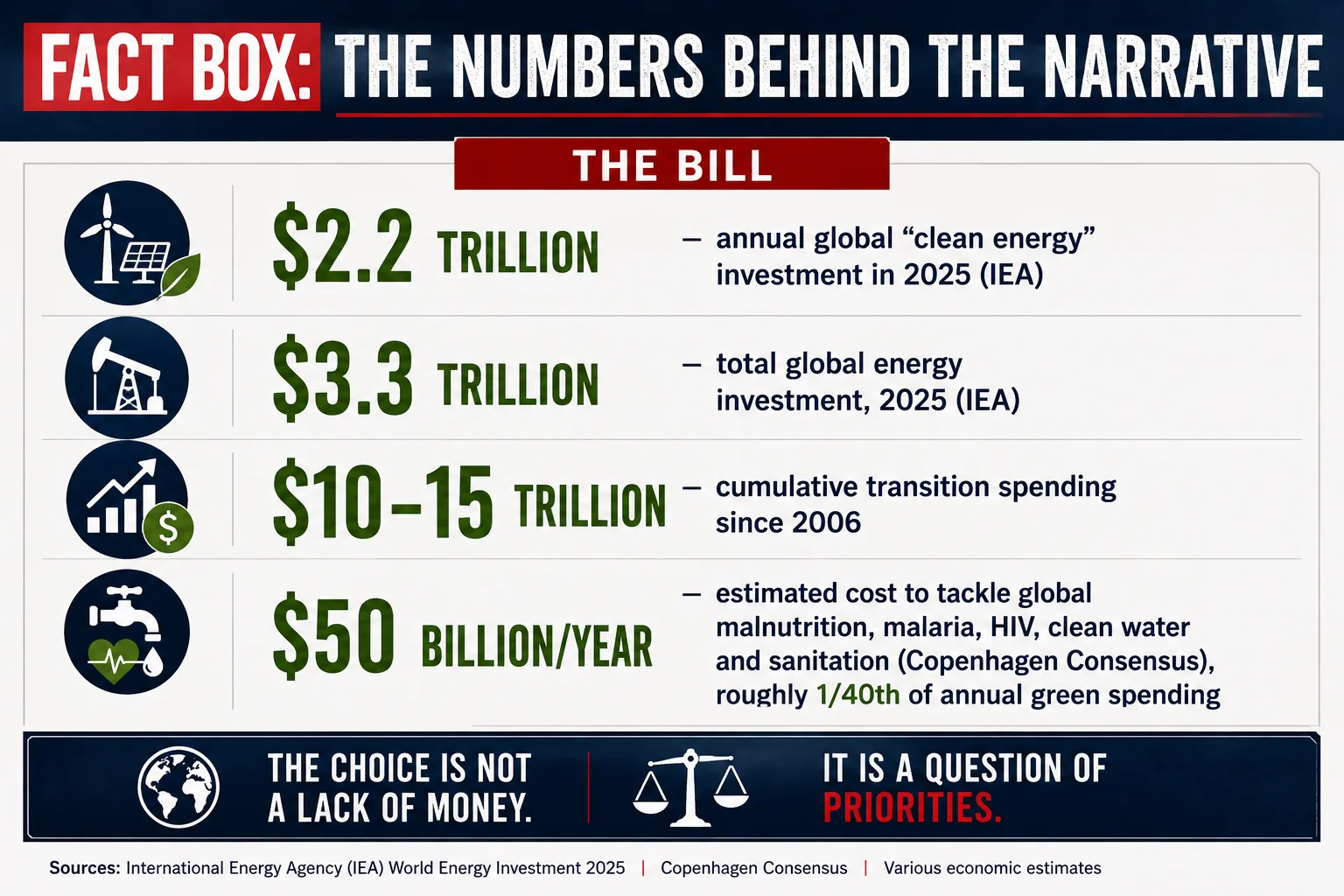
THE BILL
$2.2 trillion – annual global "clean energy" investment in 2025 (IEA)
$3.3 trillion – total global energy investment, 2025 (IEA)
$10–15 trillion – cumulative transition spending since 2006
$50 billion/year – estimated cost to tackle global malnutrition, malaria, HIV, clean water and sanitation (Copenhagen Consensus), roughly 1/40th of annual green spending
It is also expensive. The IEA's 2025 numbers put total global energy investment at $3.3 trillion, with $2.2 trillion going to "clean energy," and warn that the net-zero pathway requires yet a further tripling by 2030. The Copenhagen Consensus, led by the Danish economist Bjørn Lomborg, has repeatedly shown that the world's worst humanitarian problems, including malnutrition, malaria, HIV, education, and basic sanitation, could be addressed globally for roughly $50 billion a year, about one-fortieth of current green-transition spending (Copenhagen Consensus).
Why the Most Moral Story Is the Most Convenient
Why would a movement that styles itself "following the science" suppress or deprioritise causes that the same science confirms as urgent? Naomi Klein's This Changes Everything tells us, in her own words, why. The thesis has been the same for half a century: capitalism is the disease, climate change is the proof, and only totalising state control can deliver the cure. Long before Klein, Rachel Carson's Silent Spring (1962), Paul Ehrlich's The Population Bomb (1968), and the Club of Rome's Limits to Growth (1972) had laid the same template. Industrial activity equals sin. Only central planning can redeem us. Sceptical dissent equals evil.
It is the oldest play in the Left's playbook, and as George Orwell noted in The Road to Wigan Pier (1937), its typical recruit is not the greasy working-class hero of socialist mythology but the "prim little specimen" with a secure professional salary, vegetarianism, a "sniffish" sense of moral superiority, and a reflexive hatred of the bourgeois order that, in private life, they have every intention of joining. Twenty-first-century climate politics has merely swapped the sandwich board for the science citation.
The Electric Car Paradox
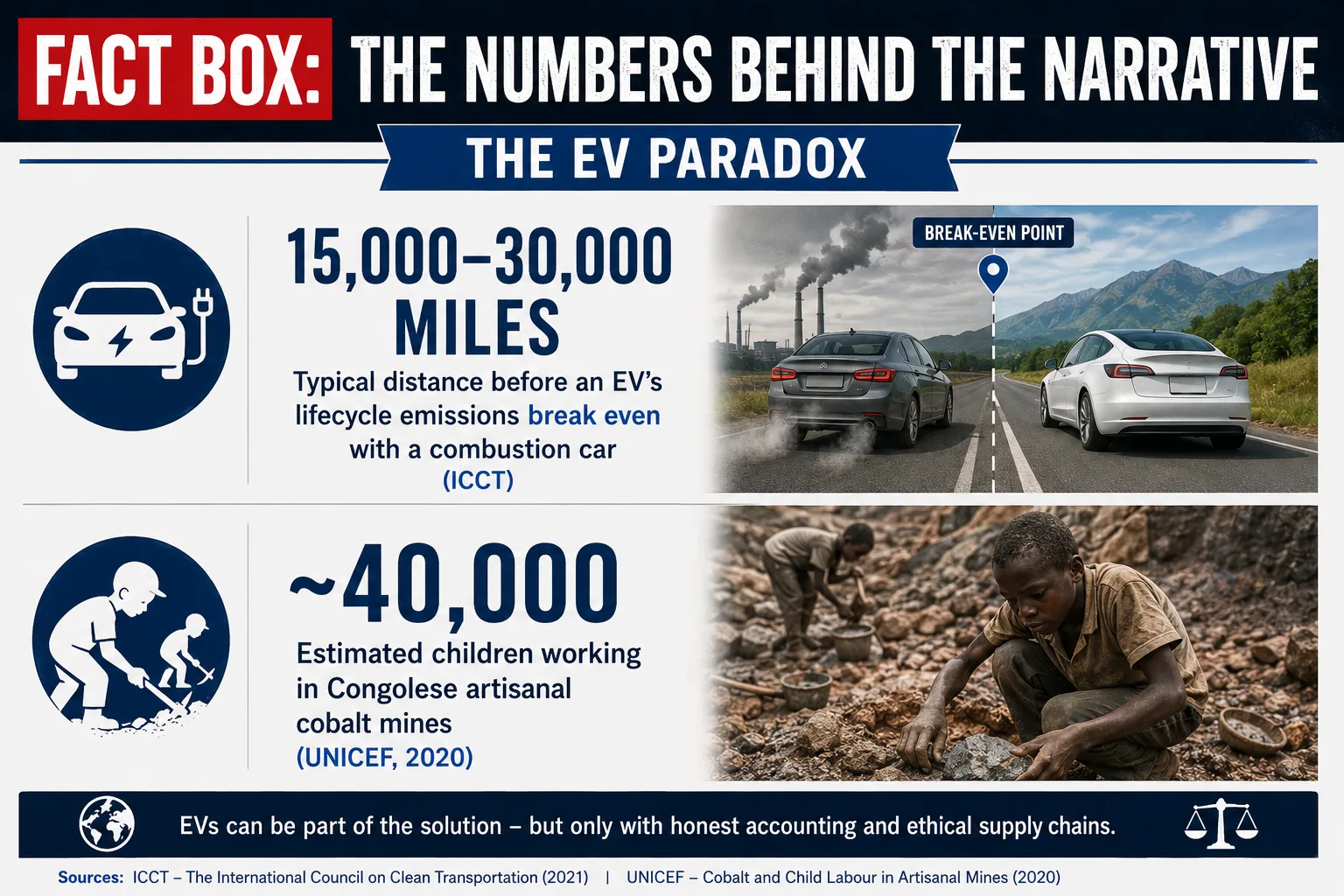
This brings us to the cleanest possible test case: the electric vehicle. EVs, we are told, are an unambiguous climate good. They are also, by the lifecycle analyses of the International Council on Clean Transportation, carbon-intensive to manufacture, and they only break even with an internal-combustion equivalent after roughly 15,000 to 30,000 miles of driving, depending critically on the carbon intensity of the local grid (ICCT, 2021). On heavily coal-fired grids in, say, parts of central Europe or China, the break-even distance stretches, and in some modelled cases reverses entirely (Carbon Brief Factcheck). A Tesla Model 3's battery pack alone contains some fifty to seventy kilograms of refined lithium, and the global cobalt supply chain remains anchored in the Democratic Republic of the Congo, where, by UNICEF's own estimate, around 40,000 children work in artisanal mines (UNICEF, 2020). The "save the planet" car, in short, runs on a supply chain that common-sense climate activists, if they were in earnest, would never have allowed to emerge.
THE EV PARADOX
15,000–30,000 miles – typical distance before an EV's lifecycle emissions break even with a combustion car (ICCT)
~40,000 – estimated children working in Congolese artisanal cobalt mines (UNICEF, 2020)
To be clear: on most European grids, the lifecycle math genuinely does favour the EV over a comparable diesel after the second or third year. The honest conservationist can defend that. What cannot honestly be defended is the claim that EVs are an act of pure planetary altruism, untouched by trade-offs in mining, refining, or grid decarbonisation. The political culture that insists on that purity, while refusing to examine the trade-offs, is the same political culture that argues today for banning combustion engines by 2035.
The Backwards Meters, the Windmills, and the Lost Megawatts
There is, meanwhile, a quieter scandal unfolding in Britain that perfectly illustrates how poor the net-zero complex has been at delivering even on its own terms. As of August 2026, more than 400 grid meters, some sources suggest closer to 800, installed at hundreds of electricity grid sites, have been physically fitted the wrong way round (The Times; Daily Mail). They run backwards: they record consumption that did not happen and fail to record generation that did. Because the National Energy System Operator relies on these meters to balance the grid, the resulting forecasting errors are projected to cost British consumers up to £100 million a year in extra balancing payments. The meters, in many cases, connect offshore wind farms, the state's proudest net-zero showpieces. That is how the system actually works: not with cost-saving innovation, but with regulations that cannot be bothered to be installed the right way round.
THE ENERGY REALITY
~31% – UK wind capacity factor in 2024 (DESNZ)
>90% – typical nuclear capacity factor
400+ grid meters installed backwards at UK grid sites, including offshore wind connections, potentially costing consumers up to £100 million/year
~86% – share of Israel's potable water from desalination, proof of what cheap, abundant energy makes possible
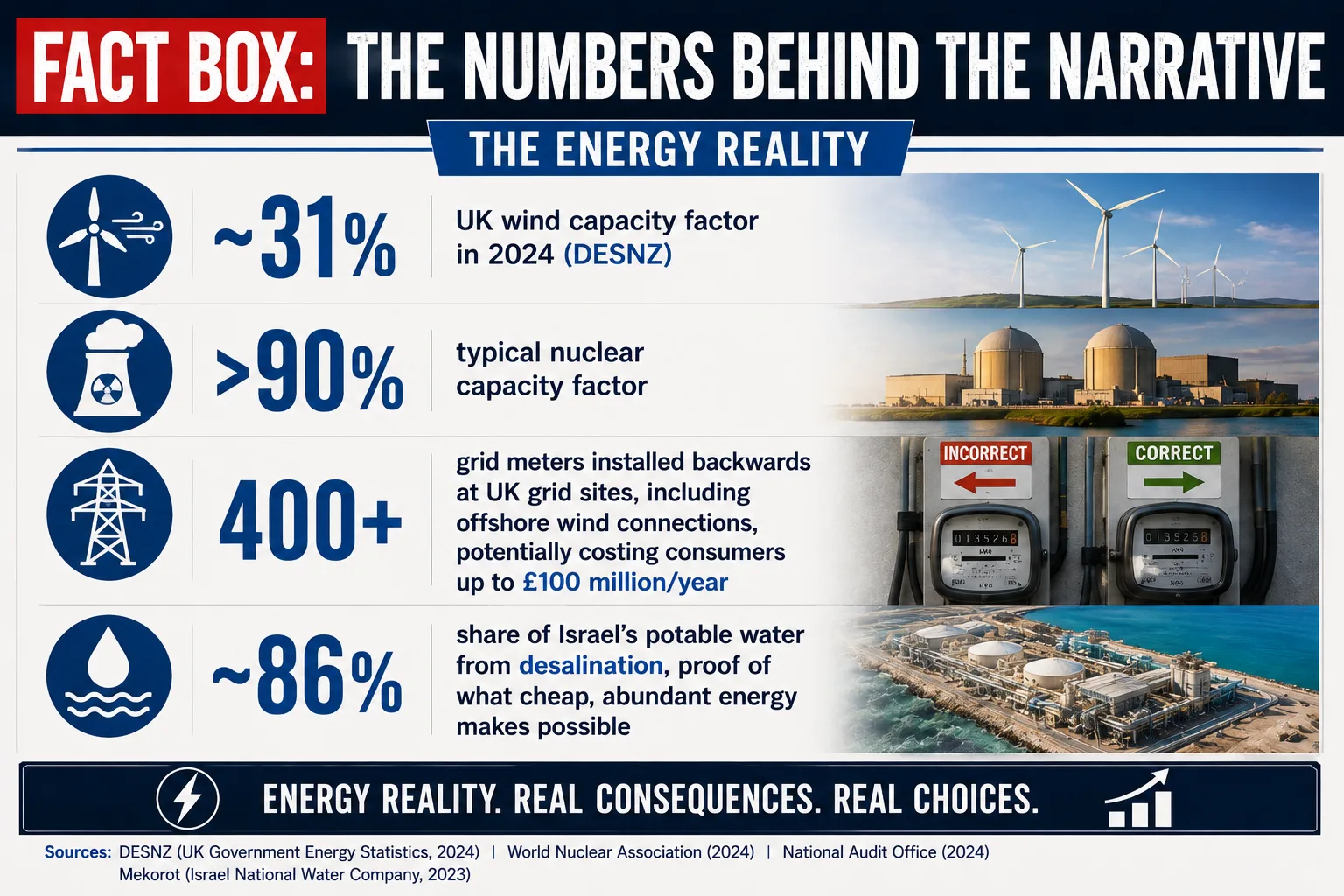
Compare that with what the same country could have done with even a fraction of the subsidies lavished on intermittent renewables. UK onshore and offshore wind operated at an average capacity factor (the ratio of actual output to maximum possible output) of roughly 31 per cent in 2024, according to the Department for Energy Security and Net Zero (DESNZ DUKES 2024). Nuclear, by contrast, ran at typical capacity factors in the high nineties. Germany's decision to shutter its last three nuclear plants in 2023, the most reliable low-carbon source it had, while burning more lignite to compensate, is the case study in cognitive dissonance that the world should study.
What We Could Have Bought Instead
Wright's Law, the empirical regularity that costs of manufactured goods fall by a predictable percentage with each doubling of cumulative production, is a real phenomenon, validated across more than sixty technologies, including aerospace, solar PV (photovoltaic), and batteries (Nature, 2022). It works for nuclear too. At the IEA's reported unit cost of around $5.5 billion per gigawatt-scale reactor, a redirected $7 trillion could finance a global fleet of 1,400 to 11,000 low-carbon reactors, the upper bound reflecting experience-curve gains. Such a fleet would supply abundant electricity to several billion people at North American consumption standards, and it would do so on a small, dense footprint that does not require mining rare-earth metals across the Congolese highlands.
Cheap, abundant, firm electricity would also unlock the desalination revolution, which Israel has already proved feasible on a national scale. Roughly 86 per cent of Israel's potable water now comes from desalination (Wikipedia, citing Israeli Water Authority data, 2022). At a tenth of present European electricity prices, desalinated water for hundreds of millions of people in North Africa, the Middle East, and southern Spain would become routine. Drought, the actual climate vulnerability for which the Sahel and Mediterranean basin have genuine grounds for concern, could be substantially engineered away.
That is the alternative future the West chose not to fund, because solving real problems would have placed the credit where it had historically belonged, mostly on private enterprise, mostly on engineering, mostly on the bourgeois industrial civilisation that the climate Left has spent twenty years denouncing.
The Mirror
None of this is a defence of doing nothing. The oceans do need cleaning, the slaughterhouses do need cameras, and the polar bears genuinely do face a warming habitat. Common-sense people, that great unfunded majority, agree with the climate Left on every one of those facts. What divides them from the net-zero cult is method. The cult wants central planning, energy poverty, forced retrofits, the abolition of meat, and an electric-car economy built on child-mined cobalt. The common-sense coalition wants cheap power, clean rivers, prosecutable factory farms, and a world in which the solution to a problem pays its own way.
THE POLITICS
68% vs 12% – Democrats vs Republicans who say global warming will threaten their way of life (Gallup, 2025)
The first half-century of An Inconvenient Truth has already been spent. The greening continent on the satellite imagery is the verdict of the planet itself. The bill is now arriving, and it is being rendered, as Orwell would have predicted, to the people who can least afford it: the working-class household whose energy bills double, the Congolese child whose school is a tailings pond (a waste repository left from mining operations), and the European pensioner forbidden to cool her flat in a heatwave.
Twenty years on, the inconvenient truth is the one on the cover of this piece. The planet has been getting greener while the propaganda has been getting darker. It is past time the public decoded the Dog Latin (an invented, deliberately obscure jargon) of the climate bureaucracy and asked who, exactly, this trillion-dollar project is for. The evidence suggests, decisively, that it is not for the planet.
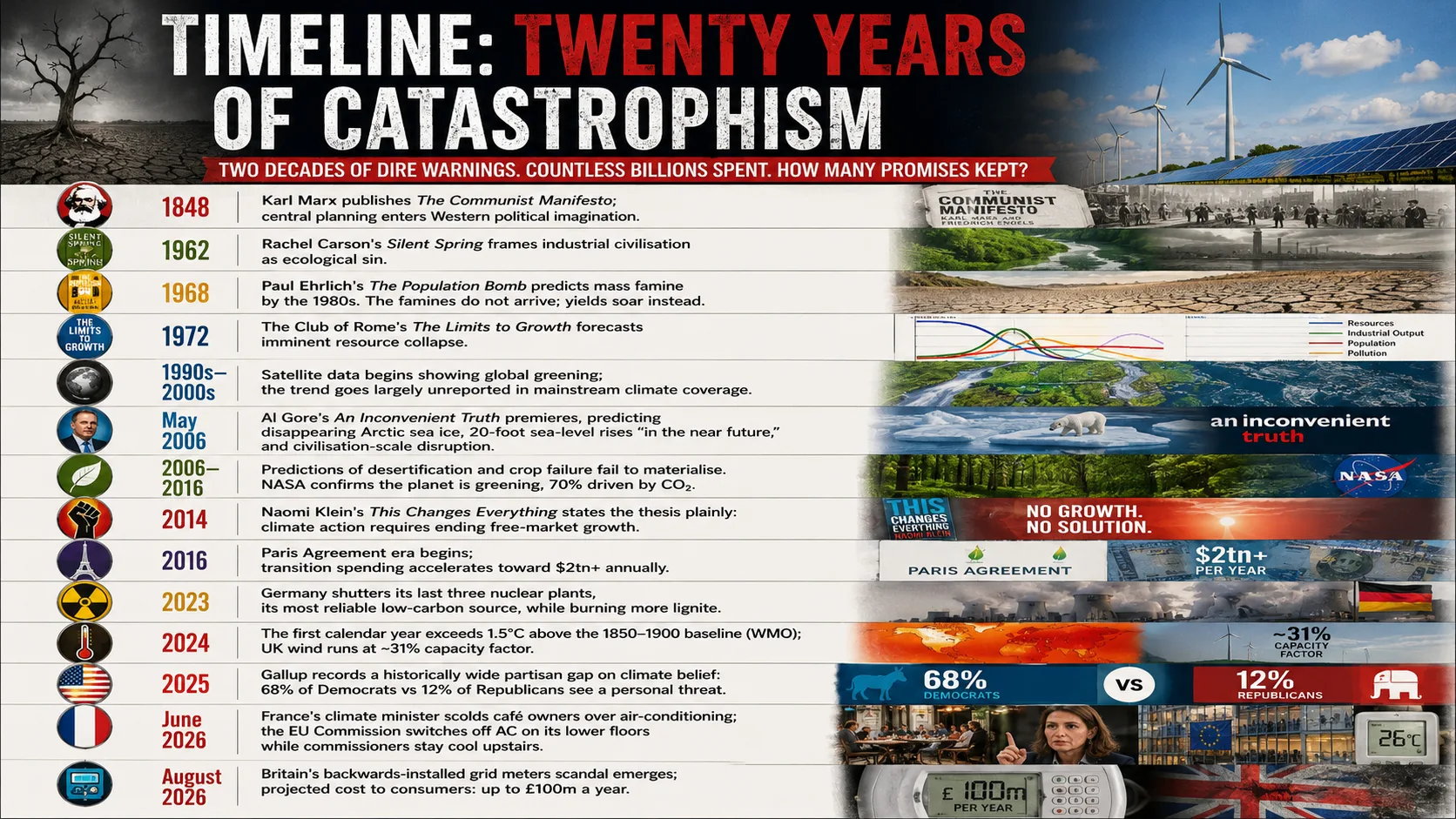
Timeline: Twenty Years of Catastrophism
1848 – Karl Marx publishes The Communist Manifesto; central planning enters Western political imagination.
1962 – Rachel Carson's Silent Spring frames industrial civilisation as ecological sin.
1968 – Paul Ehrlich's The Population Bomb predicts mass famine by the 1980s. The famines do not arrive; yields soar instead.
1972 – The Club of Rome's The Limits to Growth forecasts imminent resource collapse.
1990s–2000s – Satellite data begins showing global greening; the trend goes largely unreported in mainstream climate coverage.
May 2006 – Al Gore's An Inconvenient Truth premieres, predicting disappearing Arctic sea ice, 20-foot sea-level rises "in the near future," and civilisation-scale disruption.
2006–2016 – Predictions of desertification and crop failure fail to materialise. NASA confirms the planet is greening, 70% driven by CO₂.
2014 – Naomi Klein's This Changes Everything states the thesis plainly: climate action requires ending free-market growth.
2016 – Paris Agreement era begins; transition spending accelerates toward $2tn+ annually.
2023 – Germany shutters its last three nuclear plants, its most reliable low-carbon source, while burning more lignite.
2024 – The first calendar year exceeds 1.5°C above the 1850–1900 baseline (WMO); UK wind runs at ~31% capacity factor.
2025 – Gallup records a historically wide partisan gap on climate belief: 68% of Democrats vs 12% of Republicans see a personal threat.
June 2026 – France's climate minister scolds café owners over air-conditioning; the EU Commission switches off AC on its lower floors while commissioners stay cool upstairs.
August 2026 – Britain's backwards-installed grid meters scandal emerges; projected cost to consumers: up to £100m a year.