A political analysis from the eastern edge of England, where satire has finally overtaken sovereignty
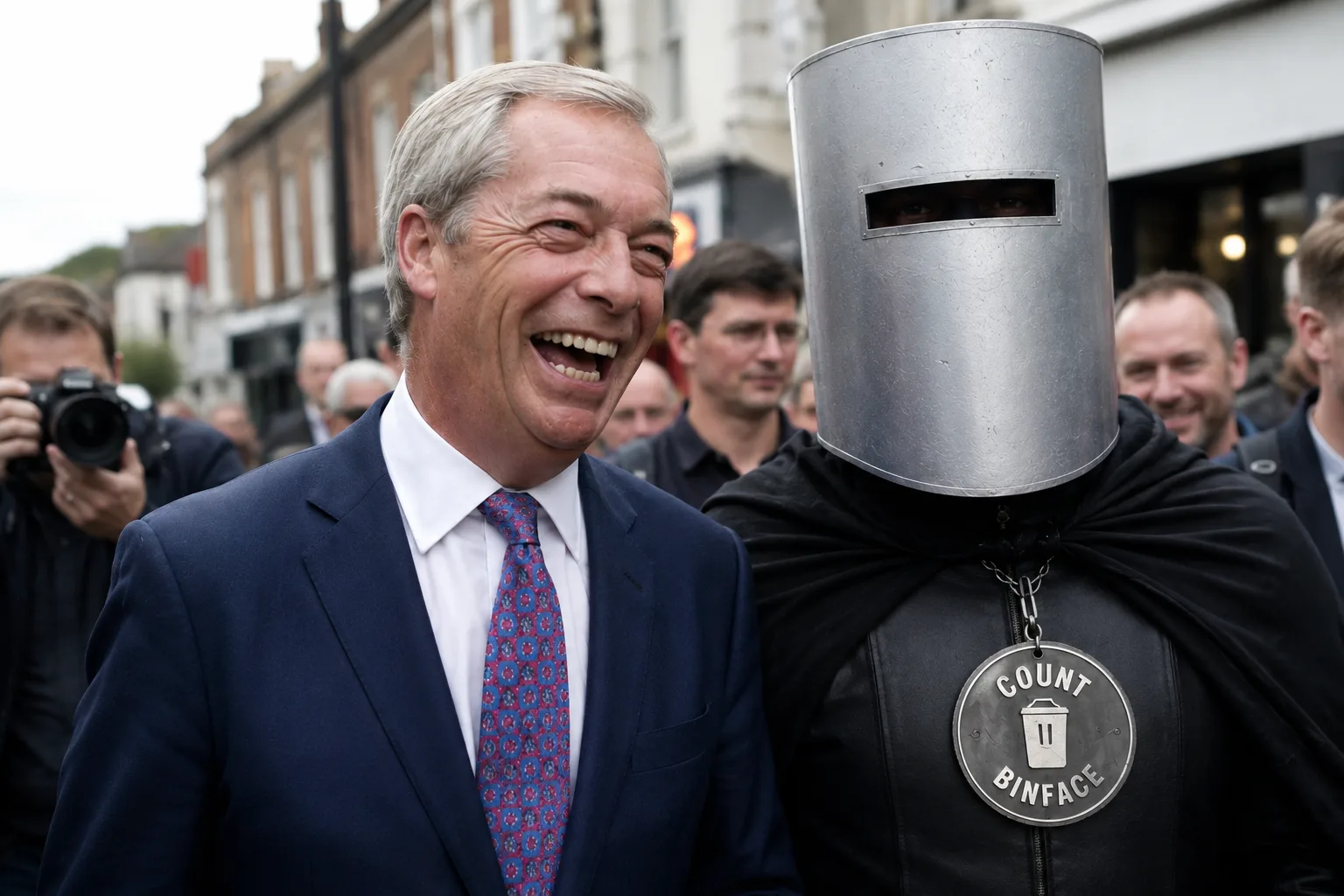
By the time the sun rose over the Essex coast on Friday morning, casting its unforgiving August light on the sweat-stained bunting outside Clacton Leisure Centre, Britain had, without quite noticing, crossed a threshold. Nigel Farage, leader of Reform UK, had won back the parliamentary seat he himself had vacated only six weeks earlier, and the second-placed candidate, on 9,455 votes, was a man wearing an upturned rubbish bin on his head. This is not, whatever the morning-after commentariat may insist, a footnote in the ongoing story of British populism. It is the story.
The temptation, particularly on the political right, is to read the Clacton by-election of August 2026 as a straightforward triumph of insurgency over establishment, a rebuke to the Westminster class from a coastal constituency that has become the closest thing English politics has to a Reform heartland. Farage himself, posting on X in the small hours, insisted the result "speaks for itself," and in one narrow sense it does. He secured 22,239 votes, a share of 63.3 per cent on a turnout of 44 per cent, which is, by any historical measure of a British by-election, an unusually engaged electorate. He improved on his 2024 general election tally by roughly a thousand votes, in a contest most seasoned observers had assumed would produce a shrunken and dispirited mandate.
Yet to leave the analysis there, as many of Farage's cheerleaders at GB News and the Reform-adjacent press have done, is to miss what actually happened on Thursday evening in a sports hall in north-east Essex. Because the more troubling reading, and the more honest one, is this: a satirical comedian named Jon Harvey, performing as the intergalactic space warrior Count Binface, took 26.7 per cent of the vote for a seat in the House of Commons, and nobody in Britain seems to think this is a scandal.
That figure, 9,455 votes for a man dressed as domestic refuse, ought to shock us to our bones. It ought to be the lead item on every serious political programme for a week. Instead it has been folded neatly into the running gag, laughed at on late-night panel shows, and forgotten by lunchtime. The comedian, in effect, is now the loyal opposition in one of the 650 constituencies that constitute the sovereign legislature of the United Kingdom, and the country has simply shrugged.
The absent parties, the vanished argument
The immediate cause of Binface's improbable rise, of course, is that the Labour Party, the Conservative Party, the Liberal Democrats, the Green Party and Rupert Lowe's newly minted Restore Britain all declined to contest the seat. Their reasoning, variously briefed to lobby journalists over the preceding month, ranged from the strategic (denying Farage the "establishment versus insurgent" framing he plainly wanted) to the fiscal (declining to spend money on a foregone conclusion) to the frankly petulant (a refusal to legitimise what Downing Street sources called, with characteristic Burnham-era bluntness, "a taxpayer-funded vanity project").
The result of this collective boycott was that the ballot paper, which reached the medieval proportions of thirty-four names and had to be printed on a scroll-sized sheet, contained no serious political alternative to Farage at all. His opponents were the actor and free-speech campaigner Laurence Fox, who to his credit was one of the very few candidates prepared to put his name on the ballot and stand up for the principle that no seat should ever go effectively uncontested, three members of the Official Monster Raving Loony Party led by the veteran Howling Laud Hope, a young farmer named Amy, a ventriloquist holding a dummy of a man wearing a bin, and the aforementioned man wearing a bin. Whatever one makes of Fox's wider politics, his willingness to show up when the mainstream parties refused to do so is, in its own way, an argument for the health of the tradition of open candidacy that Britain still, just about, protects.
Into this vacuum, Binface poured his 9,455 protest votes. And here is the point that needs stating plainly, because it will not be stated plainly elsewhere: those are not joke votes. Or rather, they are joke votes cast in earnest. In a constituency of 79,000 registered electors, close to one in eight of those who bothered to walk to a polling station on the hottest day of the year did so with the specific intention of endorsing a comedian rather than any of the thirty-three human beings on offer. They were told that the choice on the ballot was between Nigel Farage and nothing, and they chose nothing, dressed as a bin.
The Farage Fest and the collapse of ceremony
Farage himself declined to attend the count, the first winning candidate to do so since Bobby Sands was elected for Fermanagh and South Tyrone in April 1981, while on hunger strike in the Maze prison. The comparison, one imagines, is not one Farage particularly enjoys, though he cited advice from Essex Policeabout an "organised campaign to disrupt and degrade the result," a claim the force itself immediately contradicted, telling the BBC there had been "no incidents or issues" and that attendance was a matter for "individuals and their security teams."
Instead, Farage held court at "Clactonbury," a pop-up Reform festival half an hour inland, complete with firepits (in defiance of a Tendring District Council fire-risk warning), festoon lights, glamping tipis, a Ferris wheel that stranded a GB News reporter at its apex, and a live band gamely performing Luther Vandross's Never Too Much to what appeared, on the footage broadcast overnight, to be a largely empty field. Lee Anderson, on his third political party in as many years, was photographed in a personalised Reform football shirt, clutching a plastic flute of champagne. Somewhere in the tipis, Union Flag scatter cushions gathered dust.
The imagery matters, because the imagery is the argument. Farage's refusal to stand on the same stage as his opponents, whom he dismissed in a statement issued at three in the morning as "nobodies" who would "demean and humiliate" him, is not merely a personal snub. It is a constitutional statement, and it is being made, entirely deliberately, in front of an electorate that no longer expects its politicians to submit to the small ceremonies of democratic accountability. The declaration on the stage, the handshake with the returning officer, the ritual acknowledgement of the losing candidates, these are the connective tissue of a functioning parliamentary culture, and Farage has now demonstrated, with total impunity, that they can be dispensed with.
The Harborne question, and the reopened inquiry
None of this addresses the reason the by-election was called in the first place. Farage resigned his seat in late June after months of mounting scrutiny over donations he received from Christopher Harborne, the Thailand-based cryptocurrency billionaire whose gift of more than £5 million to Reform and its leader had become the subject of a formal investigation by the Parliamentary Commissioner for Standards. That inquiry was paused for the duration of the by-election, and, as the Commons website confirmed on Friday morning, it has now formally resumed.
In an overnight interview with GB News, Farage appeared to concede, with characteristic breeziness, that he may have fallen short of the rules, telling the presenter, "Maybe I haven't filled in a piece of paper." Should the Commissioner ultimately recommend a suspension of more than ten sitting days, the recall petition mechanism under the Recall of MPs Act 2015 would be triggered, requiring only ten per cent of Clacton's roughly 79,000 registered electors to sign in order to precipitate yet another by-election. At which point, the question posed by the political columnist Tim Bale of Queen Mary University of Londonbecomes acute: at what point does the electorate stop finding the circus amusing?
The £250,000 bill for Thursday's contest, incidentally, falls on the public purse, despite Farage's earlier assurances that Reform would foot it. Anderson, on the BBC's Today programme on Friday morning, waved the cost away with the observation that the recent Makerfield by-election and its accompanying mayoral contest had run to close to £4.5 million, as if two wrongs, in the accounting of parliamentary democracy, somehow made a right.
Burnham, Lowe and the closing pincer
The wider strategic picture for Reform is considerably less rosy than the Clacton headline suggests. National polling now shows Reform on around 25 per cent, trailing Andy Burnham's resurgent Labour Partyon 27 per cent, a reversal of the position Farage enjoyed at the start of the summer. Burnham, who returned to the Commons in June after his successful by-election in Gorton and Denton, has proved a more agile opponent than Keir Starmer ever managed to be, marrying a northern-mayoral directness with a willingness to engage Reform on the terrain of immigration and living costs rather than retreating to procedural pieties.
Meanwhile, on Farage's right flank, Rupert Lowe's Restore Britain, launched with the encouragement of the American billionaire Elon Musk, has begun peeling away a small but ideologically committed slice of the Reform base. Lowe has publicly offered an alliance, conditional on Farage adopting Restore's more extreme policy positions, an offer Farage has so far declined to accept. Bale's assessment, offered to reporters on Friday, was blunt: "A pact would be tricky because Restore's policies are so extreme that adopting them would make Reform less attractive to voters who aren't really into the whole far-right package."
What we lost on Thursday night
And so we arrive at the harder question, the one the morning papers will not quite bring themselves to ask. What does it tell us about the health of British democracy that a general-election-sized turnout in a nominally safe seat produced a contest in which the runner-up was a fictional intergalactic warrior, and the winner refused to appear on stage to accept his mandate?
It tells us, I think, that we have lost our curiosity about elections. Not our appetite for them, which remains robust, but our seriousness about what they are for. The Clacton by-election was, in every sense that matters, satirical from beginning to end, a piece of political theatre in which the theatre had entirely swallowed the politics. And the response of the Westminster village has been to laugh, file the copy, and move on to the next cycle.
Farage has his seat back. Binface has his headlines. The Standards Commissioner has his file, reopened. And the rest of us, if we are paying attention, have the uncomfortable sense that a country which cannot bring itself to contest a parliamentary election with actual political parties has quietly ceased to take its own democracy seriously. That is not a victory for Reform over the establishment. It is a defeat for the idea that elections are how we govern ourselves.
The Ferris wheel of Farage, as one commentator put it overnight, turns again. The question is whether anyone still remembers what it is turning for.