New polling for the civil rights organisation Liberty shows that 51 per cent of the public believe the Government has weakened their right to express their views, with only 10 per cent saying their rights have improved. Great British PAC says the findings confirm what we have warned about since Labour took office.
The picture painted by Deltapoll, which surveyed more than 2,000 adults on behalf of Liberty, is stark. A majority of Britons, 51 per cent, said their confidence in the Government to protect their right to express their views, even views with which ministers disagree, has worsened over the past two years. Only 10 per cent believe their rights have improved, a margin of five to one between the concerned and the reassured.
The detail is just as troubling. Some 42 per cent of respondents said their ability to voice controversial political opinions without facing legal consequences has deteriorated, while just 9 per cent said it had improved and 39 per cent reported no change. Nearly four in ten, 39 per cent, said their ability to speak freely on important issues had got worse, and the same proportion said their understanding of what can and cannot lawfully be said under UK law had also declined. A country in which a growing share of citizens no longer knows where the line of lawful speech falls is a country already learning to silence itself.
The record of restrictions
These findings did not emerge from nowhere. Liberty points to a specific record of government action, and the record speaks plainly. Home Office travel bans were imposed on 11 speakers due to address the Unite the Kingdom rallies organised by Tommy Robinson in May. The American political commentators Cenk Uygur and his nephew Hasan Piker were barred from attending the SXSW London festival and from addressing the Oxford Union in June. Protesters opposed to the proscription of Palestine Action were arrested in large numbers. This summer Sir Keir Starmer signalled readiness to take new powers to ban demonstrations in support of Palestine following the Golders Green terror attack, telling reporters the Government would consider "further powers" in certain "instances", citing the "cumulative" impact of repeated marches on the Jewish community. Shabana Mahmood, the Home Secretary, is now weighing a review of protest legislation led by Lord Macdonald, the former Director of Public Prosecutions, which has examined whether to make it easier to ban demonstrations where there is a risk of serious disorder.
"As repugnant as some views might be, they must not be silenced. Policing speech based on socially acceptable norms neuters the ability to challenge and stops progress. It is only through debate that society can make progress. Freedom of expression is the foundation of democracy and progress. Stop that and we end up in a dystopian dictatorship." - Ben Habib, Chairman Great British PAC
A warning for Mr Burnham
Liberty's message to the incoming Prime Minister is direct. "The new Prime Minister must see these findings as a warning sign," said the organisation's Ms Hart. "Free speech is a fundamental right that benefits us all, and a healthy democracy depends on people feeling confident that they can express themselves freely and disagree with each other. We're fortunate to live in a nation shaped by many identities and perspectives, which means differences of opinion and views that could upset or offend others are inevitable. This makes it all the more important for the new Prime Minister to adopt a non partisan approach to free speech and move away from greater restrictions."
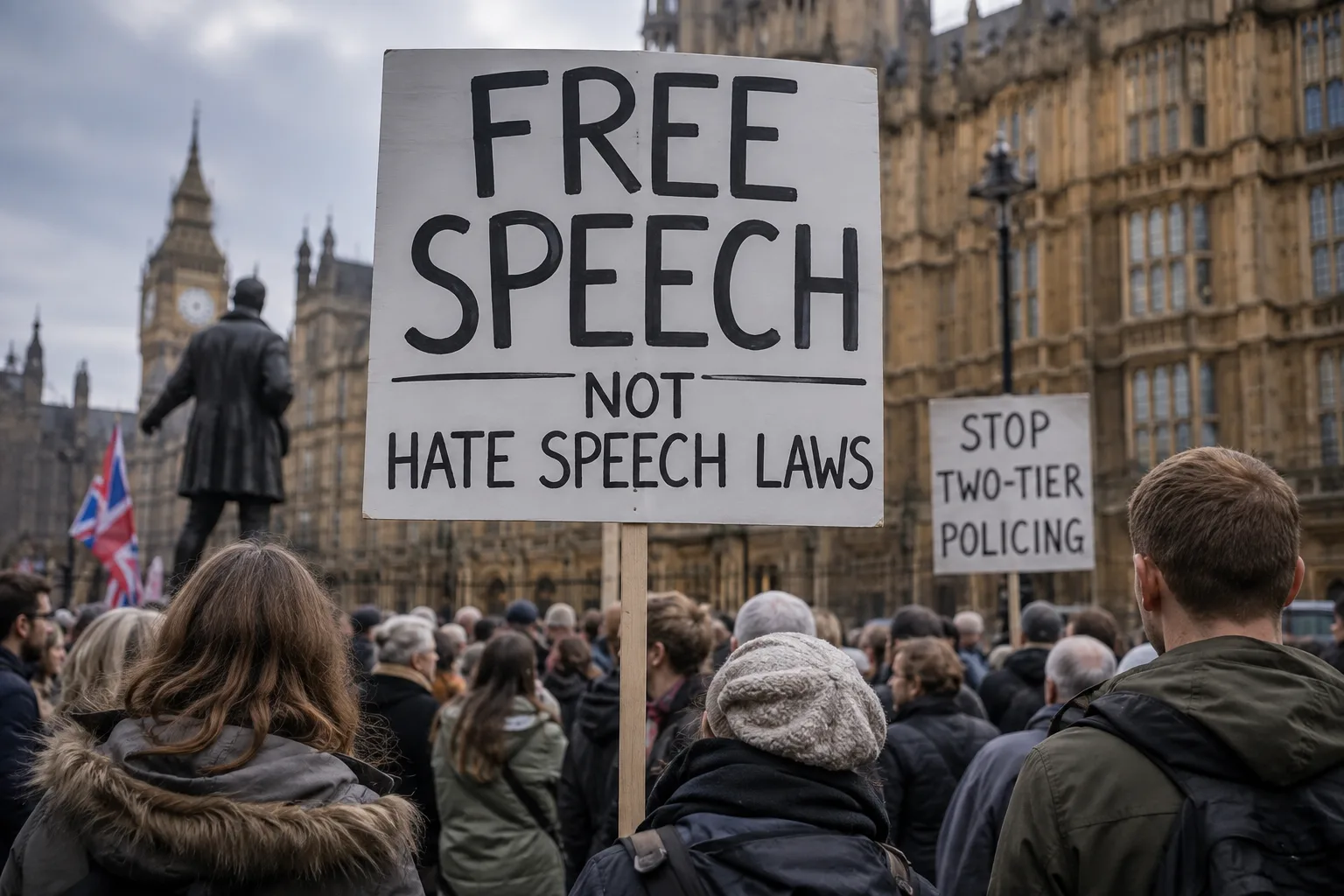
Liberty accuses the Government of failing to show "leadership and consistency" on free expression, creating a "vacuum" on the issue and fuelling persistent claims of "two tier" policing. We at Great British PAC have made this argument from the outset, and the polling suggests the public has now caught up with us.
What we have always said
Great British PAC stands, without qualification, for freedom of speech. We reject the false political correctness that has come to govern so much of public life in Britain, and we reject its use as a tool to protect ideological mindsets and to silence people who hold different opinions. The pattern documented in this poll is not an accident. It is the predictable consequence of a governing culture that treats lawful but unpopular expression as a problem to be managed, that applies the law unevenly across the political spectrum, and that responds to disagreement with bans, arrests and ever broader restrictions rather than with argument.
When speakers are barred from entering the country, when protest is criminalised by degrees, and when citizens cannot say with confidence what they are permitted to say, the damage is felt across society. People do not stop holding their opinions. They stop voicing them. They retreat into silence, and a democracy built on open contest of ideas quietly decays. That is why we reject the framing, offered by ministers, that this is simply a trade between free expression and public order. The two are not in permanent opposition, and the Government's own inconsistency has made the balance worse, not better.
The Government's defence
The Home Office rejects the critique. "Freedom of speech and peaceful protest are fundamental rights that this Government will always protect," a spokesman said. "But there is a clear difference between expressing a view and engaging in unlawful behaviour such as inciting hatred or violence, which it is right that we address."
We would agree that incitement to hatred and violence is rightly unlawful. What we dispute is the creeping expansion of what the authorities choose to treat as such, and the evident readiness to reach for state power against voices the Government finds uncomfortable while other, more sympathetic voices are left in peace. The "two tier" charge will not be answered by denial. It will be answered only by consistent, even handed application of the law.
The test ahead
For Mr Burnham, this polling arrives as an early test of his premiership. The public mood is clear: after two years of Labour government, millions of Britons feel less free to speak their minds, less sure of their legal rights, and less confident that the state is on their side. Liberty urges the new Prime Minister to adopt a consistent, non partisan approach to free speech and to move away from greater restrictions. We agree, and we would go further. Restoring freedom of expression in Britain means reversing the restrictive turn of the past two years, abandoning the bans and the over policing of lawful protest, and committing to a simple principle: that the state should never be the judge of which opinions deserve to be heard. Until ministers embrace that principle, the five to one majority of the concerned will only grow.