
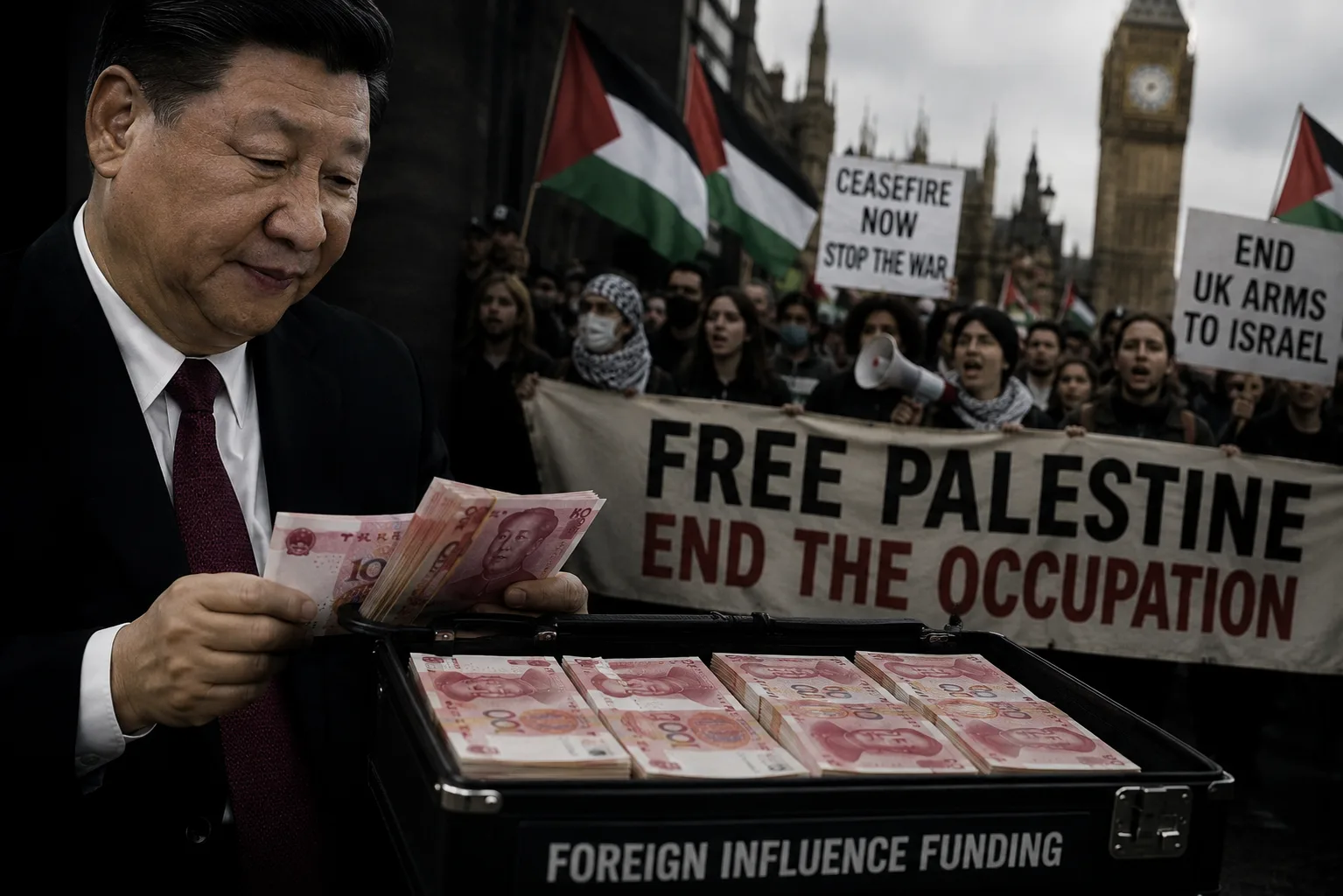
The Case for Defending British Sovereignty from Beijing's Quiet Hand
An opinion piece
There is a principle so fundamental to the British constitutional order that we rarely stop to articulate it, because we assume it goes without saying. Political protest in this country must be the product of British conscience, not foreign cash. The right to march, to chant, to demand that one's government change course is precious precisely because it belongs to the people who live under that government. The moment a hostile foreign state begins quietly financing the banners, the megaphones and the organising infrastructure on our streets, the march ceases to be an expression of British democratic will and becomes something else entirely, an instrument of someone else's foreign policy.
That uncomfortable question now sits squarely before us. As The Telegraph has disclosed, China is suspected of funding pro Palestine marches in the United Kingdom, through a money trail that American investigators believe leads from Beijing's orbit, via a tech tycoon's sprawling donor network, to groups actively organising demonstrations outside RAF bases and the Ministry of Defence. Whatever one's views on Gaza, and legitimate, heartfelt opinion exists across the entire spectrum, every Briton should be alarmed by the suggestion that a one party surveillance state may be helping to choreograph dissent in our capital. This is not a left or right question. It is a sovereignty question. It is the question the Great British PAC has been pressing with increasing urgency: foreign influence that ends up on Britain's streets is a direct erosion of the British people's exclusive ownership of their own political life.
What the investigators have found
The details, as revealed, deserve careful reading rather than dismissal. US politicians investigating alleged secret Chinese backing of Code Pink, a far left feminist protest group founded in the United States, are now examining the organisation's British activities as part of a wider inquiry into foreign interference. According to the US House of Representatives Ways and Means Committee, more than $250,000, roughly £190,000, flowed in 2020 and 2021 from organisations alleged to form part of Neville Roy Singham's funding network to a UK company linked to Code Pink. In 2024, the same company received a further $94,950, around £70,000, from the People's Support Foundation, another entity suspected of sitting within that network, recorded as payment for "consulting services".
Jason Smith, chairman of the Ways and Means Committee, was unambiguous in comments to The Telegraph: "It is clear from the Ways and Means Committee investigation that Singham's money and influence does not stop at America's borders. The committee is well aware that Singham's funding is supporting pro Hamas and pro communist causes not only in the United States, but also overseas, including in the United Kingdom."
The broader accusations against Mr Singham are severe. The committee has accused him of "actively fuelling CCP propaganda and financing indoctrination efforts abroad by providing hundreds of millions of dollars to groups that mix progressive advocacy with CCP talking points". He is the subject of a federal grand jury investigation launched by the US Department of Justice. Senator Chuck Grassley, chairman of the Senate Judiciary Committee, has formally raised concerns with the department, stating: "Evidence suggests that The People's Forum and Code Pink have been funded and influenced by Mr Singham and the communist Chinese government."
The transformation that tells its own story
What makes the Code Pink case so instructive is not merely the money, but the ideological evolution that appears to have accompanied it. In 2015, the organisation's leadership publicly condemned Beijing, with co founder Medea Benjamin demanding that "China stop brutal repression of their women's human rights defenders". Today, the same organisation runs a campaign declaring that "China is not our enemy", argues that the United States is "heading towards a dangerous confrontation with China", and claims that Washington is manipulating the minds of American citizens towards war. It has also repeatedly called for the dissolution of Nato, the alliance that underpins British security.
Coincidence is possible. But a State Department official told The Telegraph that Code Pink "agitates against the interests of the United States and our allies alike", noting that "the far left organisation has repeatedly called for the dissolution of Nato as its coffers are filled with cash from a donor network linked to the Chinese Communist Party". When an advocacy group's foreign policy positions pivot, in lockstep with its funding streams, towards the precise talking points of a hostile state, scrutiny is not McCarthyism. It is basic democratic hygiene.
Mr Singham's own proximity to the Chinese state deepens the concern. He sold his technology company Thoughtworks for $785 million, approximately £580 million, in 2017. He reportedly shares a Shanghai office with a Chinese state linked company whose stated goal is to educate foreigners about "the miracles that China has created on the world stage", and in 2023 he attended a CCP workshop on promoting the party internationally, according to a New York Times investigation. Mr Singham categorically denies working on behalf of China, insisting he is "solely guided by my beliefs, which are my long held personal views". Code Pink, for its part, has dismissed the allegations as "a big fat lie", with Ms Benjamin telling the Washington Times: "We get zero money from the Chinese Communist Party." Both are entitled to their denials, and those denials deserve reporting, as they are here. But denials are not a substitute for transparency, and transparency is exactly what these networks refuse to provide.
Britain's exposure
The British dimension is not peripheral. Code Pink's UK operation has encouraged activists to join mass pro Palestinian marches, organised demonstrations at the Ministry of Defence and at the London office of an arms manufacturer, staged a protest at RAF Akrotiri in Cyprus, a base used for surveillance flights over Gaza, and campaigned for the removal of British military bases on the island. It has issued statements claiming Britain's leaders have been "bought by Zionism". Its campaigners have included Suzie Gilbert, described as the group's "contact in Britain", whose work has included campaigning for peace with Iran and visiting China under the theme that it "is not our enemy". A spokesman for Ms Gilbert has denied involvement in any propaganda campaign on Beijing's behalf, and Jeremy Corbyn, the former Labour leader, has been listed among the movement's campaign supporters.
One does not have to impugn a single individual's sincerity to see the structural problem. Marchers waving placards in Whitehall on a Saturday afternoon are exercising a right won over centuries. If the organisational muscle behind some of those demonstrations, the coordination, the messaging discipline, the cross border campaign architecture, is partially bankrolled by entities aligned with the Chinese Communist Party, then the street itself has been quietly leased to a foreign power. The public see authenticity. The state sees a cut out. The voters see neither.
The strategic logic of "political warfare"
This is why the sovereignty framing matters so much, and why the Great British PAC's insistence on refusing foreign influence is not chauvinism but constitutional self defence. Beijing's approach, as analysts have documented, is no longer limited to promoting favourable views of China. It is about exploiting the fractures inside Western democracies, amplifying whichever cause maximises division. Cardiff University researchers found in 2021 that social media accounts linked to China had spread calls for violence in the run up to the US Capitol riots, a marked shift from traditional propaganda towards the deliberate inflaming of unrest in rival countries. The target is not the left or the right. The target is the cohesion of democratic society itself, on which British sovereignty, in the practical sense of a self governing people, ultimately rests.
And the context is darkening. The Telegraph has separately revealed that Royal Navy sea drones containing Chinese made components were secretly transmitting data back to China, and that a former Labour adviser suspected of spying for Beijing was a significant party donor who mixed with senior politicians. Add to this the long running saga of alleged Chinese espionage in Parliament and the picture is unmistakable: interference in Britain is not episodic, it is systemic.
The lesson of comparison is that Britain's machinery, on paper, is the most porous of the three allied systems. American law has, since the Foreign Agents Registration Act of 1938, required anyone acting for a foreign principal in political, public relations or fundraising work to register with the Department of Justice or face up to five years in prison, and the federal ban codified at 52 U.S.C. section 30121 forbids foreign nationals from contributing money or any thing of value to any federal, state or local election at all. Australia, after its own reckoning with Chinese linked donations in 2017, went further still, banning foreign political donations of 1,000 Australian dollars or more and creating, in the Foreign Influence Transparency Scheme Act 2018, a register that explicitly captures what it calls disbursement activity, the payment of money or things of value for political purposes, with the Attorney General's department able to issue public transparency notices naming suspected foreign government related entities; from 1 July 2026, Canberra will add donation caps of 50,000 Australian dollars per donor per recipient and a 5,000 dollar disclosure threshold with near real time reporting, as set out in the Electoral Legislation Amendment (Electoral Reform) Act 2025. Britain, by contrast, still polices donations to parties through the permissible donor test in the Political Parties, Elections and Referendums Act 2000, a test that the Rycroft Review, published in March 2026, found dangerously weak at the edges, since a company may donate simply by carrying on business in the United Kingdom, whatever its foreign owners, and third party campaigners spending under 10,000 pounds in regulated periods may lawfully take money from anyone at all, foreign included. The very seam that state linked funders are suspected of exploiting, street activism that never formally touches a party account, is therefore the seam the British regime barely polices, which is precisely the gap those allied models were built to close.
What must be done
Parliamentarians across the divide grasp the stakes. Sarah Champion, a Labour MP, has called for the UK to "work with the US to investigate the payments, their influence and who is ultimately responsible", urging "a united front with the US and show zero tolerance". Alicia Kearns, the Conservative MP, was blunter still: "The threat of the Chinese Communist Party is not abstract. It is made up of these cut outs who industrialise interference in our democracy." She demanded that the Government make full use of the National Security Act 2023 to prosecute unregistered individuals working on Beijing's behalf. Priti Patel, the shadow foreign secretary, warned that the CCP is "sowing division and instability in Britain by backing protests and subversive campaigns while pursuing widespread espionage and hostile activity against people living here".
Tim Law, deputy director of UK China Transparency and Britain's former defence attaché to Beijing, framed it with the clarity the moment deserves: "We are fortunate to live in a country where people are free to express their opinions. But if such activism is funded or inspired by any entity connected to a foreign power, that becomes something that demands transparency. We know that, during the Cold War, Russia funded sympathetic political movements in the West. If people connected in any way to the Chinese Communist Party are doing the same now, there is a real risk to our democracy that must not be ignored by the authorities."
The Government, for its part, insists that "the first duty of government is to protect our national security", pointing to robust measures against state backed threats. Fine words. But robustness is measured in prosecutions, registrations and investigations, not press statements.
Conclusion
Sovereignty is not lost in a single dramatic moment, with gunboats in the Channel. It is lost incrementally, in wire transfers labelled "consulting services", in the quiet professionalisation of street protest, in the slow normalisation of a hostile state's money moving through the arteries of British civic life. A march funded from Shanghai is still a march, and those attending may be entirely sincere. That is precisely what makes the tactic so effective, and so corrosive. The sincerity of the many becomes the cover for the strategy of the few.
Britain should defend the right to protest with one hand and defend the protest's British ownership with the other.