
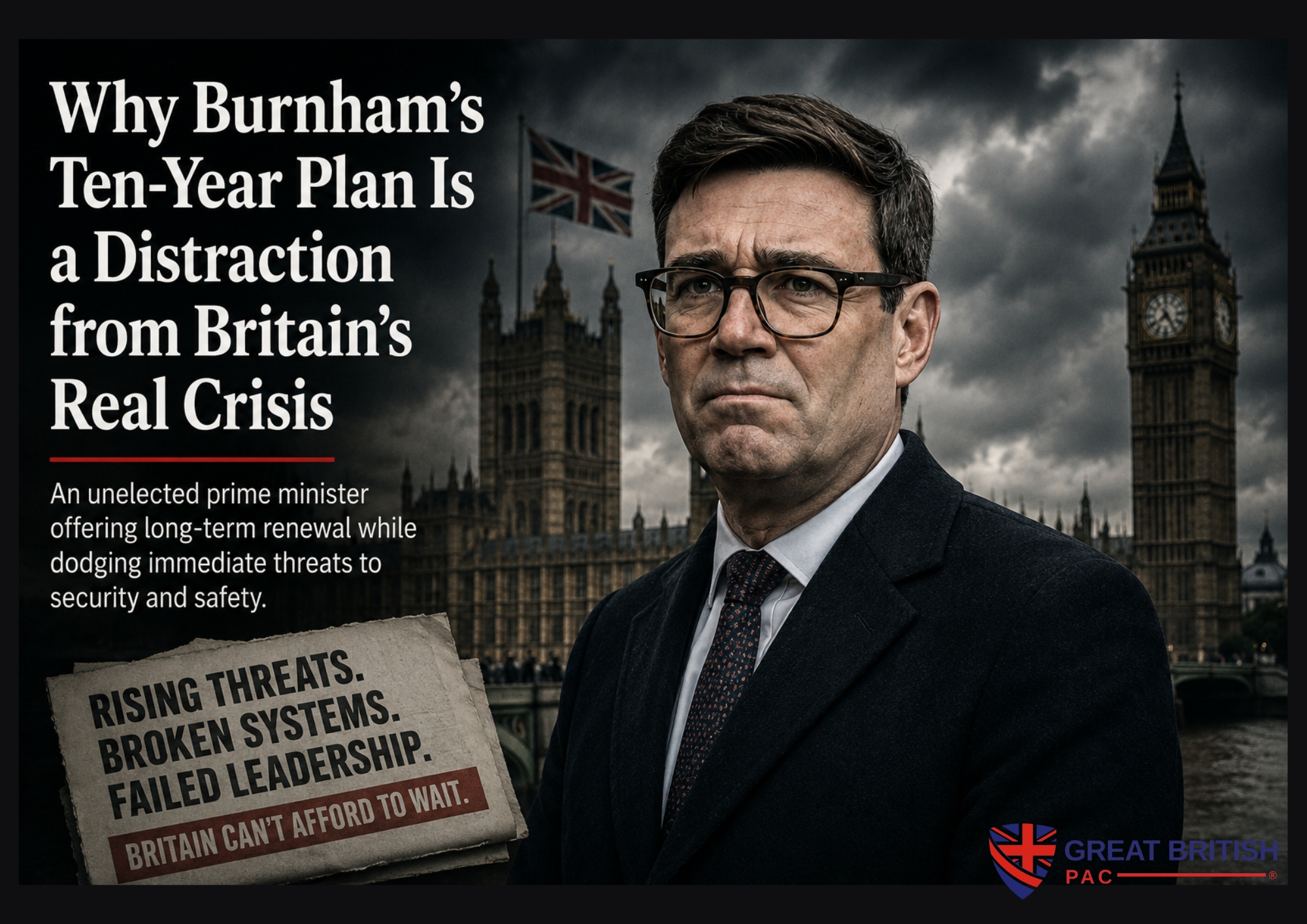
An unelected prime minister offering long-term renewal while dodging immediate threats to security and safety
Andy Burnham took office as Britain's seventh prime minister in a decade at a moment that should have prompted an uncomfortable national reckoning. Instead, it produced little more than ceremony and carefully choreographed speeches. As he stands in Downing Street promising a sweeping ten-year plan for national renewal, decentralisation, reindustrialisation, greater public control of utilities, council house building and an ambitious reshaping of regional power, reasonable people must ask two fundamental questions: Can a decade-long strategy credibly address problems that demand immediate action? And more troubling still, why is a government that came to power through internal party mechanics rather than democratic mandate suggesting that the British public should simply wait a decade while urgent national security threats mount, illegal immigration spirals, and serious crimes against the vulnerable are seemingly overlooked?
The arithmetic alone should give Burnham pause. At the next scheduled election in 2029, he will have been prime minister for approximately three years. Even if he were to win that contest decisively, a far from certain prospect given Labour's already-depleted public support, he would be looking at a second term extending to 2034, when he would be in his mid-seventies. The suggestion that he will still command a functioning government three years beyond that, pursuing coherent policies in 2036 and beyond, strains credibility in ways that his cheerful rhetoric cannot overcome. History does not suggest that British politicians maintain either the vigour or the political capital necessary to steer transformative agendas across two decades. The fact that Burnham seems to believe he might be an exception speaks more to optimism than to realism.
Yet this question of Burnham's longevity in office pales beside a more pressing concern: whether Britain itself can afford another decade of the kind of strategic ambition he is proposing while immediate crises remain unaddressed and actively worsening.
The Threats Burnham's Speech Studiously Avoids
Britain faces converging security and public safety crises that demand urgent response, not leisurely ten-year plans. These are not abstract policy questions suitable for lengthy review periods. They are matters on which the competence and judgment of government should be demonstrable now, not promised in a distant future.
Consider first the state of Britain's defences. Russia poses what the Ministry of Defence describes as "a serious and persistent threat to UK and European security in every domain, underwater, on the water, on the land, and in the sky, space and cyber." This is not rhetorical flourish. In recent weeks, Russian aircraft have conducted multiple reckless overflights of British military assets, including reconnaissance flights over HMS Prince of Wales while operating in European waters. Russian drones, launched from shadow fleet vessels, have overflown British nuclear sites and critical infrastructure. A Russian shadow tanker has infiltrated British territorial waters, and approximately 200 further vessels have passed through with minimal interdiction despite ministerial promises to take them seriously.
The defence investment plan, published just weeks ago, is incomplete, it contains a £5 billion shortfall that the government has essentially deferred to the next spending round, in effect asking the next prime minister to solve the problem. This is precisely the kind of strategic evasion that inspires neither confidence nor coherence when the threat from an increasingly aggressive Russia could materialise within years, not decades. Burnham's ten-year plan is silent on defence spending, fiscal constraints, and how Britain will maintain credible deterrence while pursuing ambitious devolution and public investment. The Defence Secretary has committed to reaching 3.5% of GDP spent on defence by 2035, the final year of Burnham's imagined tenure—but this represents a deferral of genuine military readiness to a timeframe that NATO allies, facing an increasingly belligerent Russia, regard as recklessly distant.
That problem is compounded by Britain's increasingly entanglement in Middle Eastern conflicts without proper democratic scrutiny. In March 2026, the government allowed the United States to expand its use of British military bases to conduct offensive operations against Iran targeting the Strait of Hormuz. This was not presented to Parliament for a vote. No general election mandate covers it. The decision amounts to Britain serving as a logistical support system for American military operations in a region where direct British interests are disputed and where British military capacity, already stretched and under-resourced, cannot be spared without genuine consequences for NATO readiness.
Iran's Foreign Minister explicitly stated that this policy "puts British lives in danger." One is not required to sympathise with Iran's position to recognise that the United Kingdom, with an undermanned and under-equipped military, allowing its bases to be used for offensive strikes against a regional power is a decision of profound strategic consequence. It transforms Britain from a neutral observer of Middle Eastern conflicts into an active participant, not through parliamentary debate, not through electoral mandate, but through executive decision-making that Burnham inherited and has continued. His ten-year plan makes no mention of how this entanglement will be resolved, what exit strategy exists, or how military resources will be managed amid these expanded commitments.
Immigration, Crime and the Forgotten Victims
If the immediate security situation exposes the inadequacy of Burnham's ten-year timeframe, the immigration and crime crises reveal a government seemingly indifferent to public safety in the present.
Illegal immigration into Britain continues at significant scale. While net migration has declined to its lowest level outside of the COVID pandemic since 2012, asylum applications remain elevated. More significantly, the character of the immigration debate has shifted from questions of economic policy to questions of public safety. Gangs involved in human trafficking, the exploitation of vulnerable women and children, and the organised criminality surrounding illegal entry have proven deeply resistant to government action. These problems are not solved by a ten-year plan promising devolution and regional power; they require immediate, sustained law enforcement action and a government willing to implement immigration policies that actually deter illegal entry and prosecute the criminals who facilitate it.
More troublingly, Britain's response to organised grooming gangs, systematic sexual abuse of children, often in small towns across the North and Midlands, has been characterised by institutional lethargy and what can only be described as a covering-up of institutional failure. The independent inquiry into grooming gangs, led by Baroness Anne Longfield, is ongoing, but the scandal itself is now more than a decade old. The revelations in the Casey Inquiry made clear that police forces, social services, and local authorities were aware of abuse patterns and failed to act. Some of those failures were deliberate, driven by a misguided fear of being accused of racism if they investigated gangs with a particular ethnic composition.
This is not a failure of long-term planning. It is a failure of institutional will, of prosecutorial courage, and of government willingness to prioritise the safety of vulnerable children over political convenience. Burnham has said nothing about how his government will ensure that such institutional failures do not recur. A ten-year plan for regional devolution will not recover stolen childhoods or restore justice to women and girls who were serially assaulted while authorities looked away. What is required is immediate accountability, systematic reform of police and social services priorities, and a clear public commitment that child safety supersedes all other considerations, including anxieties about offending particular communities.
The fact that this issue has faded from the frontline of British political discourse is itself the scandal. Burnham's silence on it is deafening.
Burnham's Ten-Year Plan: What It Offers and What It Cannot
Understanding what Burnham's plan offers and what it withholds is essential to evaluating whether it deserves public faith, especially given that it has not been submitted to electoral endorsement. The plan contains genuine merit in some areas but significant shortcomings in others.
The Case For: Elements of Real Promise
On the positive side of the ledger, several elements merit serious consideration.
The commitment to greater public control of utilities responds to genuine market failures. England's water companies, many drowning in debt, have spectacularly failed to maintain infrastructure or keep bills affordable while private shareholders extracted dividends. Thames Water's near-collapse has brought this reality into sharp focus. A franchise model, similar to what has been attempted in Greater Manchester with bus services, could restore accountability while avoiding the enormous costs of full nationalisation. Similarly, energy security is now a strategic priority, particularly given evolving threats from Russia and the vulnerability of supply chains. Bringing greater public control into this sector is not ideologically radical; it is prudent governance.
The housing agenda, too, addresses a genuine crisis. Council house building has essentially ceased as a meaningful enterprise; waiting lists are stratospheric; and private developers have proven unable to build affordable housing at scale. A commitment to the largest council house building programme since the post-war period could materially improve lives and has proven economically stimulative in past iterations. The emphasis on social rent, the most subsidised form of affordable housing, rather than diluting the budget with higher-cost "affordable" schemes, shows serious policy thinking.
The focus on regional reindustrialisation and "good growth in every postcode" speaks to a genuine problem. London has consumed an ever-larger share of Britain's economic activity, prosperity and investment; secondary cities have experienced genuine decline; and regional disparities in life expectancy, income, and economic opportunity have become politically destabilising. Using public procurement to favour British suppliers, supporting manufacturing in key sectors, and directing infrastructure investment outside the South-East are defensible and potentially transformative policies.
The Case Against: Fundamental Constraints and Evasions
On the less convincing side, however, the plan contains significant liabilities that extend far beyond the merely technical.
First: The Fiscal Straitjacket. Burnham has committed to maintaining the current government's debt and spending rules. This is an extraordinary constraint to accept when proposing transformative change. Major housing building programmes, comprehensive social care reform (which he has signalled he wishes to pursue), and significant infrastructure investment all require substantial public investment. Maintaining existing fiscal rules, particularly after years of frozen budgets that have degraded every major public service, is fundamentally incompatible with a genuinely transformative agenda. It is the political equivalent of promising to paint the entire exterior of a house while forbidding the purchase of new paint. The numbers simply do not work. A government cannot simultaneously pursue a post-war-level housing programme, restructure utilities into public ownership, invest heavily in regional infrastructure, and maintain existing fiscal constraints. Something must give.
Second: The Revenue Problem. The plan remains alarmingly light on taxation and revenue-raising. Burnham has said he would stick to Labour's manifesto commitment not to raise the main rates of income tax, VAT, or National Insurance. He has hinted at "movement" on other areas and has not ruled out raising capital gains tax or even introducing a wealth tax, but has set out no concrete proposals. This is politically cautious but economically deceptive. A plan of this ambition requires serious money. Where is it to come from if not from taxation? From the growth that the plan generates? Perhaps. But assuming growth sufficient to fund transformative public investment while maintaining fiscal rules amounts to assuming the conclusion. It is wishful thinking dressed in technocratic language. The British public deserves honesty about the cost of renewal. Burnham has not provided it.
Third: The Political Longevity Problem. The plan's reliance on ten-year horizons appears to underestimate the political economy of democratic governance. Even if Burnham were personally to serve two full terms, a scenario that no recent British prime minister has accomplished, he would face renewed mandates, freshly empowered parliaments, and new political constraints every five years. Ten-year planning in a democracy requires levels of cross-party consensus that currently do not exist. The Conservative opposition will argue, as Kemi Badenoch has already begun, that the plan avoids the hard choices about defence spending, welfare reform, and the genuine constraints facing the state. Reform UK will argue that it does not go far enough and moves too slowly. More seriously, on the issues canvassed above, defence, immigration, public safety, he plan says virtually nothing. This is not an omission; it is a choice. It suggests that Burnham regards these as settled questions or as beyond the scope of a "ten-year plan for renewal." They are not.
The Fourth Critic: Lack of Transparency and Accountability
Beyond fiscal constraints, revenue problems, and political longevity challenges, there exists a fourth, more fundamental problem with Burnham's approach: the utter lack of transparency about what devolution actually means and how power will genuinely be redistributed.
The Devolution Deception
Burnham speaks eloquently of a "circuit breaker," of "change," and of moving Britain from decline to renewal. He promises that power will be moved from Whitehall to the regions, that decision-making will be democratised, and that communities will finally have genuine agency over their futures. These are compelling words. But the specific mechanisms through which power shifts, the precise rules governing how regional mayors will operate, and the actual constraints on their decision-making remain fundamentally unclear. This is not accidental vagueness. It is strategic obscurity.
"Devolution" is a capacious term that can mean almost anything. It can mean genuine transfer of spending authority and political accountability to elected local representatives. It can mean creating new administrative tiers that shuffle responsibility without actually shifting power. It can mean consulting communities while retaining ultimate decision-making in the centre. Burnham has not specified which model he intends. This matters enormously.
Consider the practical question: if a regional mayor is handed a larger budget for housing but remains bound by the same procurement rules, the same planning regulations, and the same welfare criteria set by Whitehall, how much has power genuinely shifted? If a mayor can make decisions about education and training but the curriculum remains set nationally and inspection regimes remain uniform, has meaningful devolution occurred? The answer, in most cases, is no. Power has been shuffled between politicians and administrative centres, but fundamental authority remains centralised.
This is precisely what critics from the Conservative Party and Reform UK have identified as the core problem. Kevin Hollinrake, the Conservative chairman, accused Burnham of pledging "more devolution, more committees, more process." It is a fair criticism. What communities across Britain need is not more layers of political intermediaries making decisions in their region. They need genuine authority to shape the policies that affect their lives. That might mean allowing local communities to set their own welfare policies, to control their own police forces, to shape their own education systems free of national constraint. Burnham has not promised any of this. Instead, he has promised to move part of Number 10 to Manchester and to create regional power structures that remain answerable to London and constrained by central rules.
The Accountability Vacuum
Beyond the question of whether power is actually transferred lies a more serious problem: the absence of any clear mechanism for accountability if things go wrong. Who is responsible if a regional mayor appointed by a Labour-controlled Whitehall pursues policies that damage local communities? The answer is deliberately unclear. Accountability runs upward to Whitehall, not downward to communities. This is the opposite of genuine democratic empowerment.
A truly transformative devolution agenda would place spending authority and regulatory power in the hands of genuinely elected local bodies, parish councils, community boards, local referenda. It would allow communities to opt out of national policies that do not serve their interests. It would mean genuine subsidiarity: decisions made as close to the people affected as practically possible. Burnham's plan, while more distributed than the current model, still operates within the traditional logic of representative democracy from above. It is centralisation with regional characteristics, not genuine devolution.
This matters because it reveals the fundamental conservatism of Burnham's vision. He speaks of transformation and change, but what he is actually proposing is a reorganisation of existing power structures. The state remains centralised in its fundamentals. Authority remains concentrated. Communities remain subject to decisions made on their behalf by politicians rather than having the power to make decisions for themselves. This is not the circuit breaker that Britain needs. It is the same old politics, repackaged with new rhetoric about regions and place-based approaches.
The Question Burnham Will Not Answer
Why is there no general election? This question deserves a far more serious answer than has been offered.
The argument is straightforward and rests on democratic principle rather than technical preference. When a government experiences a fundamental change in leadership, particularly one as dramatic as this, the seventh prime minister in a decade, coming to power without having faced the electorate, the onus rests on that government to return to the people and ask for their endorsement. This is not merely a matter of tradition or convention. It is a matter of democratic legitimacy.
Burnham inherited a government that won an election in 2024. That was Labour's election. It is not obviously his. The party that won that election is now different in its leadership and has shifted its agenda. The public was not asked whether they approved of that change. They were simply informed of it, in a sequence of internal Labour Party procedures that, while legal, lacked any public mandate.
The refusal to call a general election is thus not a minor procedural point. It is the culmination of Britain's slide away from genuine democratic accountability. Citizens now watch as their government changes hands without their vote, as fundamental policies shift without their endorsement, and as their elected representatives claim that this represents the proper functioning of Parliament. This may be technically correct. It is democratically indefensible.
The claim that polling suggests the public does not want an election is precisely backwards. The question is not what the public wants at this particular moment. The question is what democracy requires. Democracy requires that when governments change fundamentally, the people are given the chance to judge that change. It is not optional. It is not subject to polling or executive preference. It is the foundation on which all other democratic rights rest.
A general election would not be a panacea. But it would at least acknowledge that in a democracy, power ultimately rests with the people. It would force Burnham to defend his ten-year plan to the public, to explain why defence spending is underfunded, to confront the failures on immigration and crime, and to answer for the fact that Britain is entangled in Middle Eastern conflicts without proper parliamentary oversight. Most importantly, it would give the British people the chance to decide whether they wish Burnham to pursue this agenda or whether they wish to place their trust elsewhere.
Instead, they are being asked to accept a decade-long plan announced by a prime minister they did not vote for, based on fiscal rules that will constrain reform, silent on the most pressing security threats facing the nation, and silent on the failure to adequately address immigration, organised crime, and the abuse of vulnerable children. This is not governance in the service of the people. It is governance that has lost faith in democracy itself.
Britain's Choice
The real question facing Britain is not whether Burnham's ten-year plan contains wise elements. Some of it clearly does. The question is whether a nation that has rotated through seven prime ministers in a decade, that has experienced the effective breakdown of its political system, that faces genuinely serious challenges in defence, in public service delivery, and in maintaining public faith in democracy, can afford to continue operating on the assumption that internal party mechanics suffice to confer legitimacy.
Moreover, the question is whether a nation facing Russian military aggression, inadequate defence spending, a destabilising immigration crisis, and systemic failures in the protection of vulnerable children can afford to wait a decade for change. The immediate threats facing Britain demand immediate response. They demand a government that has explicit electoral endorsement for its policies. They demand that Parliament be given proper scrutiny rights, that the public be given democratic choice, and that accountability run downward to the people rather than upward to Westminster management committees.
Burnham speaks of Britain's need for a "circuit breaker," for restored stability and renewed hope. These are reasonable aspirations. But they cannot be achieved through a ten-year plan announced by a prime minister who did not face the electorate and who refuses to return to it. They cannot be achieved while urgent security threats are unaddressed, while immigration and crime remain out of control, and while the government studiously avoids democratic accountability.
A general election would not solve all of Britain's problems. It would not immediately end the cost-of-living crisis, rebuild the NHS, restore regional balance to the economy, or deter Russian aggression. What it would do is something far more fundamental: it would restore to British citizens the power to decide who governs them and on what mandate. It would require Burnham to defend his vision for Britain, not merely to assert it. It would demand that the most pressing challenges, defence, immigration, crime, institutional accountability, be central to political debate, not peripheral footnotes to a technocratic ten-year plan.
If Burnham believes his vision for Britain is sound, he should be confident enough to ask the people whether they agree. If he is not, then perhaps he should ask himself why. The British people have waited long enough for politicians to decide that they deserve a say in their own governance.

Graphic and AI-generated illustration by Great British PAC. Created for editorial and illustrative purposes.