
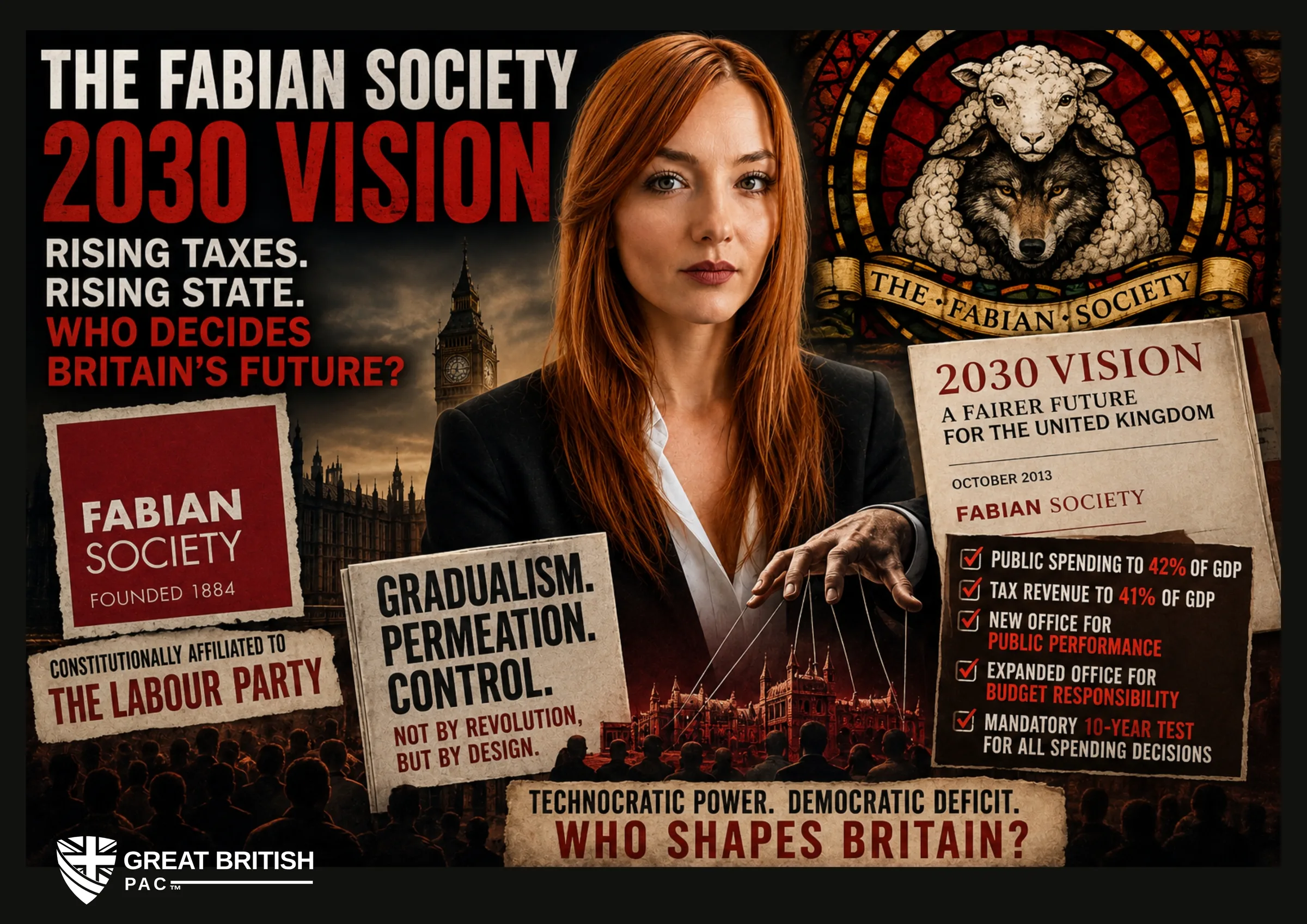
An investigation into Britain's oldest socialist think tank, its most consequential fiscal blueprint of the last two decades, and the uncomfortable questions its own symbolism has always raised.
I. The Document, and Why It Still Matters
More than a decade after its publication, and now with the 2030 horizon looming close, the Fabian Society's 2030 Vision, the 222-page final report of the Fabian Commission on Future Spending Choices, has quietly become one of the most influential fiscal texts in modern British public policy. Commissioned in autumn 2012 and released in October 2013, it was pitched to the public as a sober, technocratic exercise, a group of experts thinking dispassionately about "the public spending choices facing government over the next two decades." Read today, however, from the vantage point of 2026, it functions less as neutral forecasting and more as an operating manual. Many of its recommendations have since crystallised, almost verbatim, into the assumptions that now govern Treasury thinking, Labour Party platforms, and the "long-term" fiscal architecture of the United Kingdom.
That success is precisely what makes the document worth re-reading, and worth reading critically. Because the Fabian Society, founded on 4 January 1884, is not a neutral research house. It is, by its own official description, a socialist society, constitutionally affiliated to the Labour Party, and the only original founder of that party still affiliated to it in its original form. And its historical self-image, memorialised in stained glass, has always contained an image the Society would now rather nobody talked about: a wolf, wrapped in the skin of a sheep.
Fact Box
II. The Society's Old Emblem: The Wolf in Sheep's Clothing
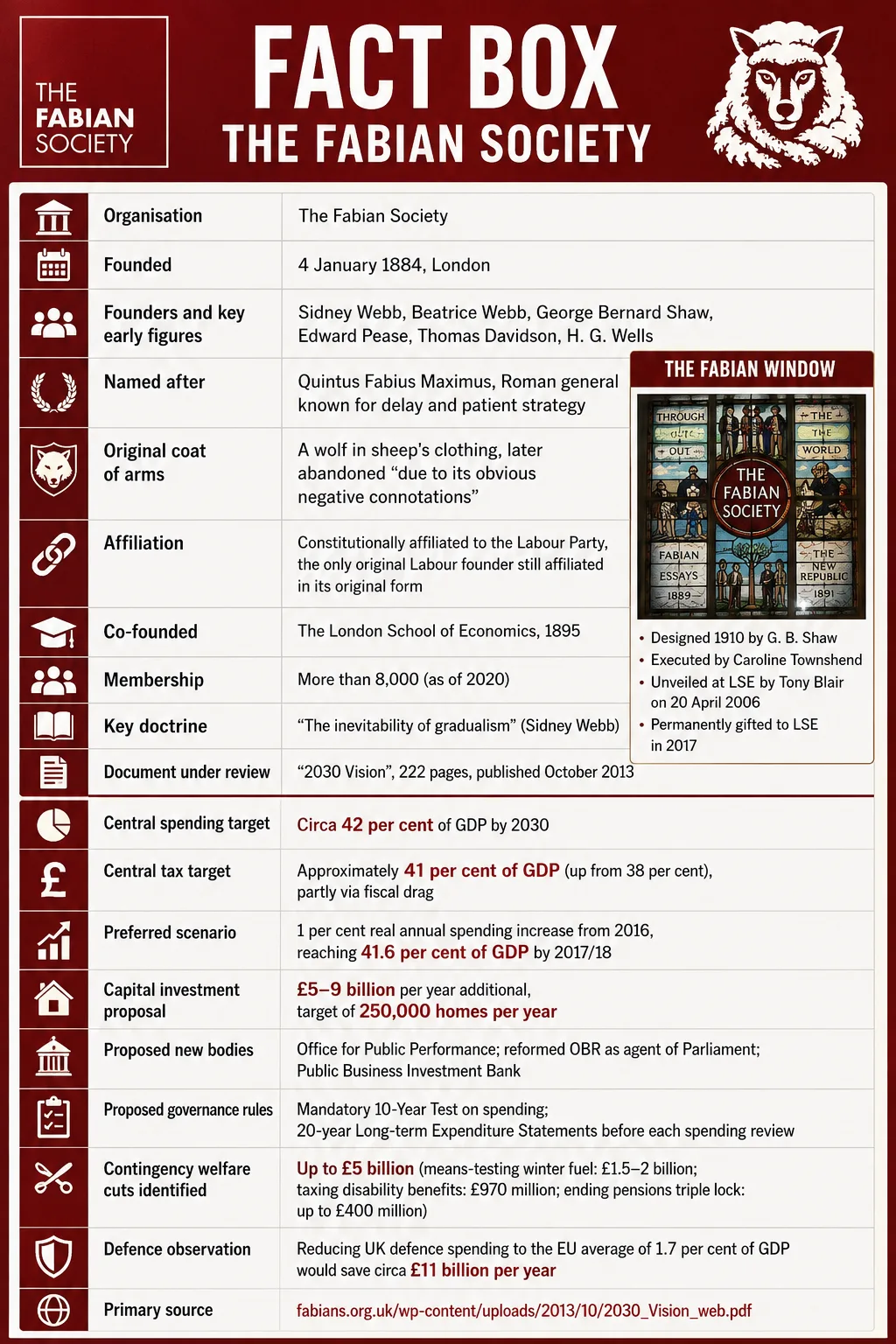
Before turning to the numbers, the symbolism deserves attention, because the Fabians themselves once thought it important enough to render in glass. The organisation's original coat of arms, later abandoned "due to its obvious negative connotations," according to the entry on the Society at Wikipedia, depicted a wolf draped in sheep's fleece. It was not the invention of hostile critics. It was chosen by the Fabians themselves as a description of their preferred political method.
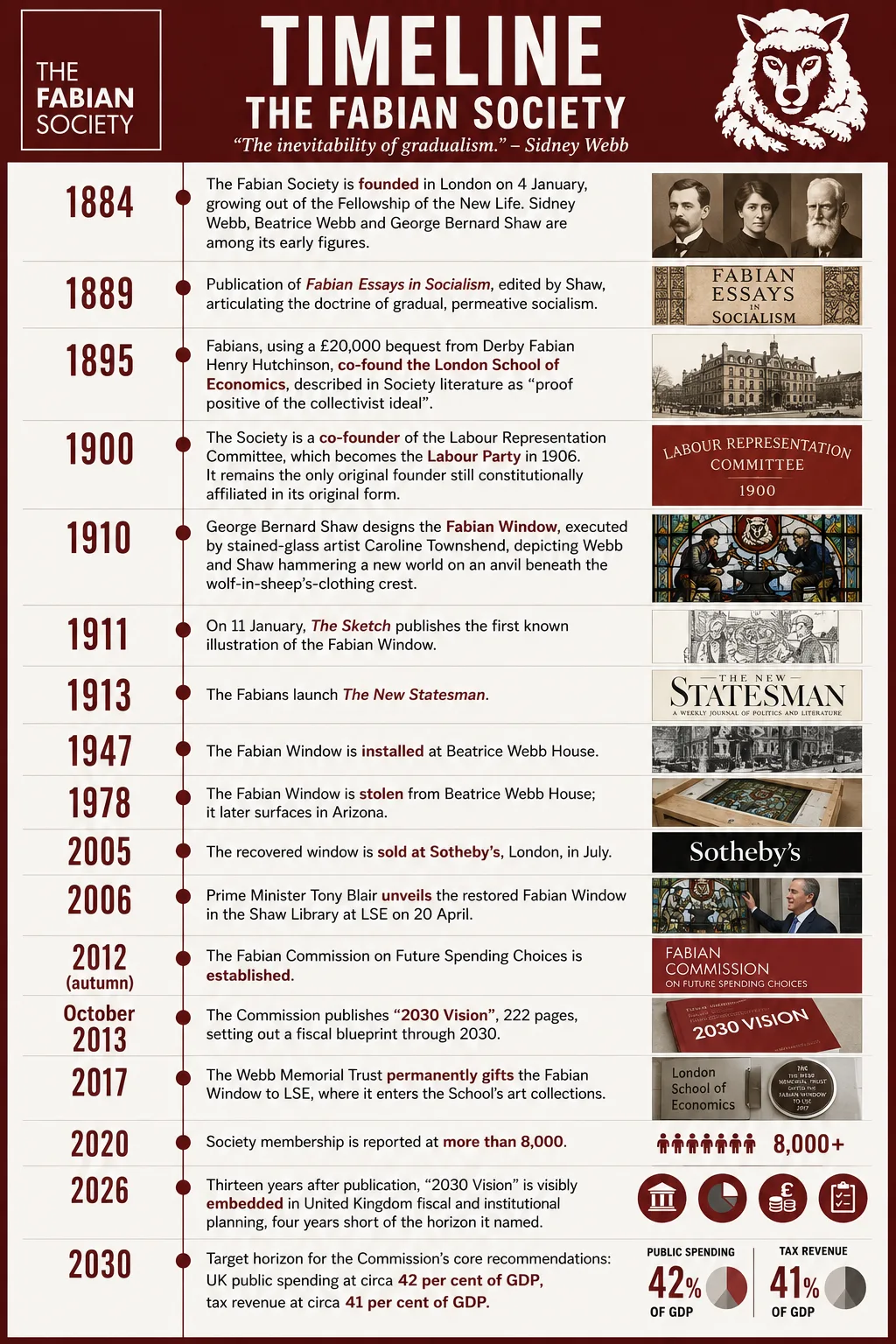
The emblem's most famous manifestation is the Fabian Window, designed in 1910 by the playwright and Fabian founder George Bernard Shaw and executed by the stained-glass artist Caroline Townshend. As documented by the London School of Economics history blog, the window depicts Sidney Webb and Shaw hammering the globe on an anvil, "hammering out a new world," beneath the wolf-in-sheep's-clothing crest. Edward Pease works the bellows, H. G. Wells cocks a snook at the leadership, and beneath them the disciples kneel in something resembling worship. The window was installed in 1947 at Beatrice Webb House, stolen in 1978, surfaced briefly in Arizona, was auctioned at Sotheby's in July 2005, and was unveiled by Prime Minister Tony Blair at LSE's Shaw Library on 20 April 2006. In 2017 it was gifted permanently to the LSE, where it remains, in full public view, a piece of the Society's own self-portrait.
The organisation's tortoise motto, drawn from the Roman general Quintus Fabius Maximus, is scarcely more reassuring in tone. As the Society's own history page proudly quotes, "For the right moment you must wait, as Fabius did most patiently when warring against Hannibal, though many censured his delays; but when the time comes you must strike hard, as Fabius did, or your waiting will be in vain, and fruitless." The tortoise is patience. The wolf is method. The strike is the object. That is the philosophy the Fabians publicly memorialised, and it is the philosophy against which "2030 Vision" must be read.
III. A Method Without a Mandate: The Doctrine of Gradualism
The Fabian doctrine, coined by Sidney Webb and enshrined in Society literature, is known as the "inevitability of gradualism." It holds that socialism will arrive not through revolution, barricades, or manifestos submitted to the electorate for a clean up-or-down verdict, but through a patient, permeative process of committees, commissions, expert reports, quangos, and administrative reforms, each individually modest, each collectively transformative. The strategy is explicitly to avoid the moment at which the voter is asked to endorse the destination.
This is what has always made the Fabians uncomfortable reading for democrats of both left and right. Vladimir Lenin, from the revolutionary flank, dismissed them as "social-chauvinists" and "the most consummate expression of opportunism." Leon Trotsky called them "provincial, boring, and unnecessary." From the liberal and classical-liberal side, Friedrich Hayek warned that Fabian methods expanded state power under the moral cover of social justice and installed "unelected bureaucrats" as the effective sovereign. The barrister and human-rights campaigner Geoffrey Robertson has criticised early Fabians for providing intellectual cover for eugenics. The American economist Thomas Sowell has described the tradition as "an elitist managerial class" that prefers "governance by intellectuals and experts" to grassroots democracy. Even H. G. Wells, once a member himself, dismissed the Society as "a middle-class talking shop."
These are not fringe complaints. They are the recurring, cross-ideological criticism of a movement that has boasted, at various points, of Ramsay MacDonald, Clement Attlee, Harold Wilson, Tony Benn, Roy Jenkins, Shirley Williams, Tony Blair, Gordon Brown, and Ed Balls among its membership. It is also a movement whose current membership, according to its own history page, stood at more than 8,000 as of 2020, and which co-founded the London School of Economics in 1895 with a £20,000 bequest from the Derby Fabian Henry Hutchinson, expressly, in the Society's own words, to provide "proof positive of the collectivist ideal."
IV. Inside "2030 Vision": The Numbers Behind the Vocabulary
Against this history, the specific recommendations of "2030 Vision" acquire a sharper edge.
The Commission's central prescription is that United Kingdom public expenditure must rise, permanently, to around 42 per cent of GDP by 2030, up from the Coalition-era trajectory of roughly 40.5 per cent. To fund this, tax revenue must rise to approximately 41 per cent of GDP, from the then-prevailing 38 per cent, achieved either through explicit policy or, notably, through what the document calls "fiscal drag," the silent mechanism by which inflation drags ordinary earners into higher tax brackets without any politician having to defend the increase at an election.
The Commission's preferred scenario recommends a 1 per cent real annual increase in public spending from 2016 onwards, reaching 41.6 per cent of GDP by 2017/18. Capital investment is to be raised by £5 billion to £9 billion per year, notionally to build 250,000 homes annually and to fund green energy. A new Public Business Investment Bank is proposed, to leverage private capital under state direction.
The governance recommendations are, from a democratic-accountability standpoint, the most consequential. The Commission calls for the creation of an Office for Public Performance, an unelected body to "champion excellence and drive productivity" across the public sector. It proposes the reform of the Office for Budget Responsibility into "an agent of Parliament with a broader remit to analyse alternative policies," effectively expanding the analytical footprint of a technocratic institution over the field of political choice. It urges a mandatory "10-Year Test" for all spending decisions, and Long-term Expenditure Statements projecting twenty years ahead of every spending review.
On welfare, the Commission opposes the so-called bedroom tax and would reverse it at a cost of some £500 million, while identifying up to £5 billion of contingency cuts, including means-testing winter fuel payments (£1.5–2 billion), taxing disability benefits (£970 million), and ending the pensions "triple lock" (up to £400 million by 2017/18). It proposes a £30 premium for contributory Jobseeker's Allowance at a cost of £220 million, and a reform of Universal Credit to improve work incentives for second earners at a cost of £700 million. On international commitments, it recommends preserving the 0.7 per cent of GNI overseas aid target in the short term, and observes, almost in passing, that reducing UK defence spending to the European Union average of 1.7 per cent of GDP would save £11 billion a year.
Taken individually, each measure is defensible on its own technical terms. Taken together, the picture is unmistakable: a permanent enlargement of the state's share of national income; a permanent enlargement of the technocracy's share of political decision-making; and a permanent shift of the fiscal centre of gravity away from parliamentary contest and toward long-horizon administrative planning by expert bodies whose members no voter ever chose.
V. The Philosophical Question: Who Decides?
This is where the wolf in the sheep's fleece walks back into the room.
Nothing in "2030 Vision" is presented as ideological. The vocabulary is exhaustively neutral, "productivity," "future-oriented expenditure," "early intervention," "long-term social and economic impact." Yet every substantive recommendation moves in the same direction: more spending, more tax, more permanent institutions insulated from electoral turnover, more decisions taken not at the ballot box but inside offices with acronyms. The document does not argue for socialism. It argues for the machinery within which a socialist settlement, once installed, becomes structurally difficult to reverse. This is Fabian method as Sidney Webb described it, precisely, and as the wolf on the coat of arms once advertised, honestly.
The question a serious democracy is entitled to ask is not whether any given proposal in "2030 Vision" is a good idea. Some of them are. The question is whether the accumulation of such proposals, all issued by an avowedly socialist society constitutionally affiliated to one of the country's two major parties, and increasingly adopted verbatim by governments of that party, is being presented to the electorate for what it is. On the evidence of the document itself, the answer is no. The framing is technocratic. The authorship is ideological. The gap between the two is exactly the space the Fabians historically claimed as their own.
VI. Reading the Society's Intentions in 2026
Defenders of the Society will object, reasonably, that a think tank is entitled to think, that a political society is entitled to advocate, and that adoption of its ideas by elected governments is itself a democratic outcome. This is true, and important. But it does not exhaust the critique. The Fabian model is not simply advocacy. It is, by its own historical self-description, a strategy of achieving irreversible structural change through means designed to attract as little political attention as possible, until the moment at which reversal is impractical. That is what the tortoise motto means. That is what the wolf-in-sheep's-clothing coat of arms meant. Neither symbol was chosen by the Society's enemies. Both were chosen by its founders and rendered in stained glass by one of them, and they still hang, today, in the Shaw Library at the London School of Economics.
There is a further, more troubling continuity. The early Fabians, as noted, provided intellectual scaffolding for eugenics, a fact acknowledged by historians sympathetic and hostile alike. The Society has since disowned that inheritance, as it disowned the wolf coat of arms, but the underlying pattern, that of a self-appointed intellectual elite entitled to redesign the lives of the majority "for their own good," is a pattern the movement has never fully escaped. It surfaces, in muted form, in "2030 Vision" every time the document proposes a new expert body to oversee a domain previously left to democratic contestation.
VII. A Warning, Not a Verdict
None of this amounts to a case for ignoring the report. On the contrary, "2030 Vision" is a serious document, in many respects an intellectually honest one, and its authors deserve engagement rather than caricature. Its analysis of demographic pressure on the public purse is sober. Its critique of short-termism in Treasury planning is largely correct. Its proposals on housing supply address a genuine and worsening crisis.
The warning is philosophical, not fiscal. It is the warning that any democracy owes itself whenever a permanent institution, ideologically committed, constitutionally affiliated to a governing party, and historically candid about its preference for permeation over persuasion, produces a blueprint of this scope, this specificity, and this longevity. The warning is to read such a document not merely for what it proposes, but for what it presupposes: that the destination is settled, and only the pace of arrival remains to be negotiated among experts.
The Fabians retired their wolf-in-sheep's-clothing crest because it became embarrassing. They did not, as far as the historical record shows, retire the method it depicted. The tortoise still walks. The anvil in the Shaw Library still stands. And in "2030 Vision," the hammer is still, patiently, coming down.
That is the reason to read the report. It is also the reason to read it, as the Fabians themselves might say, with one's eyes open, and with a certain amount of wariness reserved for any sheep that walks with the gait of something else.
Timeline
Sources and further reading
The Fabian Society, 2030 Vision: The final report of the Fabian Commission on Future Spending Choices, October 2013.
The Fabian Society, Our History and About Us.
Sue Donnelly, Hammering out a New World: The Fabian Window at LSE, LSE History Blog.
Fabian Window and Fabian Society, Wikipedia.
The London School of Economics and Political Science, Shaw Library art collections.