While Beijing prepares to dominate the world's protein markets, the United Kingdom is losing the farmers who could keep it fed. The Great British PAC says food sovereignty is slipping away at the worst possible moment.
The United Kingdom now produces 60 percent of the food it eats, down from 65 percent a year earlier, according to the latest Agriculture in the United Kingdom statistics from Defra. The figure has hovered in the low sixties for a number of years, but the fall in 2025 still matters, because it comes at a moment when the country's ability to feed itself has become a strategic question, not just an economic one. Domestic production now covers only 72 percent of the food that could feasibly be grown here. The Energy and Climate Intelligence Unit, which analysed the figures, notes that part of the drop is a price story driven by climate damage abroad, with imported coffee and tea costing more than a billion pounds extra in 2025, and cereal imports rising after England suffered its second worst harvest on record.
The National Farmers' Union has warned for years, in a warning that dates back to its analysis reported by the Financial Times, that the United Kingdom would run out of food within seven months if forced to rely on domestic production alone. At the NFU conference in February 2026, president Tom Bradshaw put it plainly, "a resilient food system isn't optional in a time of geopolitical uncertainty, it is a cornerstone to national security", adding that "the years of declining food production must end now". This summer, with drought covering much of England and all of Wales, he told the BBC that "water security is a critical part of our food security and food security is our national security".
The timing could hardly be worse. Beijing's 15th Five-Year Plan is marshalling every lever of state finance and power to end China's strategic dependence on imported food, and analysts at Systemiq expect the same playbook that conquered solar, batteries and electric vehicles to be applied to protein. They estimate that half of China's fish and beef consumption, and 40 percent of its dairy products, will come from alternative protein sources by the middle of the century, produced through cellular agriculture, precision fermentation and genetically modified crops. China's food deficit currently runs at $150 billion a year, and it sustains the Western Hemisphere's grain trade, absorbing 89 percent of Argentina's soybean exports, 71 percent of Brazil's and, before the tariffs, 54 percent of America's. If those dependency lines are cut, the world's food trade will be reshaped, and the United Kingdom, if it has allowed its own farm base to wither, will have nowhere to hide.
The domestic picture is already alarming. Office for National Statistics business demography data, reported by Farmers Weekly, shows that 1,890 agriculture, forestry and fishing businesses closed in the first quarter of 2025 alone, while only 805 opened. Over the full year, 6,365 such businesses closed, the highest number since quarterly records began in 2017, and the ONS's latest bulletin shows closures in the sector running 28.4 percent higher in spring 2026 than a year earlier. It should be said plainly that this measure covers registered businesses across agriculture, forestry and fishing, and the ONS does not publish a breakdown by farming branch. The closest branch-level evidence is bleak enough: AHDB records the Great Britain milking herd at 1.59 million head as of April 2026, its lowest ever, with 190 dairy producers leaving the industry in a year, while Defra's horticulture statistics show the United Kingdom grows only 14 percent of its fruit and 56 percent of its vegetables. The Food Foundation notes that 18 of the top 20 countries we import fruit and vegetables from are moderately to severely vulnerable to climate change.
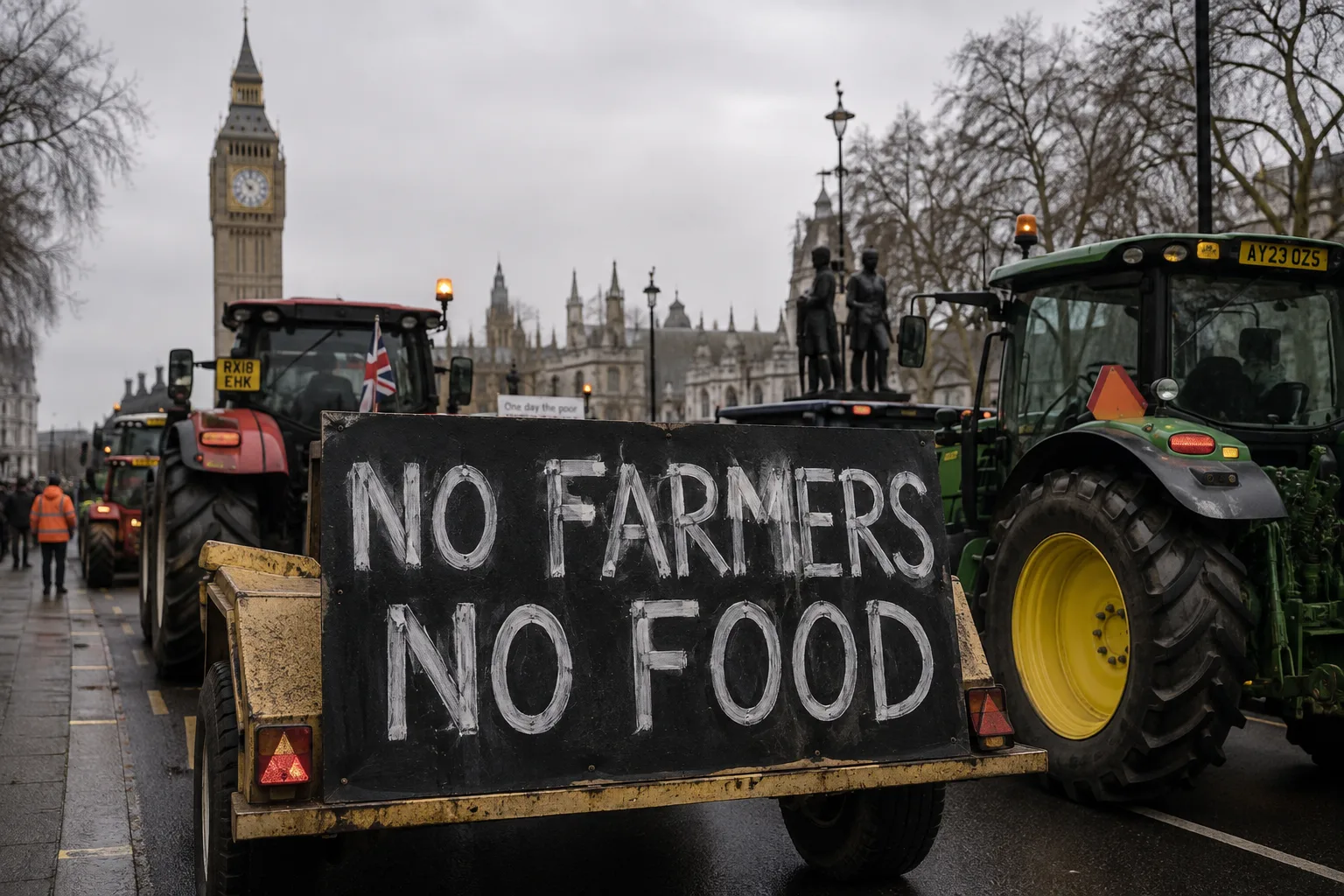
The human cost has names. David Barton, a Gloucestershire livestock farmer whose family has held his land since 1913, told the BBC his son faces an £800,000 bill and said the Budget "has just ripped the heart out of us". Jen, a seventh generation farmer from Yorkshire, said she and her brother would have to sell the family farm to pay roughly £1.2 million in tax. Jeremy Clarkson, of Diddly Squat Farm, called the policy "a very rushed last-minute decision" and said it is "the end" for farmers. Robert Craig, who milks 1,500 cattle across three Cumbrian farms, told the BBC this year's drought had already cost him £100,000, leaving him "praying for rain". In Northern Ireland, a farming community that is among the most important in the United Kingdom, Jennifer Dunlop, whose 200-acre County Antrim dairy farm has been in the family for three generations, said, "I fear for the farming community, I fear for farmers on the ground, I fear for their mental health". Her son Philip said he and his brother cannot find half a million pounds to pay a tax bill. The Antrim charity Rural Support has gone from two counsellors to more than twenty in six years.
The toll on lives is not abstract. In a written answer from the UK Statistics Authority, the Office for National Statistics data show 55 suicides registered in England and Wales in 2022 among people classed as farmers and agricultural workers, and 62 in 2023, among those aged 20 to 64. Because registrations must wait on inquests, the true numbers, the ONS cautions, are higher, and figures for 2024 remain provisional. Shadow Defra secretary Victoria Atkins said the combination of tax changes and national insurance rises is "destroying generational businesses, creating job instability and even leading to devastating suicides". The Country Land and Business Association president, Victoria Vyvyan, put it bluntly, "rural businesses are being pushed to the edge".
What reliance on imports of unknown provenance looks like was demonstrated again this month. The UK Health Security Agency reports 207 confirmed cases of a single strain of Salmonella Enteritidis between August 2025 and August 2026, linked to eggs from multiple sources including importers, with 38 percent of patients hospitalised, two bloodstream infections and one death. Investigators have found no link to UK-produced eggs, and Nick Allen of the British Egg Industry Council points out that "increasing volumes of imports" produced under "less stringent regulations" keep arriving while British Lion producers vaccinate against salmonella as a matter of course.
There is one piece of good news. After more than a year of protests across the United Kingdom, the government raised the inheritance tax threshold for farms from £1 million to £2.5 million in December 2025, ahead of the April 2026 changes, with married couples able to pass on up to £5.65 million tax free. The NFU's own timeline acknowledges this "greatly reduced the tax burden for many family farms", but warns that "for some from today, there is significant tax to pay".
The Great British PAC's position is simple. Food security is national security. The United Kingdom should be strengthening British farming and domestic food production, and it must never become strategically dependent on China, or on any foreign power, for critical food, fertiliser, agricultural inputs or technology. Lose the farms of Cumbria, Antrim, Lincolnshire and Pembrokeshire, and the country will wake up one day to find its dinner plate belongs to someone else.