
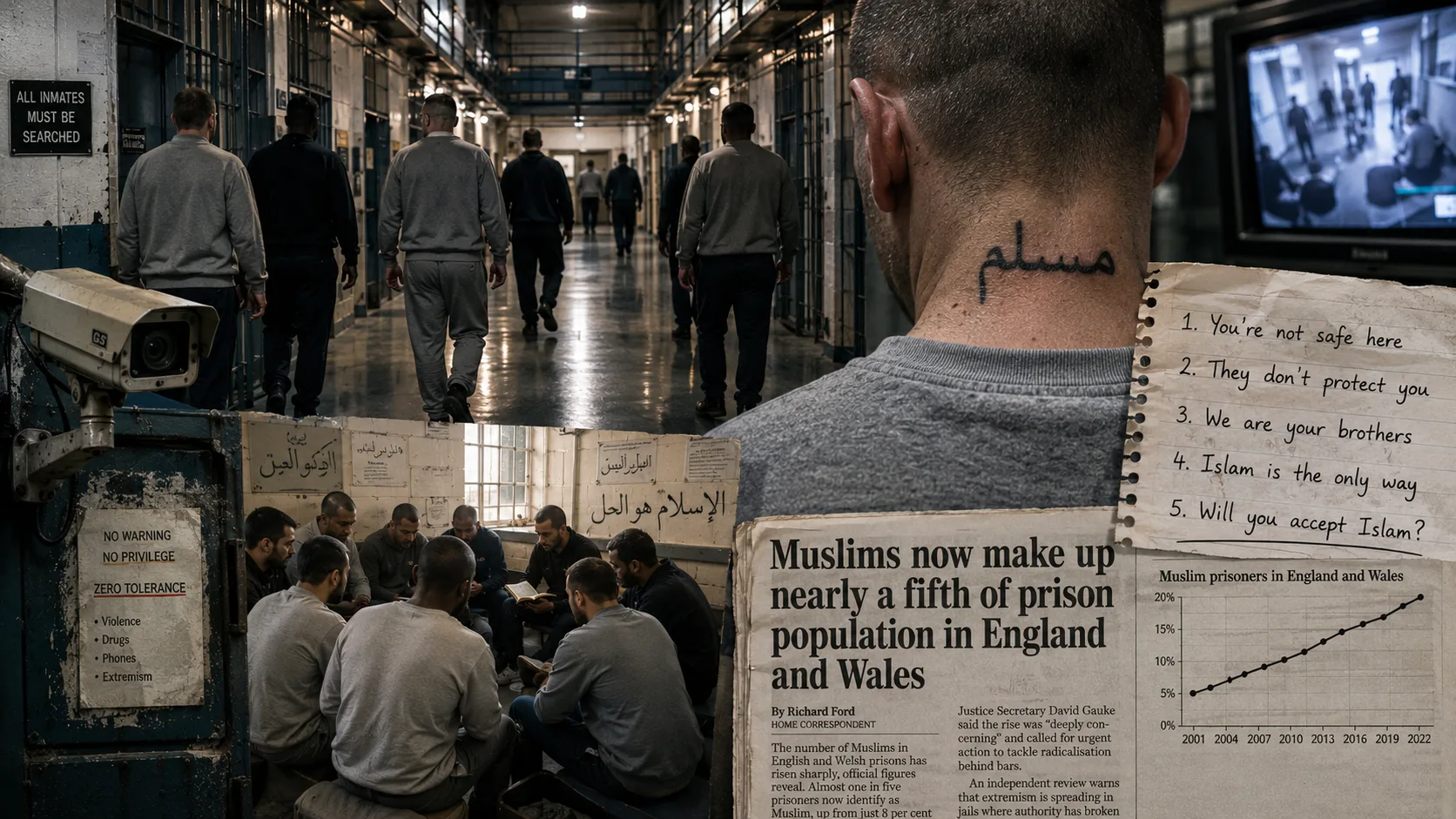
The latest figures on religion behind bars should alarm anyone who cares about the security of this country. According to the Ministry of Justice's own Offender Equalities Annual Report, Muslims now make up roughly 18 per cent of the prison population of England and Wales, nearly 12,000 men, against around 5 to 6 per cent of the general population. In some London jails the figure approaches 27 per cent. Most striking of all is the sharp rise in white prisoners identifying as Muslim, a trend driven overwhelmingly by conversion inside the estate, not by demographics outside it.
We at the Great British PAC regard this as one of the most serious and least honestly discussed security problems in Britain today. Let us be precise about what we are, and are not, saying. Every prisoner has the right to adopt a faith, and for many men, sincere religious observance is a genuine force for rehabilitation. The problem is not Islam. The problem is that an overstretched, under-resourced prison system has allowed a coercive, intimidation-driven recruitment machine to operate under the cover of faith, and that the British state has been too timid to confront it.
The testimony of those who have lived inside the high-security estate is consistent, and it is chilling. One former prisoner, who spent sixteen years in the system, describes standing on the top-floor balcony of C Wing at HMP Gartree in March 2016 as five inmates marched up the stairs and administered a sustained beating to a Muslim prisoner whose alleged offence was throwing a Quran in a bin. Four of the five attackers were themselves converts. He recalls a white, working-class prisoner from the North who had once attacked Muslim inmates at HMP Frankland, and who, after converting, emerged with his capacity for violence intact but his identity wholly transformed, telling him on the landing that he would do anything for his "brothers".
This is the mechanism that official Britain has been reluctant to name. When legitimate authority weakens, informal authority fills the space. A frightened prisoner arriving on a wing quickly learns where power lies, who sells drugs, who can hurt him, and who can protect him. In that world, conversion can offer something far more immediate than spiritual enlightenment, a new identity, belonging, and protection from the most feared network on the estate, the "brotherhood", as it is informally known. For men at the very bottom of the prison hierarchy, particularly those despised for their offences, the promise that past sins are wiped clean is not merely theology, it is survival.
Why do radicalised Muslim networks specifically seek out white British men? The answer is brutally practical. A white convert does not fit the profile that staff, police and the public have been conditioned to watch for. He can move through airports, city centres and, eventually, courtrooms attracting less scrutiny. He brings local knowledge, local language, and often a violent criminal skillset that is immediately useful. And his alienation, his grievance against a society he feels has discarded him, is the exact raw material that extremist recruiters know how to work. He is not being offered a religion so much as a tribe, a rank, and a justification for violence he already possessed.
None of this is conjecture. Ian Acheson's landmark 2016 review of Islamist extremism in prisons, probation and youth justice warned explicitly that Islamist ideology was operating in custody as a "struggle for power and dominance", exploiting the weakness of legitimate authority. His central recommendation, the creation of separation centres to remove the most influential extremists from the mainstream population, was accepted. Yet Jonathan Hall KC, the Independent Reviewer of Terrorism Legislation, found in his 2022 report Terrorism in Prisons that the centres had "never fully taken off", that their use had declined, and that simply moving influential prisoners around the estate transferred the problem rather than solving it. It is telling that, as recent parliamentary proceedings confirm, Hall has had to be appointed yet again to review separation centres, because the state still has not got this right.
The consequences do not stay behind the walls. Sudesh Amman stabbed two people in Streatham in February 2020, days after his release, having retained a radicalised mindset in custody and, as Hall recorded, having held influence among prisoners at Belmarsh and been involved in attempts to convert others. The inquest found police acted lawfully in shooting him, but the deeper question, why a known extremist emerged from prison more dangerous than when he entered, was never satisfactorily answered. Usman Khan's record was worse still, repeated associations with extremist bullying, preaching and radicalisation attempts, culminating in the murders of Jack Merritt and Saskia Jones at Fishmongers' Hall in November 2019. A man surrounded by people who share or admire his extremism has little reason to question it.
So what must be done? We propose the following.
First, separation centres must be used as intended, with statutory backing, sufficient places, and a presumption that influential radicalisers are removed from the mainstream estate early, not after their networks have formed.
Second, the Prison Service needs an intelligence-led capability to distinguish sincere faith from coercive recruitment, which means trained staff, proper vetting of chaplains and religious literature, and the confidence, currently lacking, to act without being paralysed by accusations of discrimination.
Third, conversion itself must be monitored as a risk factor, not a protected irrelevance, where it coincides with gang membership, debt, violence or intimidation.
Fourth, release decisions for terrorist offenders must be removed from automatic processes, as Parliament began to do after Streatham, and reinforced so that no extremist is freed simply because the calendar says so.
Fifth, the chronic overcrowding, drugs and staffing shortages documented in the House of Commons Library's prison population briefing must be addressed, because they are the breeding ground in which informal authority grows.
The issue is not how many prisoners become Muslims. It is whether the British state can tell the difference between a man finding God and a man being recruited into something darker. At present, we do not believe it can. If the Prison Service cannot intervene before protection and belonging harden into extremist loyalty, the consequences, as Streatham and London Bridge showed us, will be paid for in blood on our streets.