
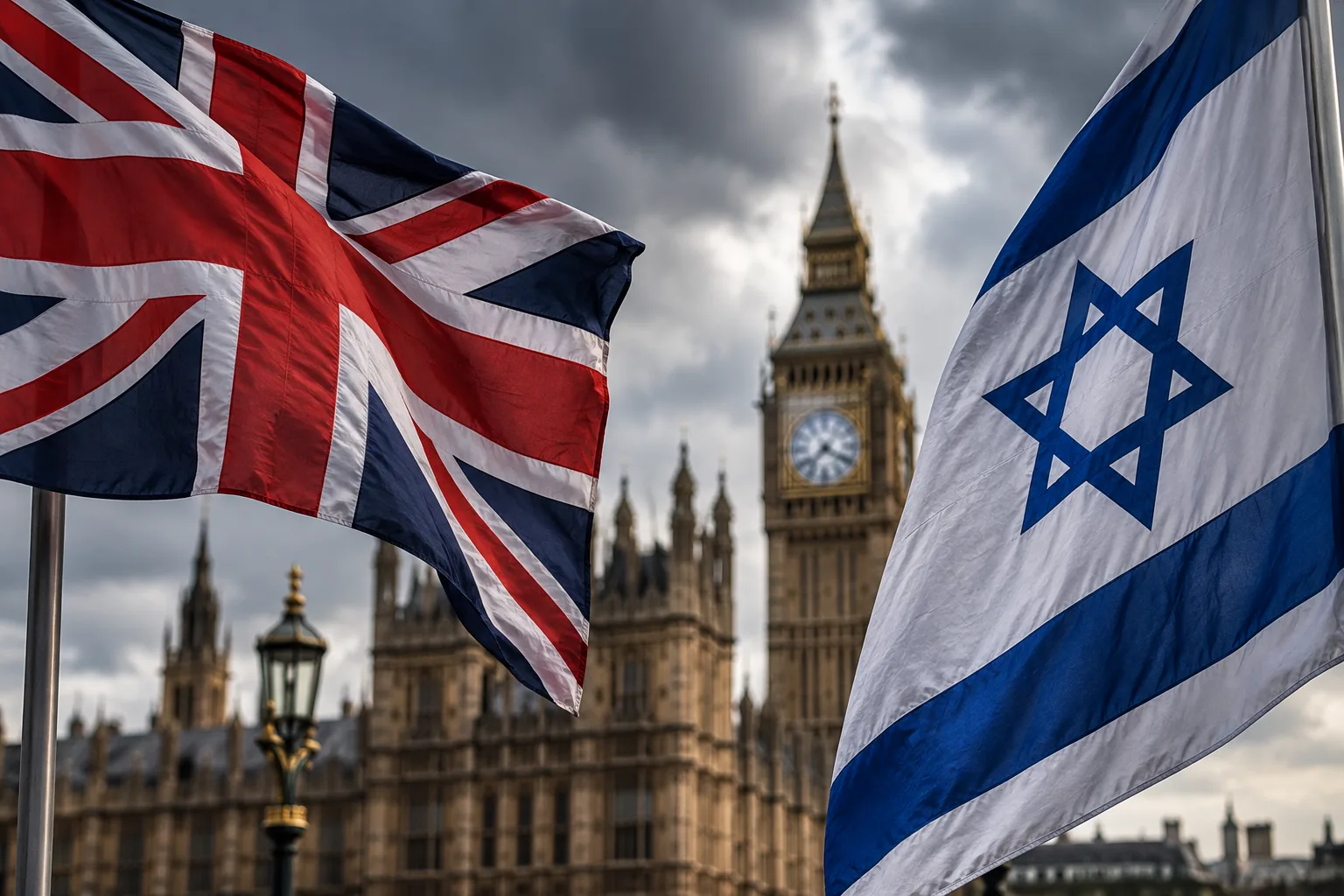
The Government says the measures defend a two-state solution, while critics warn an economically limited sanction could carry much wider diplomatic and strategic costs.
Labour is moving to sanction businesses linked to Israeli settlements in the occupied West Bank after Israel opened a fresh tender for construction in the E1 corridor, a long-contested area east of Jerusalem that Britain says would threaten the viability of a future Palestinian state. The Government condemned the tender on 19 August and Ed Miliband said a wider package of measures would follow “in the coming weeks”. On Monday, The Telegraph reported that those measures were being brought forward.
Labour says it is acting because Israel has opened bids for 1,234 housing units in E1, part of a wider 3,401-home scheme between East Jerusalem and Ma’ale Adumim. Britain argues the project would split the West Bank, isolate East Jerusalem and make a future Palestinian state markedly harder to sustain, a view also reflected in reporting by the BBC, Human Rights Watch and the International Court of Justice position cited by rights groups and the British Government. Israel rejects that legal and political characterisation. Its ministers argue that Jewish communities in the area are bound up with Israel’s historic claim to the land, and Gideon Sa’ar said it was “absurd” for Britain to lecture the Jewish people about where they may live in their “historic tiny homeland”, according to CNN’s reporting on the E1 dispute. Pezzulli disputes Labour’s territorial premise as well, arguing that Britain is treating a disputed final-status issue as though its outcome had already been settled.
The case against E1 is well established in Britain’s stated position and international criticism. So is the question of what Britain’s response is likely to achieve, and what it may cost.
The direct commercial target appears limited. The Associated Press, via PBS, reported that the settlements produce only a small amount of largely agricultural exports. That sits in sharp contrast to the wider UK-Israel relationship. Official parliamentary figures, citing Department for Business and Trade data, put total UK-Israel trade in goods and services at £6.2 billion in the four quarters to the end of Q2 2025, with the UK running a £1.0 billion trade surplus. Israel accounted for 0.3 per cent of total UK trade in that period.
Bepi Pezzulli Esq, Advisory Board & International Ambassador at the Great British PAC, said:
“The commercial significance of the measures is small. Their political significance is anything but.”
That is the core of the row. In theory, sanctions aimed at settlement-linked businesses are narrower than sanctions on Israel as a whole. In practice, that line may prove hard to hold. Labour Friends of Israel warned on Monday that such a trade ban could become a “de facto boycott” because of intertwined finance and supply chains. The Telegraph reported similar concern from MPs and business figures, while sanctions specialists told the paper that banks may decide the compliance risk is too high and pull back more broadly. Pezzulli’s argument is that the commercial distinction Labour is trying to draw may be much harder to maintain in practice because companies, banks and supply chains do not divide neatly along the territorial line set out in the sanctions. That does not mean a full boycott is inevitable. It does mean ministers are entering a grey zone where businesses, banks and investors may respond more cautiously than Whitehall intends.
The practical question is what the policy can do on its own. The sanctions do not in themselves determine Israel’s borders, dismantle settlements or create a Palestinian state. Labour presents them instead as political and diplomatic pressure intended to defend the two-state solution. The dispute is over whether that pressure is worth the likely spillover into a much wider relationship.
Miliband’s case also reaches beyond geography. AP reported that he accused “settler terrorists” of carrying out “ethnic cleansing” and said Netanyahu’s government was enabling it. Pezzulli challenges the way that argument is used in support of state-level sanctions, arguing that criminal violence by individuals and state responsibility are not automatically the same thing. That is a political and legal objection rather than a denial of the crimes themselves.
That relationship extends well beyond settlement goods. Britain has long treated Israel as a serious partner in intelligence, security, trade, technology and regional diplomacy, as the House of Lords Library noted in its review of UK-Israel relations. The consequences of a rupture are therefore measured not only in imports and exports, but in access, influence and trust.
That is where the sanctions begin to look larger than the trade involved. AP reported that Sa’ar said Israel would expel UK representatives from a joint military centre monitoring the Gaza ceasefire and end UK training of the Palestinian Authority’s security forces in the West Bank. The Telegraph’s live coverage also reported that Israel would close Britain’s consulate in East Jerusalem and bar 11 MPs, and Reuters reported on Wednesday that British diplomats there had been told they would lose their status within 30 days. Those steps matter because they narrow the channels through which Britain can press its case with Israeli decision-makers, work with Palestinian institutions and stay involved in the diplomatic machinery around Gaza.
Pezzulli said:
“A sanctions package designed principally to make a political statement has therefore achieved the remarkable feat of reducing Britain’s ability to influence Israelis and Palestinians alike.”
That argument becomes sharper when set beside the American position. Reuters reported that the United States said it would “obviously” not be adopting the same policy. If Britain is frozen out of parts of the Israeli and Gaza policy machinery while Washington declines to follow London’s lead, the risk is not simply that Israel is angry. It is that Britain ends up less useful to the very diplomacy it says it wants to shape. Pezzulli’s view is that the dispute now reaches beyond bilateral irritation and into Britain’s usefulness with allies, including in Washington.
Pezzulli’s judgment on that point is blunt:
“Britain has not strengthened the Palestinians by doing this. It has made itself less relevant to their future.”
Israel’s response has also carried a more openly political edge. Sa’ar called Labour “hostile” and announced counter-measures, according to The Telegraph’s live coverage on Monday. Other Israeli ministers went further. Itamar Ben-Gvir publicly called for Israel to recognise the Falklands as Argentine territory, while Bezalel Smotrich demanded the expulsion of the British ambassador.
Ben-Gvir’s intervention is politically significant because he is a serving cabinet minister, but it does not in itself amount to a formal change in Israeli policy. Middle East Eye reported that he called on Benjamin Netanyahu to recognise Argentine sovereignty over the islands and impose sanctions on Britain, while Al Jazeera noted that Gideon Sa’ar had already invoked the Falklands during a UN Security Council debate while defending Israel’s position on settlements. But that is not the same thing as official recognition, and no formal change in Israel’s position had been publicly announced at the time of writing. The wider backdrop is also unusual. Argentina has moved to file criminal charges against Navitas Petroleum over the Sea Lion project, while the company says it is operating under valid Falklands licences. Pezzulli points to Ben-Gvir’s call as an example of how the dispute is already spilling into areas of British foreign policy far removed from the original sanctions package.
The politics in Britain matter too, even if motive is harder to prove than consequence. In July, the BBC reported that Burnham apologised for Labour’s initial response to Gaza, saying the party “didn’t get it right”. The Guardian reported that he also promised more pressure on Israel, including further sanctions and a potential ban on trade in goods from settlements, in a move aimed at concerns among voters on Labour’s progressive flank. That does not establish that the current policy was dictated by electoral pressure. It does show that Labour’s approach to Israel and Gaza now sits inside a charged domestic political argument, not outside it. Pezzulli also questions the timing of the latest move, with the sanctions landing weeks before Israelis are due to vote on 27 October, arguing that the Government risks appearing to insert itself into a politically charged election period.
There is another reason ministers should tread carefully. Britain’s Jewish community is living through a period of acute insecurity. The Community Security Trust recorded 1,926 antisemitic incidents in the first half of 2026, up 21 per cent on the same period last year and the second-highest first-half total CST has ever recorded. Phil Rosenberg, president of the Board of Deputies, said on Monday that the last thing needed was for tensions to be inflamed further, according to The Telegraph’s account of his comments to Sky News. That is not the same thing as saying criticism of settlements is antisemitic, or that sanctions will automatically drive hostility at home. It is part of the context in which this decision is being made.
Pezzulli’s view is that the political and strategic balance has gone badly wrong.
“Labour wanted a gesture. It got a diplomatic rupture.”
Claire Bullivant, CEO of the Great British PAC, said:
“Britain can oppose the expansion of settlements in the West Bank, and support a viable two-state solution, without allowing our relationship with one of our most important security partners in the Middle East to descend into a diplomatic war.
The question Labour must answer is not simply whether it wanted to send a message over the E1 development, but whether it properly considered the consequences of the measures it has chosen. Israel is an important intelligence and security partner, and that cooperation has helped protect British interests and British lives.
With Israel already retaliating against Britain, ministers now have a responsibility to demonstrate that this policy is measured, targeted and in the British national interest, rather than another piece of gesture politics designed to satisfy parts of the Labour Party.
Foreign policy requires judgement. Britain should be able to stand firmly against settlement expansion while maintaining the relationships, intelligence cooperation and diplomatic influence that actually give us a chance of helping to secure peace.”
None of that means Britain should stay silent about settlements. It does mean ministers should be honest about the trade-off. Labour says this is targeted action in defence of a two-state solution. That may be the intention. But if a sanction aimed at a small slice of trade leads to wider financial caution, diplomatic retaliation and reduced British access in Jerusalem, Gaza and Washington, then the question is no longer whether the Government has made a statement. It is whether the statement was worth the strategic cost.
Once you start pulling at the thread, you had better know how much of the fabric comes away in your hand.