
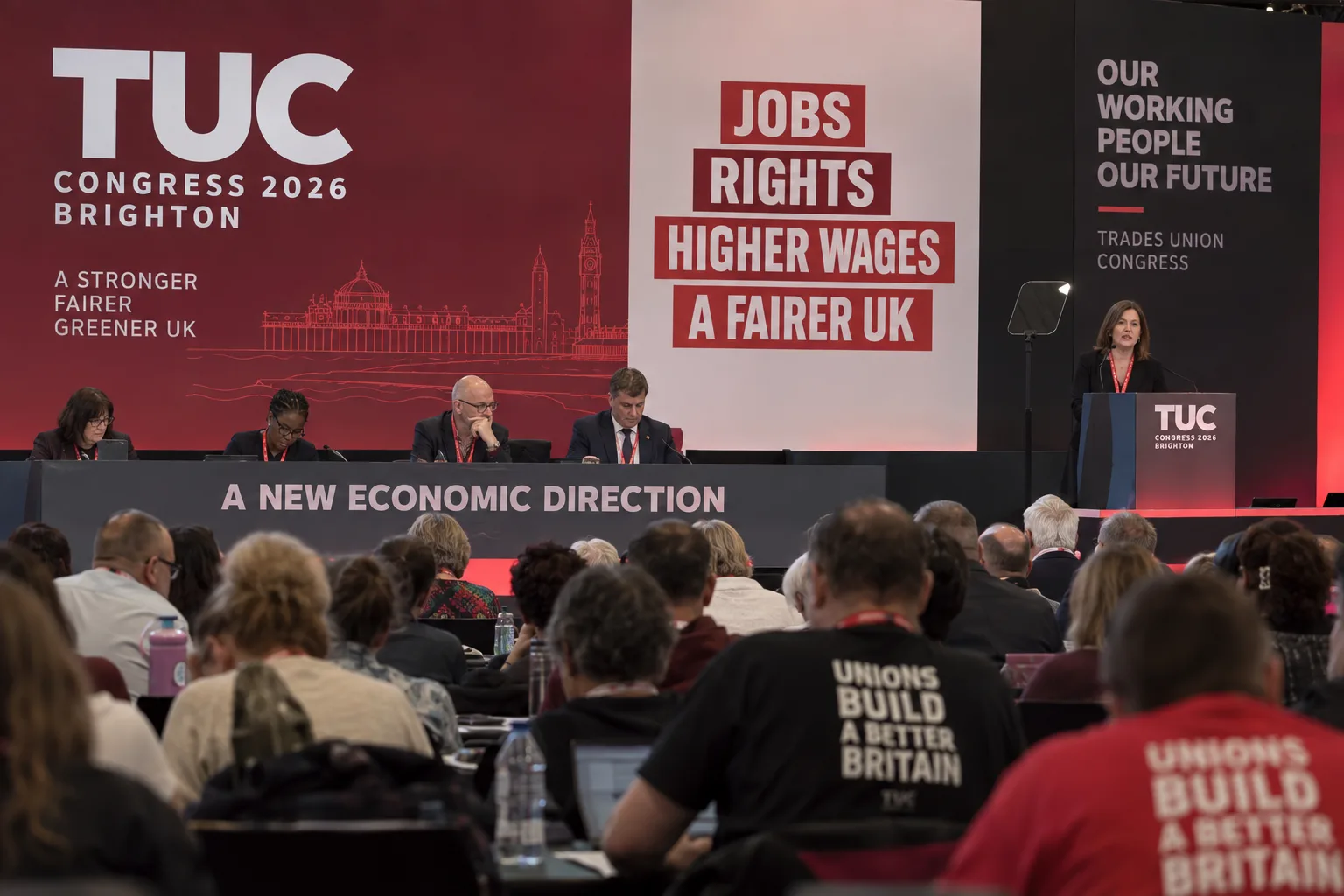
Labour’s trade union allies have delivered an awkward warning for those pushing for closer alignment with the European Union, with a debate at the Trades Union Congress calling for a more interventionist domestic economic programme while resisting a return to the old arguments over EU and Single Market membership.
The official TUC Congress programme of business shows that composite motion C17, “A new economic direction for the UK: Labour’s political and economic strategy and action to tackle the cost of living”, was debated on Monday afternoon in Brighton. The official C17 page says it was composed from motion 23, an amendment, and motions 25, 26 and 27. The published motion 23 page shows that the motion was submitted by Unison and seconded by the RMT, and called for higher wages, stronger public investment, insourcing, and wider public ownership.
The more politically sensitive Brexit language also appears in the official C17 text, which says the new strategy must “avoid taking the country into divisive debates around both nationalism and EU/single market membership” and calls for improving trade “with the EU and the world economy” while “respecting the result of the 2016 referendum on EU membership.” Supporters say the composite was carried. At the time of writing, the official C17 text was public on the TUC motions site, but the final official result was not yet visible there, so the reported outcome remains attributed rather than independently confirmed from the Congress record.
That makes this a narrower and more interesting development than any crude claim that the trade union movement has suddenly turned pro-Brexit. It has not. The point is that parts of Labour’s own industrial base are now making an argument about economic freedom, public ownership and domestic policy room that would once have been associated much more readily with Brexit supporters.
The historical contrast is real. In 2018, the TUC said openly that it had backed the Single Market for 30 years, and argued that membership protected workers’ rights and did not prevent a Labour government from pursuing renationalisation or industrial intervention. Eight years later, one of the arguments now being advanced within Congress is that returning to the Single Market could itself constrain parts of the programme some unions want a Labour government to pursue.
Rail is the clearest example. The official RMT motion 25 argued that single market membership would reverse the UK’s progress to rail public ownership, and in its reporting on the Congress debate, the Morning Star said the RMT’s position is that re-entering the Single Market would reverse progress towards rail renationalisation and narrow the choices available to government on public ownership and industrial policy. Whether that legal and political reading is accepted across the whole movement is a separate question. What matters here is that the argument is now being made, from the Left, in support of retaining British control over economic policy.
The political irony is difficult to miss. Economic sovereignty was one of the central arguments made by Brexit supporters. Parts of the union movement are now invoking a similar principle from the Left, arguing that Britain should retain the freedom to pursue public ownership, procurement choices and industrial policies that they support.
Steve Wright, Campaign Lead for Brexit at Great British PAC, said:
"The left of UK politics is the traditional home of Euroscepticism, and those roots go deep. Whether a future UK government wishes to drive an agenda further to the left or the right in the years to come, that wish is only possible through independence from the EU"
This Congress argument also sits inside a much wider economic debate. TUC Congress is running in Brighton from 13 to 16 September, with Andy Burnham only a few months into Downing Street. In a BBC interview ahead of Congress, TUC general secretary Paul Nowak urged Burnham to use the autumn Budget to show that government is “back in the service of the British people”, including extra help with energy bills through a social tariff funded by reversing the cut to the bank surcharge. The TUC estimate, reported by the BBC, is that this would raise £9 billion over four years. That is why this story matters beyond Brexit alone. The Congress debate is about a broader post-Brexit economic programme built around wages, public investment, public ownership, insourcing and action on living costs. Do not rerun the sermon. Fix the bills.
The wider political backdrop is shifting quickly too. The BBC reported that Reform UK received a second £36 million donation in as many days when Christopher Harborne matched the £36 million given by Ben Delo, taking the combined total to £72 million. The BBC said the two donations marked the largest sums received by a UK political party since donations began being declared in 2001. In the same Congress week, Motion 68, “Cleaner politics”, listed separately for debate on Tuesday in the TUC programme, refers to rising large political donations, including record-breaking contributions to parties such as Reform. Together, these debates illustrate the unusually fluid political backdrop against which Labour and the unions are debating their next economic direction.
Claire Bullivant, CEO of Great British PAC, said:
“When even Labour’s trade union paymasters are effectively telling the Government that reopening the argument over Brexit and the Single Market is the wrong road for Britain, the debate really has moved on.
This is a remarkable acknowledgement of something Brexit supporters have argued for years, that leaving the EU was not simply about trade, it was about restoring the democratic freedom to decide how Britain governs its economy, supports its industries and runs its public services.
The unions themselves are now warning that Single Market membership could restrict precisely the sort of economic freedoms they want Britain to exercise, including over public ownership of the railways. They are also explicitly calling for the democratic decision of 17.4 million people in 2016 to be respected.
If even some of Labour’s most powerful union allies can recognise that going backwards towards the Single Market is not the answer, there can be absolutely no justification for politicians attempting to take Britain back into Brussels’ orbit by stealth.
Brexit is settled. The task now is not to reverse it, dilute it or apologise for it, but to use the freedoms it gave us. Britain should be making its own laws, controlling its own economic policy and pursuing trading relationships with Europe and the wider world as a sovereign nation.”
The important point is not that unions want Labour to be bolder. They usually do. The sharper point is that some of Labour’s own industrial base is now warning against sliding back into a Single Market debate just as ministers are being pressed to go further on wages, ownership and the cost of living.
That does not amount to a settled new doctrine for the whole trade union movement, and the final published wording of C17 still matters. But politically, the source of the warning is what gives it weight. This is not an argument coming from Labour’s opponents. It is coming from within parts of the movement on which Labour has traditionally relied most heavily, and it is being made in the language of economic intervention rather than free-market Brexit. That is why ministers, and Labour’s pro-European wing, will find it difficult to ignore.