
Oxfordshire villagers vote overwhelmingly to “secede” from Britain as anger grows over proposed accommodation at former MoD Bicester site
Residents of the Oxfordshire village of Piddington have voted overwhelmingly to “secede from the United Kingdom and pursue self-determination” in a symbolic referendum held in protest against plans to house up to 1,256 male asylum seekers at a former military site nearby.
The result was announced shortly after 7am on Wednesday. Of the 312 ballots cast, 285 were in favour, 26 against and one ballot was spoiled, with turnout reported at nearly 92 per cent.
The referendum has no legal or constitutional force. It was organised as a protest against the proposed use of the former MoD Bicester site, rather than as a legally binding act of secession.
The Home Office planning application seeks full planning permission for the temporary change of use of the former defence storage and distribution centre. The application was validated on 2 September and is currently in its representation period, which closes on 17 September. No final decision has been made.
The proposal is for non-detained asylum accommodation, including new modular buildings, health and welfare facilities, roads, security infrastructure and recreational areas for up to 1,256 service users.
The vote took place on 15 September, Battle of Britain Day, a coincidence that residents incorporated into the symbolism of their campaign.
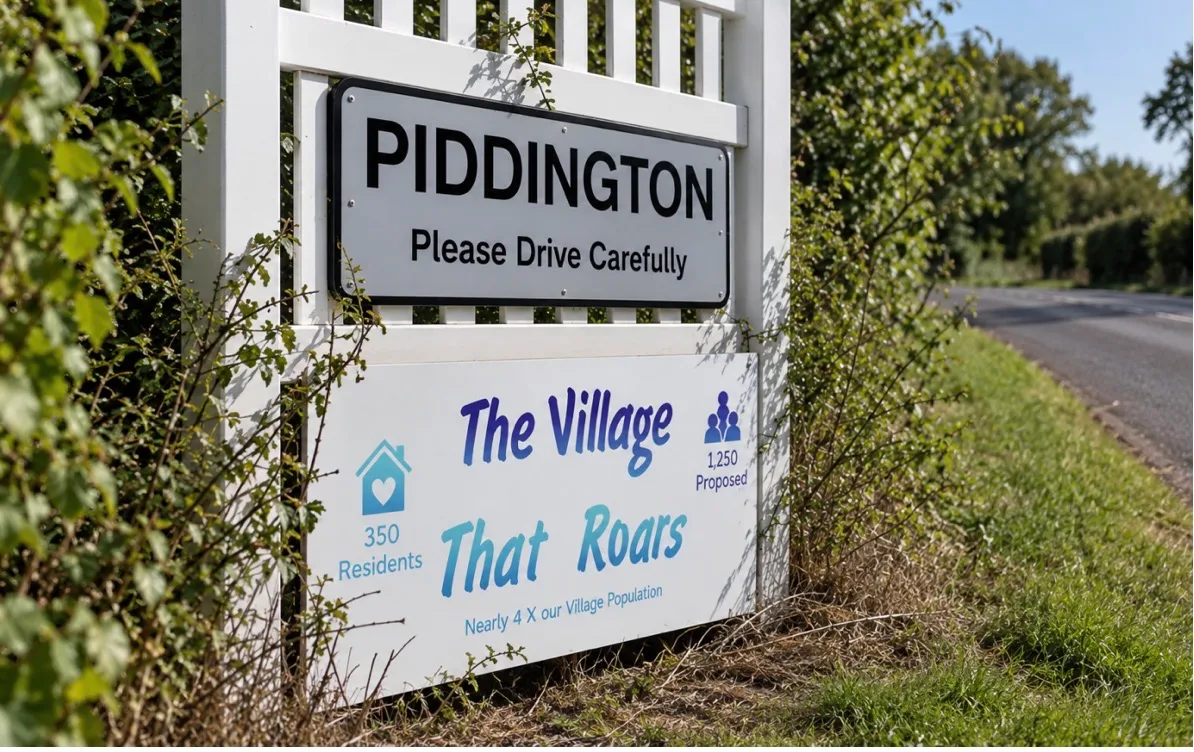
Piddington has about 350 residents. On polling day, a small black letterbox outside the village hall was used as a makeshift ballot box. Bunting at the entrance featured Union flags, poppies and RAF imagery, while a pennant read “Battle for Britain 2026”.
The hall is more commonly used for coffee mornings, dances and other village events than political votes. More than 50 residents gathered there later that evening for a campaign meeting after the polls closed.
Tim McNally, chairman of Piddington Parish Council, described the vote as a “battle for Britain” and an example of “democracy in operation”.
“It is a message to the Government that you are going to have to change. You are going to have to grow into our way of thinking,” he said.
Later that evening, Mr McNally told residents: “The politics of our country are broken on so many levels. And we're sending our message back to Westminster.”
Mr McNally acknowledged that the referendum had no legal standing. He said the village would nevertheless now be known as the “principality of Piddington”, with residents planning to put up a sign to mark the decision.
He also said the campaign could lead to similar votes elsewhere. Mr McNally claimed that around 500 councillors and residents from other towns and villages had contacted the parish seeking advice on how to organise their own campaigns. The Telegraph reported his claim that the campaign had been backed by Conservatives, Reform and Liberal Democrat supporters.
Restore Britain leader and Great Yarmouth MP Rupert Lowe also arrived at the village hall during the evening and spoke to reporters outside. He described the vote as something that should be “lauded”, according to Press Association reporting.
Herbert Owen, 76, has lived in Piddington for 33 years. He voted with his wife, Jenny, and became emotional when speaking about his father’s military service.
“What did my father fight for?” he asked.
Mr Owen said his father joined the Army at 17, became a prisoner of war and later served in Korea.
After casting his vote, he said: “It means everything our grandparents, our parents fought for. This isn’t just about Piddington, this is about our whole country,” he said. His comments were reported from the village by the BBC.
The proposed site lies between Piddington and Upper Arncott. Home Office planning material describes pedestrian access as “limited” and says that travelling on foot is “not recommended”.
Mike Nixon, a Piddington parish councillor, said the nearest footpath was about a mile and a quarter away, along a busy and unlit road. Minibuses are expected to transport asylum seekers to nearby towns, including Bicester.
The planning and travel documents refer to the use of shuttle buses and public transport for journeys to nearby towns and villages. They also refer to high-visibility clothing for people who travel on foot.
The Home Office says the accommodation would be designed to be as self-contained as possible, with essential facilities available on site. Its planning documents say the need to travel would therefore be significantly reduced.
The Government has also said it is engaging with local authorities and police forces to reduce the impact on surrounding communities and address safety and security concerns. Home Office planning material says the proposed accommodation would include facilities intended to limit the need for residents to travel.
The proposed site forms part of a wider Government policy to reduce reliance on asylum hotels and move people into larger, managed accommodation, including former military sites. The Home Office’s military-site factsheets state that no final decision will be taken on new sites, or changes to existing sites, until the necessary assessments, planning permissions and approvals have been completed and properly considered.
The Government says planning permission is currently being sought for MOD Bicester and MOD Barnham in Suffolk, while discussions are under way over MOD Linton-on-Ouse in North Yorkshire. Those three proposed sites could eventually provide accommodation for around 3,750 asylum seekers, according to the Government’s account of the policy.
Existing military-site accommodation is operating at RAF Wethersfield in Essex and Crowborough Training Camp in East Sussex. The Government is seeking to extend the use of both sites, with Crowborough proposed to continue until 2030 and Wethersfield beyond 2027.
Piddington has faced a similar proposal before. Plans for an asylum accommodation centre at Bicester were abandoned by the then Labour Government in 2005. The National Audit Office said the project was cancelled in June that year because it was “no longer economically viable”.
The earlier proposal was discussed in Parliament, including concerns about the scale and suitability of the proposed centre. Hansard records from 2005 refer to a petition relating to the Bicester accommodation centre and the Piddington parish councils affected by the proposal.
The plans have prompted substantial opposition in Piddington, reflected in the referendum result and in a campaign led by local residents.
Around 133 women from the village wrote to every female MP last week to share their concerns.
“Life as we know it will be destroyed,” they wrote.
“We will not feel safe walking our streets. We are already living in fear.”
Victoria Hubbocks, 39, a mother of three and one of the women involved in the letter, said the proposed site would fundamentally change village life.
“The asylum site is going to fundamentally change how we live our lives,” she said. “The community will completely change. And we've had no say in the matter.”
She also said residents had received no reassurance from the Government about the scale of the proposal.
Susannah Parden, who volunteered to act as the returning officer for the referendum, said: “This isn't about politics but we're frightened.”
She also questioned whether the former MoD site was suitable for the proposed use.
Residents have discussed installing wireless CCTV cameras, an emergency alert system and security patrols in response to those concerns. Some women have also said they intend to take self-defence classes.
Those concerns have been disputed by other residents. One woman, identified by GB News as Rachel, said she believed some opposition to the plans had crossed into racism. She said she had faced hostility after criticising the campaign and arguing that it risked “othering” people.
Another resident, Alice West, told The Telegraph that her concern was about the number and sex of the proposed residents rather than their nationality.
“If you added 1,256 males of any demographic to the end of our village, the risk to women would rise, simply because of the arithmetic,” she said. Her comments were reported by GB News and The Telegraph.
Speaking before the result, Culture Secretary Lisa Nandy said the Government had heard the village’s message.
“I think they have, and we’ve heard it. We’re listening, and I do really understand that when changes are made that affect your community, it can be very distressing,” she said.
Ms Nandy argued that poorer communities had already carried much of the burden of asylum accommodation in hotels and houses in multiple occupation. She said using former military bases could distribute accommodation more fairly across the country. Her comments were reported by The Telegraph.
Her argument echoed comments by Prime Minister Andy Burnham, who has said that wealthier parts of Britain should house more asylum seekers. In an interview reported by the BBC, Mr Burnham said it could not be the case that only the poorest communities received asylum seekers through the dispersal system.
Claire Bullivant, CEO of Great British PAC, said:
"Piddington has shown what real democracy looks like, and it's an embarrassment to this Labour Government that it took a 350-person village to remind them. 285 votes to 26, on a 92 per cent turnout: that's not a protest, that's a verdict. Labour ministers can talk all they like about 'sharing the burden fairly,' but what they actually mean is dumping life-changing decisions on communities without ever asking them first. Piddington said no. And if the enquiries flooding into their parish council are anything to go by, they won't be the last village to say it. The Great British PAC stands with every resident who stood up this week, and we'll be standing with the next village, and the one after that, for as long as this Government keeps ignoring the people it's supposed to serve."
Ben Habib, Chairman of Great British PAC, went further in his criticism of the proposed site:
"Piddington will be overrun by illegal migrants. It will be the ruination of a quintessential English village. Their referendum was a cry for help. They have nowhere to go. Of course, the illegal migrants do. They have homes they left to enter England illegally. They should not be in Piddington. They are not welcome. They should go home."
Piddington’s declaration of independence has no legal force. But 285 votes for secession in a village protest over asylum accommodation are politically harder to dismiss.