
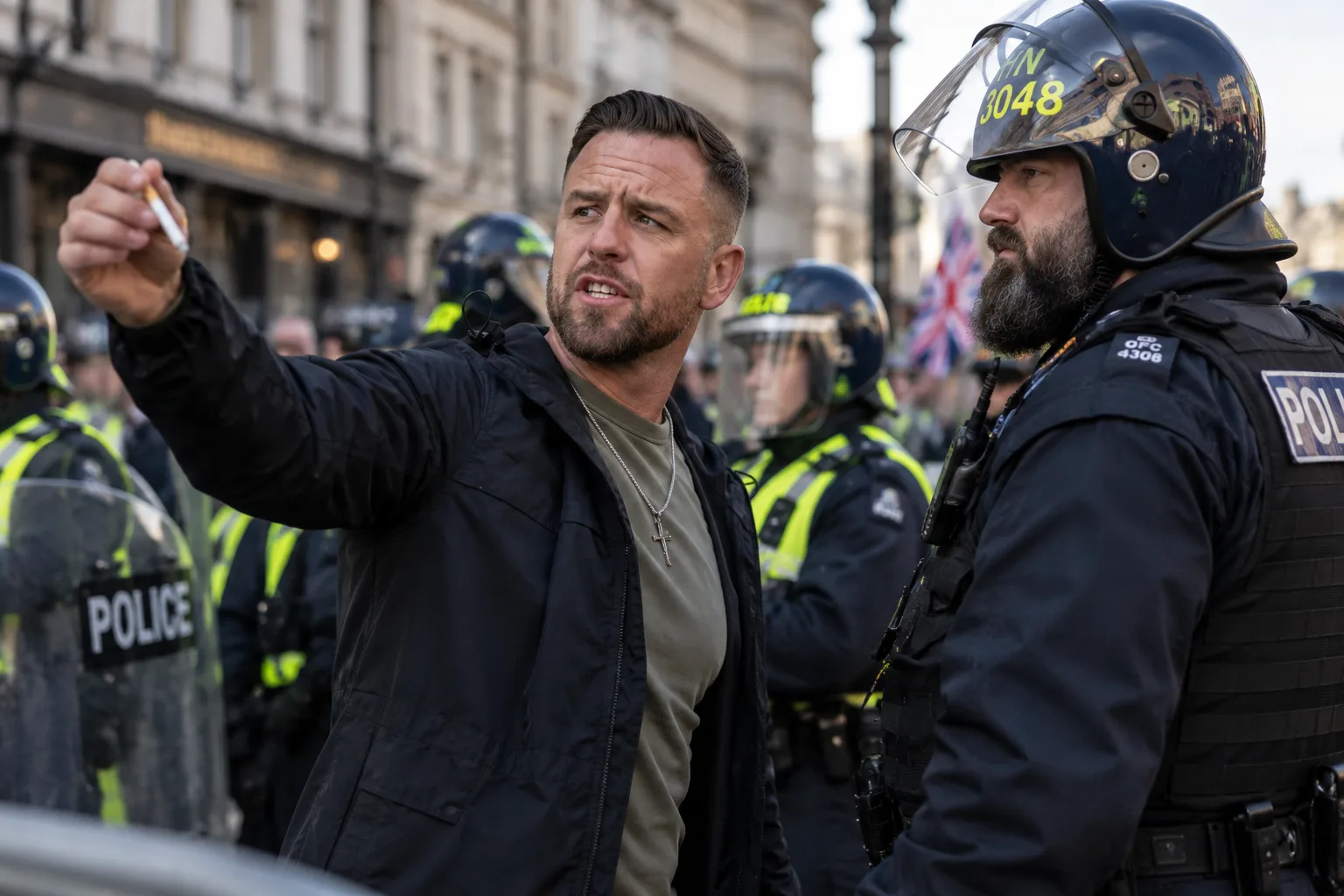
Demonstrators in the city followed the coaches carrying the arrivals to Dover in the early hours of Monday, and police stopped and checked one car travelling behind the convoy before releasing the driver.
Protesters followed the coaches carrying the arrivals from Portsmouth to Dover in the early hours of Monday, after a weekend in which an unusually large inflatable boat, reported to be carrying an estimated 140 people, was brought ashore in the city.
Kent Police stopped one car travelling behind the convoy on the M20 near Folkestone, around 10 miles from Dover, spoke to the occupants and checked the vehicle. No criminal offences were identified, and the driver was allowed to continue.
The force said it was notified of a suspicious car on the eastbound carriageway at 6.19am on Monday. A roads policing unit stopped the vehicle at the Stop 24 service station. "No criminal offences were identified and the driver continued his journey," a spokesman said.
Footage posted on X by the account Andy Public UK, which regularly shares content critical of illegal migration, shows a car on the motorway behind a line of white vans and coaches, captioned: "In pursuit of migrant coaches from Portsmouth NOW!! We are heading towards DOVER." The account later posted pictures and video of the coaches parked behind barriers at Dover cruise terminal, where those on board were said to be processed.
The arrival
The crossing that set the weekend in motion was one of the largest of its kind, and was reported to be the first small boat arrival brought ashore in Portsmouth. The vessel, described in reports of the crossing as a mega-dinghy, was intercepted in the Solent, between the Isle of Wight and Portsmouth, on Sunday, and its occupants were brought ashore in two Royal National Lifeboat Institution boats after being rescued south of the Isle of Wight.
French authorities estimated that as many as 140 people were on board, 90 short of the record 230 believed to have crossed on a similar boat last month. The craft was launched from a base east of Cherbourg, part of a change in tactics by the smuggling networks, which have moved to larger boats and begun setting off further west to avoid French patrols. The crossing is believed to have taken the longest route across the Channel yet used by the people-smugglers.
The demonstration that followed came a day after a similar protest blocked the Port of Dover on Saturday, as crowds of people dressed in black also gathered there.
The protests at Eastney
At Eastney, where the arrivals were expected, demonstrators blocked the only access road to the marina. Around 500 people, thought to be supporters of Daniel Thomas, an activist against small boat arrivals and associate of Tommy Robinson, gathered in the area, some dressed all in black.
Footage posted from the scene by GB News was captioned: "The British people have had enough. The fact you're questioning peaceful protest is absurd."
Police formed lines with riot shields and used pepper spray. Part of the crowd pushed through the line, and some of those present made their way into the marina compound. Footage from the evening shows protesters wading into the water and one man being lifted off the ground after lying down behind a police van.
Police later issued a dispersal order for the area, granting officers the power to arrest anyone who refused to leave, and Thomas told his supporters to go home.
During the evening, Thomas, who livestreamed the demonstration and runs the Patriot Platform group set up in protest at small boat arrivals, stood in the sea at Eastney shingle beach with a small group of others as officers looked on. "Roads are all blocked. They are never going to be able to leave here," he said. "If you put them back on boats and take them back to France, we will get out of the water."
He told officers it was "no longer an option to tell us that the boat numbers are down", and demanded a personal conversation with the Home Secretary. "If that can't happen, then we are not leaving and we won't leave," he said. "I want her to understand if one more boat arrives in the UK this whole country is going to erupt. We don't want that."
Not everything about the night was confrontation. One local grandmother, named online as Joy, paddled out to the men in the water with battery packs and bottles of water. Barry John-Williams, 69, deflated his own dinghy rather than sell it to protesters he described as "idiots".
The stated grievance behind the demonstration was the scale and repetition of small boat crossings, and an operation bringing arrivals to a city with no experience of it. The concern was not confined to those who gathered at Eastney. Portsmouth City Council says it was never consulted about the decision to land the boats in the city, and the police and crime commissioner for the area says the wider south coast is not equipped for landings of this kind.
Government and local reaction
The Government condemned the behaviour of the crowds as "intimidating and thuggish". "The right to peaceful protest is fundamental to our democracy, but it must never cross a line into disorder," a spokesman said, thanking the emergency services.
Emma Reynolds, the Chief Secretary to the Treasury, told LBC on Monday that she supported the right to peaceful protest but that the scenes "cross a line", while saying the public had "legitimate concerns about immigration", that net migration was down and that boat crossings were at a seven-year low.
The Home Office says more than 48,000 crossing attempts have been prevented and 1,100 boats and engines seized since the election, that the number of small boat crossings is down this year with the lowest July since 2020, and that a payment-by-results deal with France will put 40 per cent more officers on French beaches.
But the weekend also highlighted a different challenge. The boats that still get through are becoming larger, while Sunday's crossing followed a route considerably further west.
Steve Pitt, the leader of Portsmouth City Council, said the council had not been asked about the decision to land the boats in Portsmouth, a decision he said was taken entirely by UK Border Force, the Maritime and Coastguard Agency and the Home Office. He called the site "a completely unsuitable location", said the disruption was avoidable, and accused the Home Office of "lack of planning, inconsistent decision-making and ultimately, poor judgement". "They put people at risk. This cannot happen again," he said.
Donna Jones, the Hampshire and Isle of Wight police and crime commissioner, said officers had been sent from across the country, including the Met, to police the protest, and told the BBC's Today programme that Portsmouth was "not set up for it". The Government had "invested heavily into Dover", she said; if Dover was no longer the smuggling destination of choice, a spread of landings across hundreds of miles of southern coastline would become "a significant issue". "My concern now, as a police and crime commissioner, is that we don't have this repeated," she said.
Joe Robertson, the Conservative MP for the Isle of Wight East, called the crossing "extremely concerning" and said he would ask the Home Office whether new routes were being used by the smugglers.
Nigel Farage, the Reform UK leader, said Labour and the Tories had "facilitated an invasion of our country" and argued that "the only solution is the ballot box". George Madgwick, the leader of Reform UK in Hampshire, who attended Sunday's demonstration, said it was "the first time Portsmouth's been invaded since the Tudor era" and called the city "a proud naval city" that would not accept boats being delivered there by Border Force.
A separate case in the background
The protest also took place against a local case that had circulated widely online in the days before the landing. Footage posted from the scene noted that the arrival had come days after an Iraqi national was charged with rape of a 14-year-old boy.
The case exists, but the details matter. Sadiq Farhad Azad, 33, an Iraqi national of no fixed address, has been charged with the rape of a 14-year-old boy in Portsmouth in August, along with stalking a woman in her twenties and criminal damage, the BBC reported. He was remanded in custody and was due to appear at Portsmouth Crown Court on Monday. The allegations have not been tested in court, and there is no suggestion in any of the reporting of a connection between Mr Azad and the people brought ashore this weekend, nor can the charge be read as a comment on migrants or asylum seekers as a group. The case was nonetheless part of the atmosphere in which the weekend's anger built, and was cited by those at the demonstration.
Great British PAC response
“This should be a watershed moment. When a dangerously overcrowded boat carrying around 140 people can take an extraordinary new route across the Channel and end up off Portsmouth, we are no longer talking about a problem confined to Dover. The people-smuggling gangs are adapting, changing their routes and testing the limits of Britain’s border security.
“What happened in Portsmouth should concern every coastal community in the country. The British public has every right to demand secure borders, competent government and straight answers about who is entering this country and how our authorities intend to respond as the smugglers change tactics.
“Peaceful protest is a fundamental British liberty, but violence and criminal damage are not. The anger and frustration behind this issue cannot simply be dismissed, however. Ministers need to understand why public confidence has been so badly eroded and address the cause, rather than continually reacting to the consequences.
“A sovereign country must be capable of controlling its own borders. Britain cannot allow criminal gangs to dictate where the next route opens, which community is affected next, or how our border is managed. The Government must get ahead of the smugglers, restore control and give the British public confidence that our borders actually mean something.” - Claire Bullivant, CEO Great British PAC.
The smuggling networks have already adjusted, launching larger boats further west than Dover. The concern voiced in Portsmouth this weekend, by the city's own leaders as much as the crowds, is that the response has not adjusted with them. For ministers, the immediate question is whether other south coast communities are prepared if the routes continue to shift.