
How a network of charities, foundations and government grants quietly rewrote Britain's migration settlement, and the question nobody in Westminster wants to answer
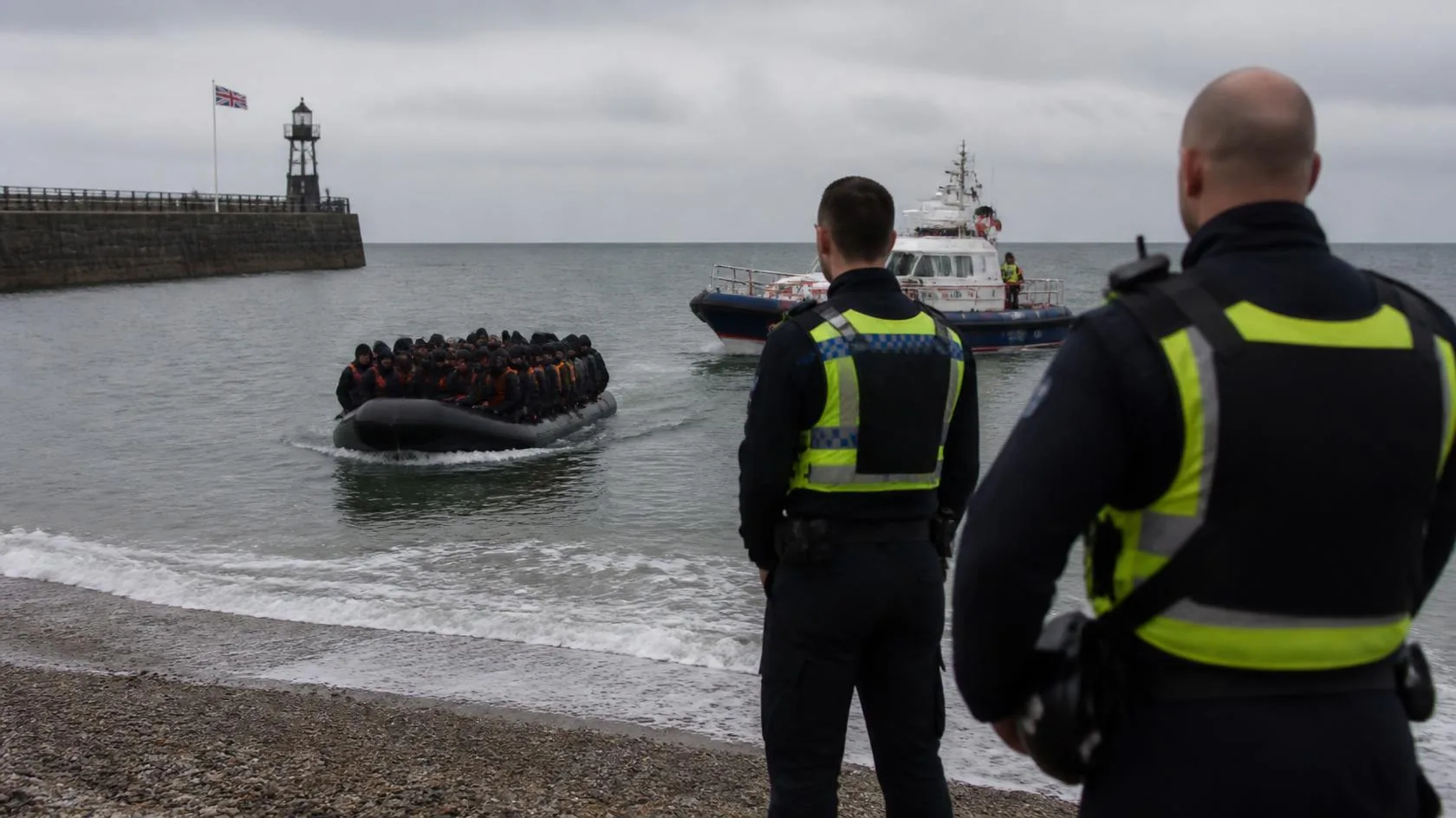
There is a particular kind of silence in British public life. It is the silence that falls whenever the conversation turns to who, in practice, actually runs the country's migration policy. Ministers speak, of course. Home Secretaries make speeches. Prime Ministers promise crackdowns, deterrence deals, offshore processing, tougher removals and safer routes, in almost identical language, parliament after parliament, election after election. And yet the boats keep arriving, the hotels keep filling, the courts keep ruling and the backlog keeps growing.
That contradiction, between the noise of politicians and the reality on the beaches at Dover, is not accidental. It is the product of a system, quietly assembled over more than a decade, whose scale and coordination is only now becoming visible. Call it, for want of a better term, the open-border industrial complex. It is not a conspiracy. It is something more troubling than that. It is an ecosystem, a settled institutional consensus, comprising charities, philanthropic foundations, legal advocacy groups, media-training networks, sanctuary schemes and, at the apex, the British state itself, which continues to underwrite the whole apparatus with taxpayers' money.
"The illegal migration crisis is part of a larger failure of European governments to protect the existence of their countries. Nation states stand in the way of globalism and governments across Europe are globalist. Burnham is a globalist. These people want borders gone. They want control centralised in Brussels. The Schengen zone is one of the most idiotic self harming creations in the history of Europe. So, it is no surprise there is a multitude of organisations, many created and sponsored by governments, supporting migration - both legal and illegal. Ancient European countries are being deliberately erased by the very people charged to protect them." - Ben Habib, Chairman Great British PAC
The shape of the machine
To understand the modern British migration debate, one must first understand that the state and the sector are no longer separate. They have merged. Public grants, philanthropic capital, charity structures, campaigning bodies and civil-service commissioning now form a single continuous surface, along which money, personnel, ideas and language travel in both directions.
At the highest level sit the grant-givers, the philanthropic foundations that provide the patient capital underwriting activism between political cycles. On the public grant database 360 Giving, the same names recur across the disclosures of one migration charity after another. The Barrow Cadbury Trust, a Quaker foundation with a long progressive record. The Joseph Rowntree Charitable Trust, another Quaker foundation. The Paul Hamlyn Foundation, which openly funds pro-migration advocacy. The Esmée Fairbairn Foundation. The Lloyds Bank Foundation. The Tudor Trust. Trust for London. The National Lottery Community Fund. Unbound Philanthropy, whose declared purpose includes advancing the rights of migrants.
Crucially, some of these ostensibly independent foundations have themselves received substantial taxpayer funding. The Paul Hamlyn Foundation received £1.4 million of public money between 2020 and 2023. The Barrow Cadbury Trust received £350,000 in 2024-25 alone. In plain terms, British taxpayers subsidise foundations that in turn subsidise the charities campaigning to loosen Britain's borders. The public is effectively paying for advocacy against its own recorded political preferences.
Below the grant-givers sit the operational giants of the sector. The British Refugee Council received £41,588,000 from taxpayers between 2021 and 2025, more than £8 million a year, every year, from the public purse. The Joint Council for the Welfare of Immigrants combines legal advice with sustained lobbying. Choose Love at least funds itself privately through celebrity endorsements. And City of Sanctuary UK occupies a category of its own.
Beneath the giants swarms a dense layer of small, hyper-local outfits, each modest on its own but collectively formidable. A single partners list published by Choose Love for its 2020 activities in the United Kingdom named more than twenty such bodies, among them the Injera Club, Magool Foundation, Meena Centre, Migrant Helpline, Ourmala, Project MAMA, RAPAR, Salusbury World, Say It Loud, Search and Rescue Relief, Streatham Drop In, Women for Refugee Women and Young Roots. One funder. One year. One country. Multiply that by the dozens of similarly positioned meta-funders across the sector, and the density of the network becomes clear.
The sanctuary racket
Of all the operational bodies, City of Sanctuary UK merits particular scrutiny, because its business model is essentially the institutional capture of public bodies. It approaches councils, universities, schools, hospitals and even theatres, and offers them an accreditation, "Place of Sanctuary", in exchange for commitments to prioritise asylum seekers and irregular migrants, whom the sector's linguistic protocols now insist on describing as "people seeking sanctuary".
Its funder list is, at this point, almost predictable. The Tudor Trust. The Paul Hamlyn Foundation. The Esmée Fairbairn Foundation. The Lloyds Bank Foundation. Unbound Philanthropy. By its own recent count, 34 local authorities have received "Local Authority of Sanctuary" designation, including 14 of London's 33 boroughs. The scheme functions in much the same way that the Stonewall Diversity Champions programme once did for public bodies on gender ideology, that is, as a moral badge chased for reputational reasons whose underlying policy destination is far more contested than the badge suggests. The endpoint of "sanctuary", when followed to its logical conclusion, is the removal of enforceable immigration control at the local level. Local authorities, funded by council tax and central grants, are signing themselves up to a private accreditation programme whose end state actively contradicts the elected government's stated policy. The Treasury has not intervened. The Charity Commission has not intervened.
The gatekeepers of opinion
No industrial complex functions without enforcement, and this one is no exception. A set of organisations exists principally to ensure that dissent from the pro-migration consensus carries a professional cost.
The most visible is Stop Funding Hate, which pressures advertisers to withdraw from outlets such as GB News and The Sun that cover small-boat arrivals with what the group regards as insufficient sympathy. Its strategy is straightforward, starve dissenting media of commercial oxygen.
More aggressive still is Hope Not Hate, operating both as a charitable trust and a limited company, which has become the sector's de facto research and dossier arm, producing briefings that regularly appear in mainstream media coverage of critics of the asylum system.
Then there is British Future, a charity that received £750,650 from British taxpayers between 2021 and 2024. Its own declared mission is to help "immigration and refugee advocates to unlock public support" and to "bring about a more positive and informed policy agenda and debate on immigration". Its funders, past and present, include the Paul Hamlyn Foundation and the Open Society Foundations network founded by George Soros. In other words, the British state has been paying, out of public revenues, an organisation whose explicit function is to manufacture public consent for migration levels that repeated polling shows the British public does not want.
The propaganda pipeline
Perhaps the most revealing corner of the machine is the one that produces its media-facing spokespeople. Anyone who watches BBC News, Channel 4 or Sky will be familiar with a rotating cast of "migration researchers" and "asylum experts" who materialise, on cue, whenever the subject arises. One prominent example is Zoe Gardner, routinely captioned as a migration expert and researcher. In practice she is a full-time activist and a graduate of the New Economy Organisers Network, better known as NEON.
NEON is not a research institute. It is a media school. Its Spokesperson Network trains young progressives, and indeed sitting Members of Parliament, in the techniques of television performance, message discipline and press interaction. Its training materials are remarkably prescriptive. Trainees are given phrasebooks instructing them to say "people seeking asylum" rather than "asylum seekers", to avoid the term "refugees" in certain framings, and to reframe every argument on migration as a matter of humanitarian obligation rather than lawful order. The linguistic uniformity heard across BBC panels and Radio 4 discussions is not accidental. NEON's funders, once again, are the usual suspects. Barrow Cadbury. Joseph Rowntree. Paul Hamlyn. Open Society.
Follow the money
To understand any political phenomenon in modern Britain, follow the money. That old newsroom instruction has rarely been more instructive than it is here.
Public spending on the migration and asylum system now runs into billions each year, and much of it never sees serious parliamentary scrutiny. The Public Accounts Committee has reported that the Home Office and Ministry of Justice spent £4.9 billion on asylum in 2024-25, of which £3.4 billion went on accommodation and support. The National Audit Office has documented individual monthly hotel bills of £274 million, and total asylum support spending expected to reach £4.7 billion in the year to March 2024, including £3.1 billion on hotels alone.
Yet the money does not stop at the front line. It flows outwards, into a wider ecosystem of grants, contracts and support agreements. Some of it goes directly to campaigning bodies, such as the more than £750,000 received by British Future or the £41.6 million absorbed by the British Refugee Council. Some of it goes to the philanthropic foundations that then quietly redistribute it to smaller advocacy outfits, insulating both donor and recipient from direct political accountability. Some of it goes to French authorities under bilateral agreements, with £662 million pledged between 2026-27 and 2028-29 to combat illegal migration in northern France, even as arrivals continue. Some of it goes to accommodation providers on contracts the NAO has already criticised as under-scrutinised, requiring the Home Office to try to claw back £46 million because of weak contract management.
Once one joins it up, a striking picture emerges. Taxpayers finance the state side of the system through billions in accommodation, processing and enforcement contracts. Foundations finance the pressure groups whose campaigning shapes the political weather around that state spending. And in significant numbers of cases, those same foundations themselves receive taxpayer money. The result is a closed loop, in which the state is effectively subsidising both the machinery of the crisis and the political lobby that argues against controlling it.
The government question
Which brings us, inevitably, to the question that hangs over the entire architecture, and which no front-bench politician of either party has ever been willing to answer honestly. Why has successive British government, and to a lesser extent the wider European political class, permitted, funded and in many cases openly celebrated this state of affairs?
The scale of the problem is not in dispute. Home Office data confirms that in the year ending March 2026, there were 43,806 detected arrivals via illegal routes, of which 39,271, or 90 per cent, came by small boat. The average boat now carries 63 people, up from a handful only a few years ago. The 2022 peak of just under 46,000 has never been fully reversed.
At the same time, the Public Accounts Committee has warned that the asylum system is "on the brink". The number of people claiming asylum stood at 100,600 in December 2025, more than double the December 2019 figure. Backlogs have swelled. Hotel usage has soared. Contract management has slipped so badly that £46 million had to be recovered. And the Home Office has been unable to state, with any confidence, where its failed asylum seekers actually are.
There are essentially three possible explanations. The first is incompetence, that the machinery of the British state simply does not know what it is funding. The second is capture, that the civil service and quasi-governmental grant bodies have been so thoroughly colonised by alumni of the sector that they no longer regard the government's stated immigration policy as binding on their own activity. The third, and most disquieting, is intention. That successive governments of both parties have concluded, whatever they say at election time, that mass migration serves the country's economic and demographic interests, that the electoral cost of admitting this outright is prohibitive, and that funding a network of ostensibly independent charities to do the political work of normalising it is the least uncomfortable way of getting the policy the political class actually wants.
On the evidence available, all three are probably present in varying measure. Charity Commission enforcement of political-campaigning restrictions under the Charities Act 2011 has been notably light. Home Office spending disclosures, while technically public, are rarely aggregated. And parliamentary scrutiny of grant flows to advocacy bodies is close to nonexistent.
Britain is not, of course, alone in any of this. Similar structures exist in most European Union member states, and the European Commission itself has for years funded NGOs whose activity in the central Mediterranean has drawn sustained criticism from Frontex. But post-Brexit Britain no longer has the diplomatic cover of blaming Brussels. Every pound of public money that flows into this complex now flows because a British minister has signed off on it, without seeking any meaningful mandate from the British electorate.
The question nobody wants to ask
Which brings this piece to its final, unavoidable question. If the current settlement is not delivering for the British public, and it plainly is not, given the state of housing, GP surgeries, schools, wages and public trust, and if it is not delivering fully for the migrants themselves, many of whom are stranded for years in hotel limbo, forbidden from working, dependent on charity, moved between towns without consent, and used as political footballs by successive governments, then who, exactly, is it delivering for?
Not the taxpayer, who is paying billions.
Not the towns absorbing arrivals, which are consulted only after the fact, if at all.
Not, in any complete sense, the migrants themselves, who receive a fraction of the value of what is spent nominally in their name, the bulk of it consumed by accommodation contractors, legal firms, advisory bodies and the charity infrastructure that surrounds their claims.
Not the countries of origin, drained of their young men by a pull factor that European governments have collectively failed to close.
Not the electorate, which has voted, repeatedly and unambiguously, for control that no government seems capable of delivering.
So who?
The honest answer is that the current system delivers, in different but overlapping ways, for a very specific set of interests. It delivers for the philanthropic foundations, whose staff, campaigns and moral prestige depend on the persistence of the crisis. It delivers for the charity sector, whose payrolls, contracts and grant portfolios expand in direct proportion to the numbers arriving. It delivers for the accommodation contractors, for whom a permanent hotel population represents an almost risk-free revenue stream underwritten by the Treasury. It delivers for the legal profession, whose asylum, appeals and judicial-review workload has become one of the fastest-growing categories of publicly funded litigation in the country. It delivers for the media-training networks, whose graduates find comfortable careers as approved voices in national broadcast media. It delivers for large sections of the political class, both in Britain and across Europe, who have privately concluded that mass migration is economically expedient, but who lack the political courage to say so, and who therefore rely on the charity sector to do their moral heavy lifting for them.
It delivers, in short, for the complex itself. The very machinery, philanthropic, legal, charitable, political and administrative, that has grown up around the crisis is now the primary beneficiary of the crisis. Its interests are aligned with its continuation, not its resolution. That is why, whichever party is in office, whichever minister makes the speech, whichever policy is announced, whichever new "landmark deal" is signed with France, the boats keep arriving, the hotels keep filling, the courts keep ruling and the backlog keeps growing.
The open-border industrial complex is not a failure of British governance. It is a form of British governance. And until Parliament is willing to defund it, discipline it, and where necessary dismantle it, no immigration policy announced in the House of Commons will ever be worth the paper it is printed on.
The British public, having voted, repeatedly and clearly, for a country its leaders decline to deliver, will be entitled, in the end, to draw its own conclusions about whose country this now actually is.
If you have tips, documents, or stories that Great British PAC should investigate in the public interest, please contact us. We want to hear from people with information that matters to the British public. tips@greatbritishpac.com