
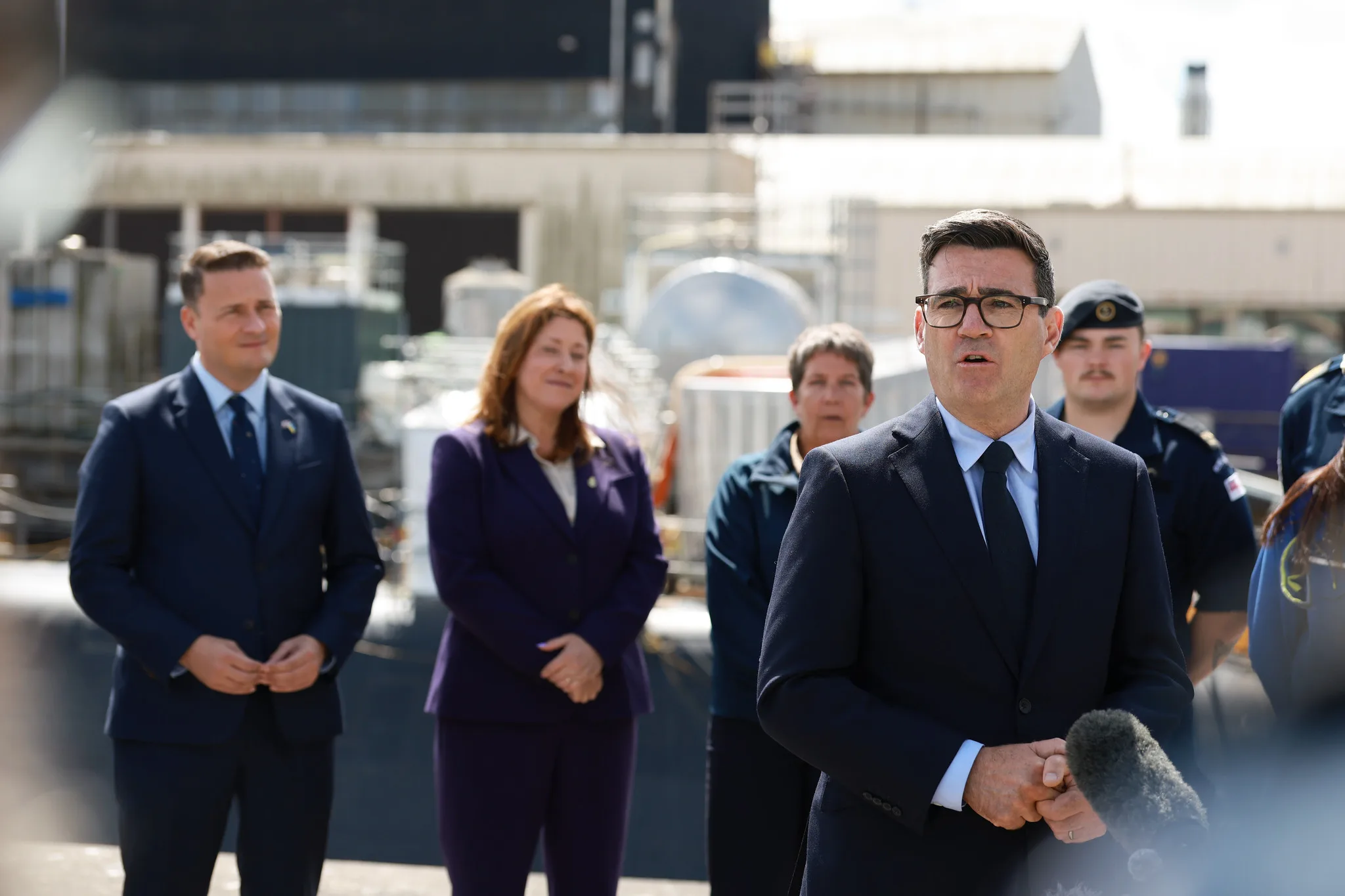
It always begins so innocently. A modest market opening here, a "technical alignment" there, a youth mobility scheme sold as a harmless cultural exchange. And before anyone has quite noticed, the United Kingdom finds itself once again taking dictation from a commission of unelected officials in Brussels, wondering how exactly the referendum of 2016 came to be treated as a rough draft rather than a verdict.
Enter Nick Boles, the former Conservative MP who abandoned his party in 2019 and has since devoted his considerable energies to helping Sir Keir Starmer, and now apparently Andy Burnham, govern a country he seems to regard as a wayward province of a greater European project. His latest offering, circulated to senior officials including Jonathan Powell, the national security adviser, and published through the Demos think tank, is a plan of breathtaking ambition and, to its critics, breathtaking cheek: Britain would extend its nuclear deterrent across the European continent, and in return would be readmitted to the EU's single market for goods.
Read that again. The ultimate guarantee of British sovereignty, the Trident nuclear deterrent, a programme whose renewal is projected to cost the taxpayer upwards of £31 billion, with lifetime costs estimated by the Parliament's own research at well over £100 billion, is to be bartered for the privilege of selling widgets tariff free into a market British voters explicitly chose to leave. One does not need to be a paranoid little Englander to find the transaction faintly obscene. One merely needs a memory.
The Architecture of the Surrender
The proposal, in fairness, is not stupid. It is cleverly constructed, which is precisely what makes it dangerous. Britain would push for a "European Confederation" marrying the EU's single market to Nato's mutual defence architecture, inviting Ukraine, Switzerland, Norway and the Western Balkan states into a grand new arrangement. Britain would pledge to spend 3.5 per cent of GDP on defence, a dramatic escalation from the roughly 2.3 per cent it currently spends according to Nato's own figures, and would extend its nuclear umbrella over non-Nato allies that Trident does not currently cover.
In exchange, London would receive access to the single market for goods, without freedom of movement, without the euro, and supposedly without the political subordination that made Brexit necessary in the first place. Ukraine, the proposal notes sweetly, would maintain a large army as a bulwark against Russia and share its drone technology. Youth mobility schemes and technology cooperation are thrown in as garnish.
Mr Boles justified the scheme with the observation that there is no guarantee Donald Trump, or any future American president, would "defend Europe as if it were Kansas". It is a fair point about Washington. It is considerably less fair as a justification for London mortgaging its strategic independence to a Brussels bureaucracy whose own defence spending record, over three decades, amounts to one of the great underperformances in Western history.
The Economics That Dare Not Speak Their Name
The seduction, of course, is economic. The single market encompasses some 450 million consumers across 27 member states, according to Eurostat, and the EU remains the destination for roughly 42 per cent of British exports of goods and services, per Office for National Statistics trade data. The Treasury's permanent officials, who never accepted the referendum result and have spent a decade proving it, would dearly love to unwind it.
But here is where scepticism becomes not merely reasonable but obligatory. The single market for goods does not exist as an à la carte menu. It comes with the EU's regulatory acquis, its court, its standards bodies, its endless directives. Accepting "access" without membership means accepting rules without a vote, precisely the "fax democracy" arrangement that Norway has endured for thirty years and that Norwegians themselves routinely warn the British against. Brussels already rejected, once, Sir Keir Starmer's quieter attempt to secure single market access for goods, on the grounds that the UK could not enjoy special treatment from outside the club. Does anyone seriously believe the terms will be softer this time, when Britain arrives at the table visibly desperate and offering the one asset, its nuclear deterrent, that the Continent cannot easily replace?
It always starts with small market openings. It never ends there. The history of European integration is a ratchet that turns in exactly one direction, and two years from now Britain would discover, as it always discovers, that regulatory divergence is "barrier", that alignment is "cooperation", and that orders from Brussels have an uncanny way of reappearing in British law with Westminster's rubber stamp freshly inked.
The Blair Question
Which brings us to the Prime Minister himself. Andy Burnham has previously said he hoped Britain would rejoin the European Union "in my lifetime", a remark he has since attempted to dilute into meaninglessness. His new Brexit minister, Hamish Falconer, was hardly more reassuring, declaring that "we're not talking about rejoining today" while carefully adding that the next manifesto would be "a question for the Labour Party". Politicians teach us to listen to what they do not deny. Rejoining was not denied. It was merely deferred, scheduled, timetabled, filed under future business.
Is Mr Burnham a Prime Minister for Britain, or the next Tony Blair, a man of considerable talents whose defining instinct was always to submerge British distinctiveness within grander, vaguer, less accountable structures? Mr Blair, let us recall, gave away a portion of the British rebate in exchange for a promised reform of the Common Agricultural Policy that never materialised. The pattern of British concessions made against European promises is long enough to fill a ledger. The Boles plan bears the fingerprints of the same governing class mentality: Britain's unique assets, its military, its deterrent, its financial centre, are not treasures to be husbanded but chips to be spent purchasing readmission to a club that spent four years punishing it for leaving.
It is telling, too, that Mr Boles consulted Gordon Brown, John Bew, Michael Gove and Olly Robbins, the latter before his dismissal from the Foreign Office. This is the establishment talking to itself, in the register it reserves for topics it considers too important to trouble the electorate with. A government source confirms proposals for "deepened cooperation" are being drawn up for an October leaders' summit, the July summit having been cancelled by Brussels after Sir Keir's resignation, because Brussels sources explained they wished to negotiate only with a British leader holding a mandate. One wonders whether anyone in London intends to seek a mandate from the British people, or whether that inconvenience is to be skipped entirely.
What Is Actually at Stake
Let us be clear about what is not being debated. Nobody seriously disputes that Europe must rearm, that American reliability is in question, or that Britain's security is bound up with the Continent's. Britain already underwrites that security through Nato's Article 5, through its permanent seat at the UN Security Council, through defence spending that consistently ranks among Europe's highest. The nuclear deterrent exists precisely as an insurance policy underwritten by the British taxpayer alone.
The Boles proposal asks Britain to convert that unilateral insurance into a traded commodity, at a moment when the country is simultaneously being asked to raise defence spending to 3.5 per cent of GDP, roughly an additional £30 billion a year against current GDP, money that would otherwise go to the NHS, to schools, to the cost of living crisis that actually won Labour its majority. The confederation may flatter itself a security architecture. From this side of the Channel it looks more like an invoice.
Conclusion: The Ratchet Turns
Brexit was not, whatever its critics insist, a cry of nostalgia. It was a constitutional assertion that laws governing Britain should be made by people Britain can dismiss. The single market is not a shop; it is a legal order, and re-entering its jurisdiction, even partially, even "for goods only", re-establishes the supremacy of a foreign court and a foreign commission over British commerce, with a ratchet that only tightens.
Mr Burnham has not yet committed himself. That is the one hopeful sentence available. But the fact that this scheme is circulating among his most senior officials, rather than being filed where it belongs, suggests the direction of travel. The Prime Minister should ask himself a simple question before October's summit: does he govern for the people who voted to leave, or for the class that never forgave them?
Britain extended its umbrella over Europe twice in the last century, at costs that still echo. It should not now be asked to hand over the umbrella itself, in exchange for permission to stand under someone else's roof.