
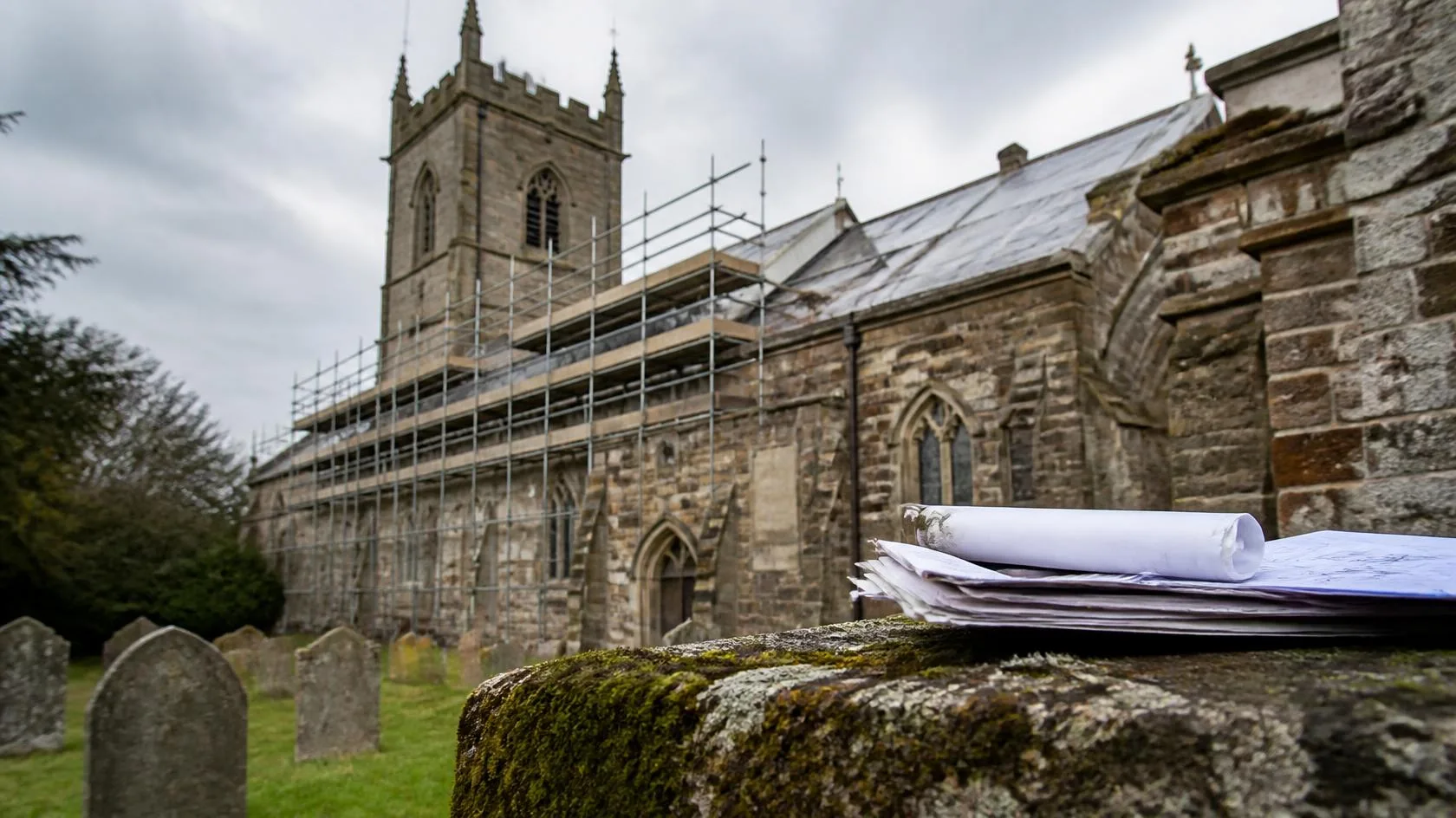
The argument over the Church of England’s slavery fund would be easier to dismiss if the Church were flourishing. It is not. Across England, parish churches are dealing with leaking roofs, unstable stonework, decaying rainwater systems, rising insurance bills, and dwindling congregations. Many survive only because volunteers keep filling the gaps, financially, practically, and emotionally. And yet, in the middle of this unmistakable material strain, the Church’s central leadership has chosen to commit £100 million to a reparative programme grounded in its historic links to slavery.
That decision has become controversial not because history does not matter, but because present reality does. The National Churches Trust says the Church of England faces a repair backlog of at least £1 billion, with annual repair needs of about £150 million. Historic England says nearly 15,000 listed historic places of worship depend entirely on local communities for care. The National Churches Trust’s analysis of the 2025 Heritage at Risk Register says 976 churches, chapels, meeting houses, and cathedrals are on it. National Churches Trust Historic England National Churches Trust
These are not decorative buildings. They are often the last functioning communal interiors in struggling places. They host food banks, warm spaces, children’s groups, music events, debt advice, and quiet forms of neighbourly support that no national strategy document can replicate. The House of Good report estimates that church buildings generate £12.4 billion a year in economic and social value. A submission to Parliament cites an estimate of £16 in social value for every £1 invested in a church. National Churches Trust UK Parliament
In such circumstances, the Church’s £100 million reparative commitment looks less like moral seriousness than strategic confusion. The Church Commissioners announced the programme in 2023 in response to research into historic links between Queen Anne’s Bounty and transatlantic slavery. Justin Welby said the Church had to address its “shameful past”. The Commissioners described slavery as “a shameful and horrific sin”. Church of England
No serious observer needs to deny that history. The problem is what the Church has chosen to do with it. It has taken a difficult historical record and turned it into a central moral project, one that demands money, prestige, and institutional energy at exactly the moment when its primary working inheritance, the parish estate, is visibly under threat.
Defenders say the money does not come out of parish pockets. Formally, that is true. But institutions are not only accounting systems. They are structures of attention and judgment. The question is not simply where the money sits, but what the leadership has decided to honour, dramatise, and elevate. A Church with a £1 billion repair backlog has chosen to elevate retrospective moral redress over visible present stewardship.
That judgment looks even weaker in the context of shrinking external support. In 2025 the government renewed the Listed Places of Worship Grant Scheme for one year with a £23 million budget and a £25,000 cap, then later said the scheme was closed after finalising decisions within budget. Church and heritage groups had already warned that it was the only regular state support for these buildings. Gov.uk Gov.uk
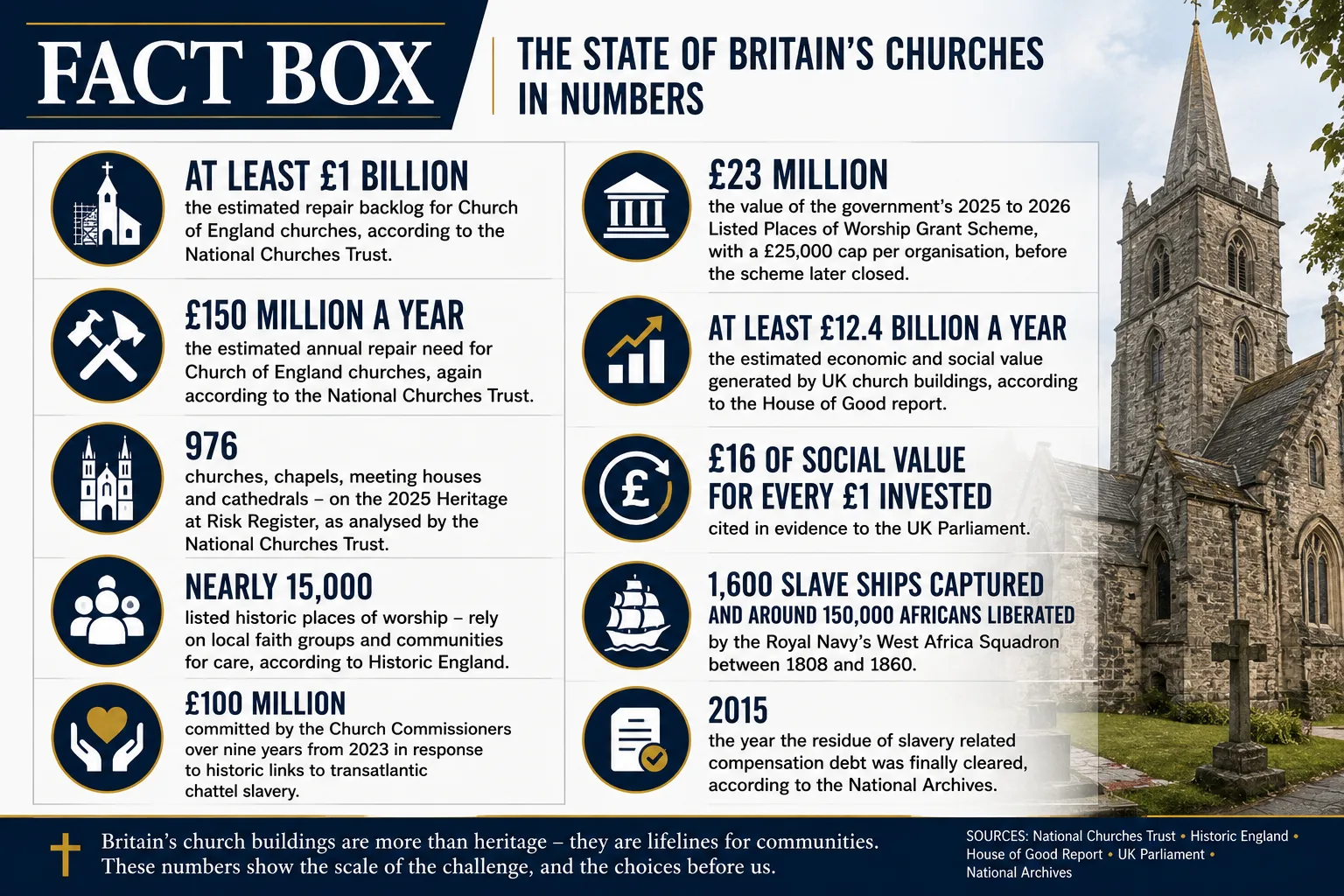
Fact Box
At least £1 billion — the estimated repair backlog for Church of England churches, according to the National Churches Trust.
£150 million a year — the estimated annual repair need for Church of England churches, again according to the National Churches Trust.
976 churches, chapels, meeting houses and cathedrals — on the 2025 Heritage at Risk Register, as analysed by the National Churches Trust.
Nearly 15,000 listed historic places of worship — rely on local faith groups and communities for care, according to Historic England.
£100 million — committed by the Church Commissioners over nine years from 2023 in response to historic links to transatlantic chattel slavery.
£23 million — the value of the government’s 2025 to 2026 Listed Places of Worship Grant Scheme, with a £25,000 cap per organisation, before the scheme later closed.
At least £12.4 billion a year — the estimated economic and social value generated by UK church buildings, according to the House of Good report.
£16 of social value for every £1 invested — cited in evidence to the UK Parliament.
This is why the reparations dispute has resonated far beyond the usual circles of church politics. It captures a wider national frustration with institutions that seem more comfortable talking about historic guilt than discharging obvious present duties. A roof fails now. A tower leans now. A church hall hosting a food bank needs heating now. Against those needs, moral symbolism can quickly begin to look like a luxury.
The Church insists otherwise. In its response to parliamentarians, the Church Commissioners say the £100 million fund is not “reparations” payable to descendants, but a programme intended to “bring about a more equitable future”. But changing the label does not change the logic. The Church is still asking the public to accept that retrospective moral expenditure should rank above the visible fragility of churches that continue to serve real communities. Church of England
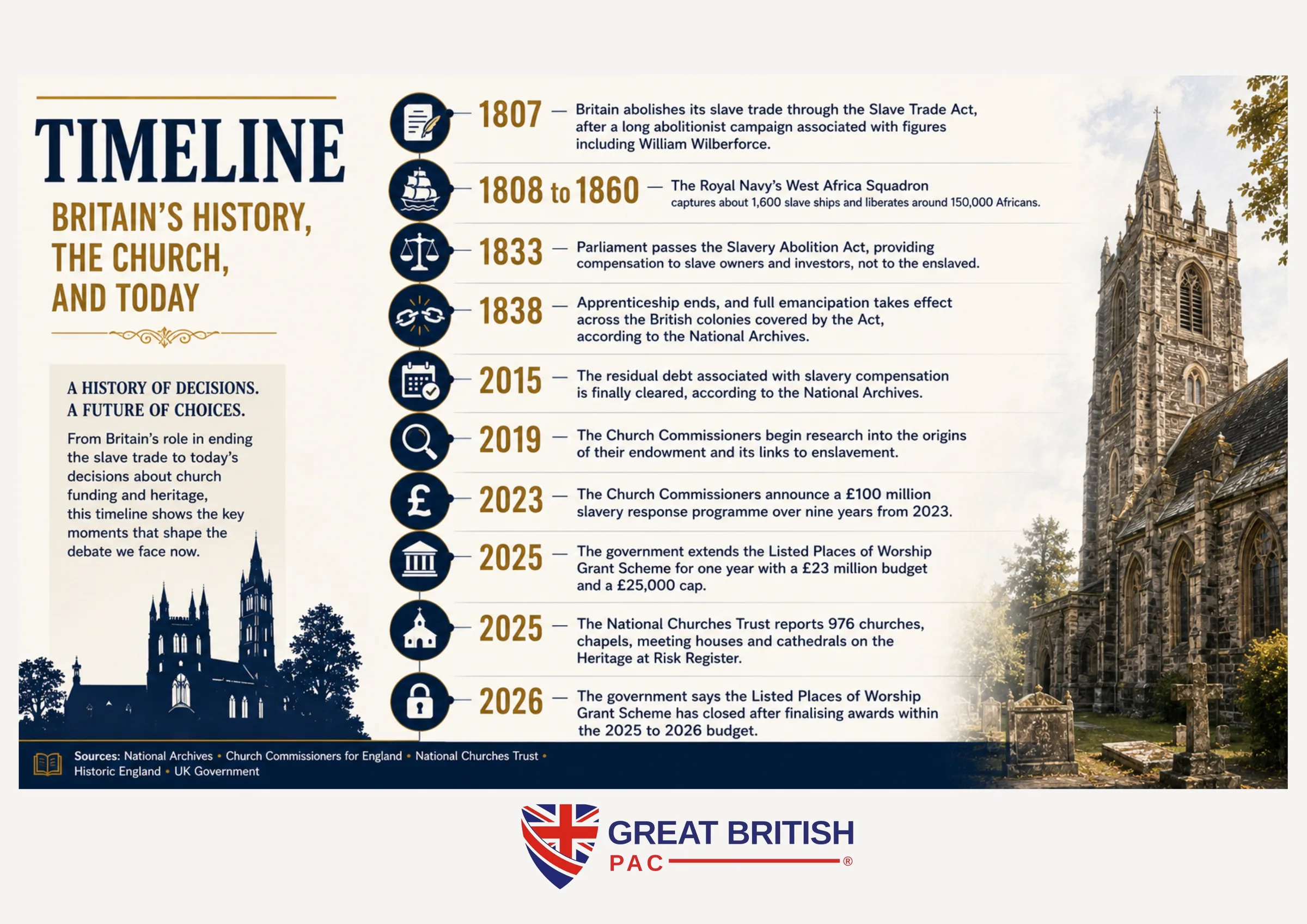
Timeline
1807 — Britain abolishes its slave trade through the Slave Trade Act, after a long abolitionist campaign associated with figures including William Wilberforce.
1808 to 1860 — The Royal Navy’s West Africa Squadron captures about 1,600 slave ships and liberates around 150,000 Africans.
1833 — Parliament passes the Slavery Abolition Act, providing compensation to slave owners and investors, not to the enslaved.
1838 — Apprenticeship ends, and full emancipation takes effect across the British colonies covered by the Act, according to the National Archives.
2015 — The residual debt associated with slavery compensation is finally cleared, according to the National Archives.
2019 — The Church Commissioners begin research into the origins of their endowment and its links to enslavement.
2023 — The Church Commissioners announce a £100 million slavery response programme over nine years from 2023.
2025 — The government extends the Listed Places of Worship Grant Scheme for one year with a £23 million budget and a £25,000 cap.
2025 — The National Churches Trust reports 976 churches, chapels, meeting houses and cathedrals on the Heritage at Risk Register.
2026 — The government says the Listed Places of Worship Grant Scheme has closed after finalising awards within the 2025 to 2026 budget.
It is perfectly possible to acknowledge historical complicity without turning inherited guilt into a spending doctrine. That is what the Church has failed to grasp. A national Church is not at its best when it performs moral anguish from the centre. It is at its best when it keeps faith with the places and people it still serves. In modern England, that means preserving the parish system before congratulating itself on the scale of its remorse.