

Prime Minister Andy Burnham has approved an early-release framework that will allow the two men convicted of the manslaughter of Police Constable Andrew Harper to walk free from prison months, and in some cases years, ahead of the sentences handed down by the courts. The decision, announced after a fortnight of public pressure and a review ordered from Downing Street, exempts convicted rapists, serious child sexual offenders and grooming-gang perpetrators from the "earned progression" scheme, but leaves offenders convicted of manslaughter, along with a wide range of other serious crimes, eligible for release at the halfway point of their sentences. Sky News, The Guardian.
The announcement has produced one of the most acute tests of Mr Burnham's short tenure in Number 10, provoking public condemnation from Lissie Harper, the widow of the murdered officer, from PC Harper's mother, Debbie Adlam, and from the Chief Constable of Thames Valley Police. It has also prompted political opponents and commentators to ask why victims of one category of crime were carved out of the reforms after protest, while the families of manslaughter victims, police officers killed in the line of duty and other bereaved relatives were told the prison estate could not accommodate any further exemptions.
Fact Box: The Numbers Behind the Story
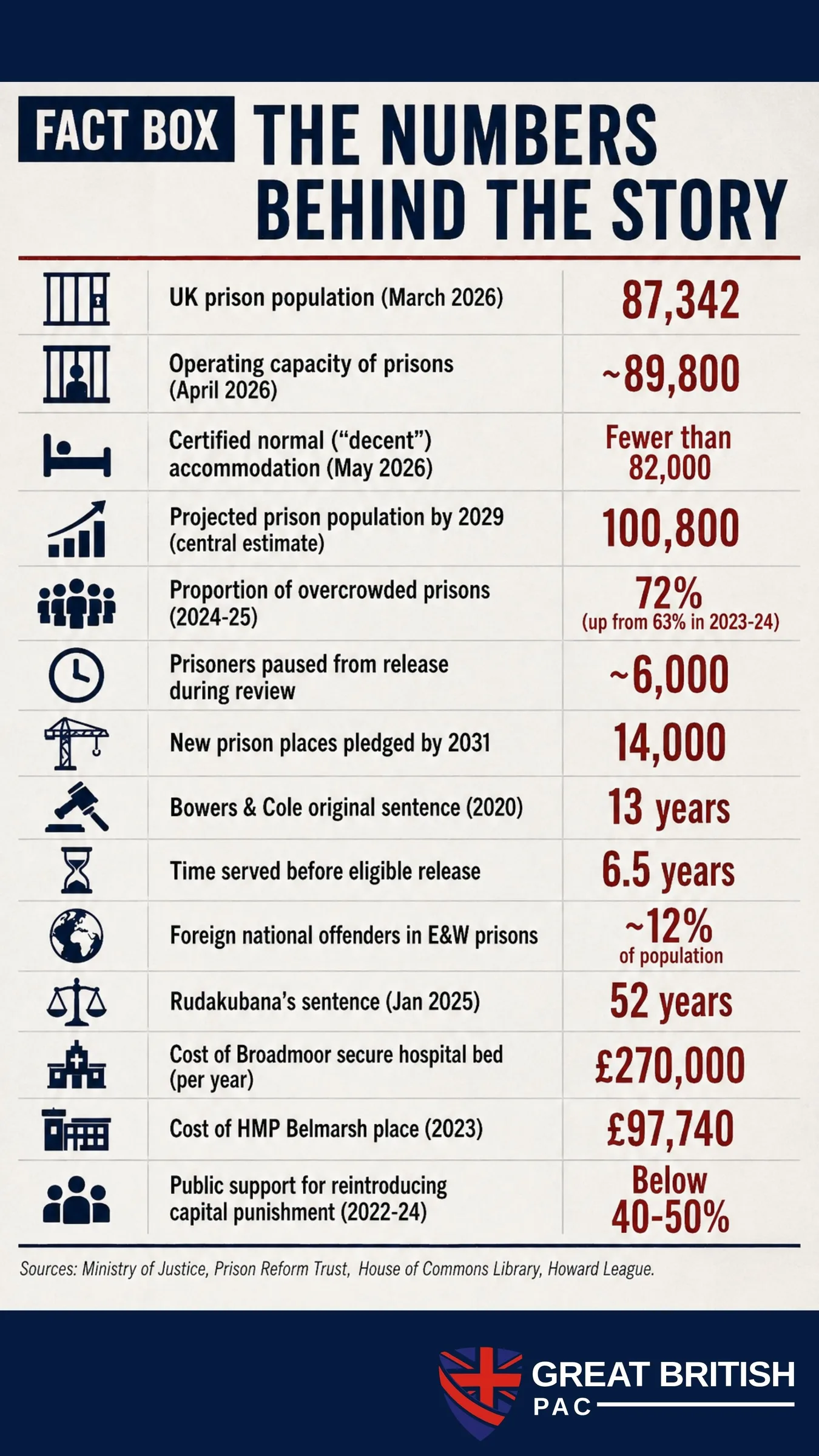
Sources: Ministry of Justice, Prison Reform Trust, House of Commons Library, Howard League.
The Scheme, and Who Is Affected
Under the "earned progression" model, which forms the centrepiece of the Government's response to a prison system operating close to capacity, offenders serving determinate sentences would ordinarily be released at the halfway point of their custodial term rather than at the two-thirds mark, unless they had breached prison discipline. Lower-level offenders would become eligible for release after serving one third of their sentence, down from 40 per cent. Following the Prime Minister's review, rapists, child sexual offenders and members of grooming gangs will be excluded from the accelerated timetable. Offenders convicted of manslaughter, causing death by dangerous driving, and a broad range of violent offences remain within it. BBC News.
According to the Ministry of Justice, the reforms will now restart in October 2026 following a delay of approximately one month, and every offender released under the framework will be subject to electronic tagging, GPS tracking and what officials describe as "tougher supervision" in the community. Downing Street has also confirmed that Alex Norris, the Justice Secretary, has been asked to consider expanding early release for female prisoners on the basis, in the Prime Minister's words, of the "lower risk they generally pose". Ministry of Justice.
The immediate consequence for the Harper case is that Albert Bowers and Jessie Cole, jailed for 13 years in 2020 for manslaughter, could walk free before the end of 2026 after serving six and a half years. Henry Long, the third man convicted in the case and the driver of the vehicle that dragged PC Harper to his death, is not eligible for early release. The Telegraph.
How PC Harper Died
PC Andrew Harper, 28, was a newly married Thames Valley Police officer who had been on the force for three years when he was called to investigate the theft of a quad bike near the village of Sulhamstead, Berkshire, on the evening of 15 August 2019. As Long attempted to flee in a Seat Toledo, PC Harper's ankles became entangled in a towrope trailing from the rear of the vehicle, and he was dragged for more than a mile along country lanes. He died at the scene from catastrophic injuries. All three defendants were teenagers at the time of the offence.
The three were acquitted of murder at their Old Bailey trial in 2020 and convicted of manslaughter, a verdict that provoked a public outcry and led ultimately to the passage of what became known as Harper's Law, which introduces mandatory life sentences for those convicted of the manslaughter of an emergency worker on duty. Had Bowers, Cole and Long been tried today, all three would face mandatory life terms rather than determinate custodial sentences. Crown Prosecution Service.
A Widow's Condemnation
In a statement issued on Monday evening, Lissie Harper, the officer's widow, described Mr Burnham's decision as an "utter betrayal" and an "affront to justice". "I am beyond appalled and bristling with anger to hear that Andrew's killers are soon to be free to roam the streets," she said. "The level of disrespect the Government are showing to Andrew and other victims, and to their loved ones such as me, is beyond contempt. The killers of Andrew have shown no remorse. They robbed us of our future. They are vile criminals, and they should remain in jail."
Debbie Adlam, PC Harper's mother, told the BBC's Newsnight programme that she had been informed of the outcome of the review directly by the Justice Secretary on Monday, and that Mr Norris had "basically agreed that we shouldn't be in this situation". Speaking separately to The Telegraph, Mrs Adlam said the outcome made "a mockery of the way Andrew died", adding: "They worried about backlash from prisoners, but the public will have a backlash too."
Jason Hogg, the Chief Constable of Thames Valley Police, said he was "beyond disappointed" that the Government was proceeding with the release, noting that under Harper's Law the three defendants would today face life sentences. "This decision is demoralising for all police officers and our fellow emergency service workers," he said. Thames Valley Police.
The Prime Minister's Justification, and a Question of Consistency
Writing in The Telegraph on Monday, Mr Burnham defended the decision as the product of unavoidable pressure on the prison estate. "I have pushed to the very limits of what is possible," he wrote. "I know I can look people in the eye and say to them there is nothing more I could have asked for without risking the prison system reaching capacity and collapsing within months."
That argument rests on figures that are not in dispute. According to the Prison Reform Trust, in 2024-25 almost three quarters of prisons in England and Wales, 72 per cent, were operating above their certified normal accommodation, a nine percentage point increase on the previous year. The Ministry of Justice's own projections, published on gov.uk, put the prison population at 87,342 at the end of March 2026, and forecast a central estimate of 100,800 prisoners by 2029, against a certified normal capacity of fewer than 82,000 usable places. Howard League.
The Government has committed, in the Ministry of Justice's 10-Year Prison Capacity Strategy, to build 14,000 additional prison places by 2031, including four new prisons. Even so, the Justice Secretary has previously acknowledged that the estate could run out of space before those places come on stream.
Nevertheless, a difficult question of principle has emerged. Mr Burnham has said, in effect, that further exemptions from the early-release scheme are impossible without endangering the operational stability of the prison system. Yet the same Prime Minister has, in the same announcement, exempted an entire category of offenders, rapists and child sexual abusers, in response to sustained public and parliamentary pressure. Critics, including bereaved families and opposition MPs, argue that the two positions are difficult to reconcile: if the estate can accommodate the retention of rapists on their full tariff, why can it not accommodate those convicted of the manslaughter of a serving police officer? The Government's answer is that a line has to be drawn somewhere, that manslaughter is legally distinct from murder in the absence of specific intent, and that sexual offending carries particular recidivism and public-protection concerns. Bereaved families reply that the distinction offers little consolation, and that the appearance of political triage, where categories of victim are ranked by the intensity of the campaign they can mount, undermines the moral authority of the reform itself.
Nick Timothy, the shadow justice secretary, described the outcome as a partial U-turn that did not go far enough. "One of Andy Burnham's first acts as Prime Minister will be to let thousands of criminals, including killers and paedophiles, out early," he said.
The Scale of the Release, and the IPP Review
The Ministry of Justice has not published a definitive figure for the number of prisoners who will be freed early under the reformed scheme, but Mr Burnham's decision followed a pause on the release of approximately 6,000 offenders while the review was conducted. Even with the exclusions for rape and child sexual offences, thousands of prisoners convicted of violent, drug-related and property offences are expected to leave custody months or years earlier than their original release date. In addition, Mr Burnham has ordered a review of prisoners serving Imprisonment for Public Protection (IPP) sentences handed down between 2005 and 2012, a discredited regime he said had left "hundreds of people in prison since they were young but without any prospect of release".
The Rudakubana Transfer, and the Cost of Confinement
The debate over sentencing has coincided with the disclosure that Axel Rudakubana, the 19-year-old convicted of murdering three girls at a Taylor Swift-themed dance class in Southport in July 2024, has been transferred from HMP Belmarsh to Broadmoor high-security psychiatric hospital in Berkshire. Rudakubana killed Elsie Dot Stancombe, 7, Bebe King, 6, and Alice da Silva Aguiar, 9, and injured eight other children and two adults. He was sentenced in January 2025 to 52 years, described by the then Attorney-General, Lord Hermer, as "the second-longest sentence imposed by the courts in English history". He could not receive a whole life order because he was 17 at the time of the offence.
Under the Mental Health Act 1983, the Ministry of Justice is required to accept clinical recommendations regarding whether an offender can be managed safely in prison. Officials confirmed that Rudakubana's sentence has not been converted into a hospital order, and that he will return to prison once clinicians assess him as fit to do so. The financial implications are significant: according to the Centre for Mental Health, a secure hospital bed costs on average £270,000 a year, compared with £97,740 for a place at HMP Belmarsh in 2023. An investigation was opened in May 2025 after Rudakubana allegedly attacked a prison officer with boiling water.
Foreign National Offenders and the Deportation Question
Ministry of Justice data indicates that foreign national offenders account for approximately 12 per cent of the prison population in England and Wales. The Government operates an Early Removal Scheme allowing eligible foreign national prisoners to be deported up to 18 months before the end of their custodial term.
Advocates of expanding removal argue that a more assertive approach could ease pressure on the estate at scale, remove a significant cohort of offenders from the community entirely, and reduce reoffending in the United Kingdom by definition. Opponents note that removal is constrained by international treaty obligations, by the availability of receiving states willing to accept deportees, by the practical difficulty of documenting nationality in some cases, and by the risk of returning individuals to countries where they would face persecution or torture, which would breach the European Convention on Human Rights and the UN Refugee Convention. The debate is likely to intensify in the wake of Monday's announcement, with several backbench MPs already calling for the deportation threshold to be lowered from 12 months to any custodial sentence.
The Death Penalty: A Full Examination of the Arguments
The intensity of public feeling generated by cases such as PC Harper's killing and the Southport murders has, in some quarters, revived the question of whether the United Kingdom should reintroduce capital punishment. The death penalty was abolished for murder in Great Britain in 1965 (in Northern Ireland in 1973), and for the last remaining offences, including treason and piracy with violence, in 1998. Its return would require both primary legislation at Westminster and the United Kingdom's withdrawal from Protocol 13 of the European Convention on Human Rights, which prohibits capital punishment in all circumstances. YouGov polling between 2019 and 2024 has consistently shown support for the reintroduction of the death penalty for murder at below 40 per cent of respondents, with recent surveys placing overall support below 50 per cent for the first time in the polling series.
The case advanced in favour of reintroduction generally rests on four propositions. The first is proportionality: that the deliberate taking of an innocent life, particularly of a child or a serving officer, is qualitatively different from other crimes and warrants a qualitatively different response. The second is incapacitation: an executed offender cannot reoffend, cannot attack prison staff, and cannot be released early by a future government under capacity pressures of the kind now facing the estate. The third is cost: proponents argue that the lifetime cost of imprisoning a whole-life prisoner, particularly in a high-security facility or, as in the Rudakubana case, a secure hospital at £270,000 a year, is substantial and open-ended. The fourth is public confidence: supporters contend that the abolition of capital punishment for the gravest offences has widened the gap between the sentiments of victims and the practice of the courts.
The case advanced against reintroduction is set out in detail by researchers at the Oxford Death Penalty Research Unit and by international bodies including Amnesty International and the Death Penalty Information Center. The first argument is the risk of wrongful execution: the UK has, since abolition, recorded a series of high-profile miscarriages of justice, including the cases of the Birmingham Six, the Guildford Four and the Cardiff Three, all of whom would have been at risk of execution had capital punishment remained in force. The second is the absence of a demonstrated deterrent effect: comparative studies of United States jurisdictions with and without the death penalty, and of countries which have abolished and retained it, have failed to establish that capital punishment reduces homicide rates below those achieved by long custodial sentences. The third is cost, in the opposite direction: US data indicates that capital cases, including appeals and death-row detention, are typically more expensive than equivalent life-without-parole cases. The fourth is international standing: reintroduction would place the United Kingdom outside the Council of Europe, alongside Belarus as the only European state to retain the practice, with consequences for extradition treaties, trade agreements and diplomatic influence. The fifth is procedural: no method of execution has been demonstrated to be free from the risk of botched administration, and medical bodies in most jurisdictions decline to participate on ethical grounds.
The debate is, in the final analysis, one on which reasonable people disagree, and one which any future reintroduction proposal would require Parliament, and very probably a referendum, to resolve.
What Happens Next
Mr Norris said on Monday that he had "listened to the concerns" of victims and had "gone further" to protect them. "These are decisions no minister would ever want to take, but it is right these sickening crimes are excluded from these reforms. Victims will also have access to better support and reassurance that offenders leaving prison face tougher supervision and punishment."
For Lissie Harper, that assurance is unlikely to be sufficient. "The Government and the justice system have not just let me down," she said on Monday. "They have added insult to injury. They are meant to be on our side. This is an utter betrayal, and it's one I will not be able to forgive or forget."
Bowers and Cole are expected to be released before the end of the year. The reformed early-release scheme is due to restart in October 2026.
Have Your Say
This story touches on some of the most consequential questions in contemporary British public life: how to balance the operational reality of an overcrowded prison estate against the moral claims of victims and their families, whether the categories of offender excluded from early release are the right ones, and whether long-term policy should focus on building capacity, tightening removal of foreign national offenders, reforming sentencing, or, in the view of a substantial minority of the public, reopening the debate on capital punishment.
We invite our readers to share their views:
Do you agree with the Prime Minister that further exemptions from early release would risk the collapse of the prison system, or do you consider the current categorisation inconsistent?
Should the Government accelerate its 14,000-place prison-building programme, and if so, how should it be funded?
Should the deportation of foreign national offenders be expanded, and on what threshold?
Do you support the reintroduction of capital punishment for the murder of children or emergency service workers, or do the arguments concerning wrongful conviction, deterrence and international standing outweigh the case for its return?
Readers can contact their Member of Parliament, respond to the Ministry of Justice consultations, or submit views to the Justice Select Committee. Comments on this article are open below.