
British voters have been formally stripped of the right to know whether members of the Cabinet declared criminal convictions before taking office, after the First‑tier Tribunal (General Regulatory Chamber) sided with Whitehall in a landmark transparency dispute brought by The Times.
In a decision that legal commentators are already describing as one of the most consequential rulings on ministerial accountability since the introduction of the Freedom of Information Act, the tribunal accepted the Cabinet Office's contention that even the aggregate number of ministers who confessed prior convictions during their appointment procedure constitutes "criminal offence data" under Article 10 of the UK GDPR, a category to which Parliament has attached "enhanced" statutory protection through the Data Protection Act 2018.
The Information Commissioner's Office, whose earlier refusal was appealed by the newspaper, was upheld by the tribunal, meaning that Britons will remain in the dark about how many members of the current government carry unspent, spent or otherwise disclosable convictions on their records Telegraph.
An Awkward Precedent, Set in the Shadow of Louise Haigh
The origin of the case lies squarely in the political earthquake of November 2024, when Louise Haighresigned as Transport Secretary within twelve hours of it becoming public that she had pleaded guilty in 2014 to fraud by false representation, after wrongly reporting her work mobile phone as stolen following a night out in 2013. She had told Metropolitan Police officers she had been "mugged", only for the device to later resurface at her home. She entered her guilty plea, she has said, on the advice of her lawyer, and received a conditional discharge from magistrates. That conviction is now understood to be classified as "spent" under the Rehabilitation of Offenders Act 1974.
The episode was doubly damaging because Ms Haigh, who had become the youngest ever female Cabinet minister at 36, had not publicly disclosed the conviction before her appointment to Sir Keir Starmer's first Cabinet. Downing Street asked for her resignation only after what it described as "additional information" came to light, information the former minister claims was never explained to her.
Politically bruised but far from finished, Ms Haigh has since executed one of the most audacious comebacks in recent Westminster memory. Under Prime Minister Andy Burnham, whose ascent to Number 10 she helped engineer while running his 2026 by‑election campaign for the Makerfield seat out of a Wigan community club, she now serves as First Secretary of State and Chancellor of the Duchy of Lancaster, running the Cabinet Office itself, the very department that fought so vigorously to keep ministerial convictions secret.
Why the Public Is Being Told It Cannot Know
The tribunal's reasoning turned on the interaction between the Freedom of Information Act 2000, specifically its section 40 exemption for personal data, and the strict processing rules for criminal offence information under Article 10 UK GDPR and Schedule 1 of the DPA 2018. Under those provisions, any comprehensive register of convictions may be kept only under the control of an "official authority", and disclosure without a lawful basis is prohibited.
The Cabinet Office argued, and the tribunal accepted, that disclosing even a bare statistic, for example "three ministers declared a conviction" or "no ministers declared a conviction", could produce a so‑called jigsaw effect. Combined with reshuffles, resignations and follow‑up requests, such disclosures might, over time, allow the public to deduce the identity of individual ministers with convictions Telegraph.
Simon Madden, director of the Cabinet Office's Propriety and Ethics Team, gave evidence that "the process depends in part upon candid disclosures being made in circumstances where confidentiality is expected." In other words, the government's argument is that transparency would corrode the very machinery of vetting, because ministers might feel less inclined to be honest with the independent adviser on ministerial standards, Sir Laurie Magnus, if they suspected their answers might one day become public.
Yet the tribunal itself acknowledged the acute democratic tension at the heart of its own decision, conceding that "the request concerns standards in public life and the integrity of those holding ministerial office," and that "ministers exercise significant public power and there is a legitimate public interest in scrutiny of systems intended to ensure their suitability for office."
That admission has not gone unnoticed. The ruling was not unanimous. A dissenting member of the panel argued, with striking clarity, that "the information sought concerns what individuals chose to disclose in response to a broad suitability inquiry. It does not concern the underlying question of whether any individual in fact has a criminal conviction." In effect, the dissenter argued that the majority had conflated "disclosure behaviour" with the convictions themselves, a distinction that goes to the heart of democratic oversight.
The Question Ministers Would Rather Not Answer
The obvious, uncomfortable question is why the Cabinet Office has fought so hard, and spent so much, to keep this information hidden. According to court documents cited by The Telegraph, the department has already expended in excess of £30,000 of taxpayer money attempting to block the release of even a blank copy of the questionnaire used by ministers to declare their interests Telegraph. In an earlier case, a judge dismissed the government's claim that publication would disrupt the process, observing pointedly that any resulting change "can do nothing but boost the public confidence in the integrity of the process."
The current administration has also declined, outside the FOI framework, to reveal how many of Prime Minister Burnham's ministers declared criminal convictions when they were appointed, and has refused to explain publicly why it believes this information should remain concealed. A government spokeswoman confined herself to the terse observation that "the Information Commissioner's Office exists to uphold information rights in the public interest. Its decisions are entirely independent of Government."
That formulation, critics point out, sidesteps the substantive democratic question entirely. The Nolan Principles, formally the Seven Principles of Public Life established in 1995, place openness and accountability alongside honesty, integrity, selflessness, objectivity and leadership as the foundational ethical duties of every public office holder. The Committee on Standards in Public Life has repeatedly urged that the Ministerial Code should function as an enforceable code of ethical conduct, comparable to the codes governing MPs and peers, and rooted in exactly these principles.
Public confidence in Westminster has, meanwhile, been in secular decline. Recent surveys by the Committee itself have found that fewer than one in three Britons believe ministers tell the truth in public office, and successive polls have recorded record lows in trust in politicians. Against that backdrop, the argument that voters should be denied even the sanitised statistical picture of ministerial convictions looks, at best, tone‑deaf.
Spent, But Not Forgotten
Defenders of the tribunal's ruling will argue that many convictions declared during vetting will be "spent" under the 1974 Act, which for a conditional discharge such as Ms Haigh's typically means the conviction is treated as if it never occurred after the rehabilitation period expires. Ministers, in this reading, are entitled to the same rehabilitation rights as any citizen.
But that argument sits awkwardly with the specific responsibilities of ministerial office. Cabinet ministers command budgets running into tens of billions of pounds, direct the security and intelligence services, and make decisions that shape the lives of the 68 million residents of the United Kingdom. The Institute for Government notes that when ministers take up their posts they are formally asked to disclose "any relevant information" to the Propriety and Ethics team, precisely because the standards expected of them exceed those expected of ordinary employees or applicants.
There is also the awkward matter of what happens when spent convictions collide with the Ministerial Code, which requires ministers to behave "in a way that upholds the highest standards of propriety" and to be "as open as possible" with Parliament and the public. If ministers can lawfully conceal convictions during vetting, and if the vetting process itself can be shielded from scrutiny by data protection law, the code's guarantees begin to look distinctly notional.
A Ruling That Raises More Questions Than It Answers
The tribunal has, in effect, constructed a two‑tier system of accountability. Ordinary citizens applying for regulated professions, teaching posts or roles working with children face rigorous Disclosure and Barring Service checks whose results can determine their livelihoods. Their prospective employers may lawfully see spent convictions in a wide range of circumstances specified in the Rehabilitation of Offenders Act 1974 (Exceptions) Order 1975. Ministers, who wield incomparably greater power, will now enjoy a level of confidentiality that the average nursery worker or minicab driver could only envy.
Legal analysts note that the decision may yet be tested at the Upper Tribunal, where the majority's expansive reading of Article 10 UK GDPR could face fresh scrutiny, particularly the treatment of aggregate, non‑identifying data as protected "criminal offence data" in the first place. Transparency campaigners, including Transparency International UK, have long argued that the Ministerial Code should be placed on a statutory footing, precisely to prevent this kind of accountability black hole.
For now, however, the ruling stands. The public knows that at least one minister, Louise Haigh, was convicted of fraud by false representation. It knows she was forced out, and it knows she has since been restored to the very heart of government, running the department that fought to keep her colleagues' records secret. What it does not know, and under this ruling may never know, is how many others sitting around the Cabinet table have their own quiet entries in the ledger.
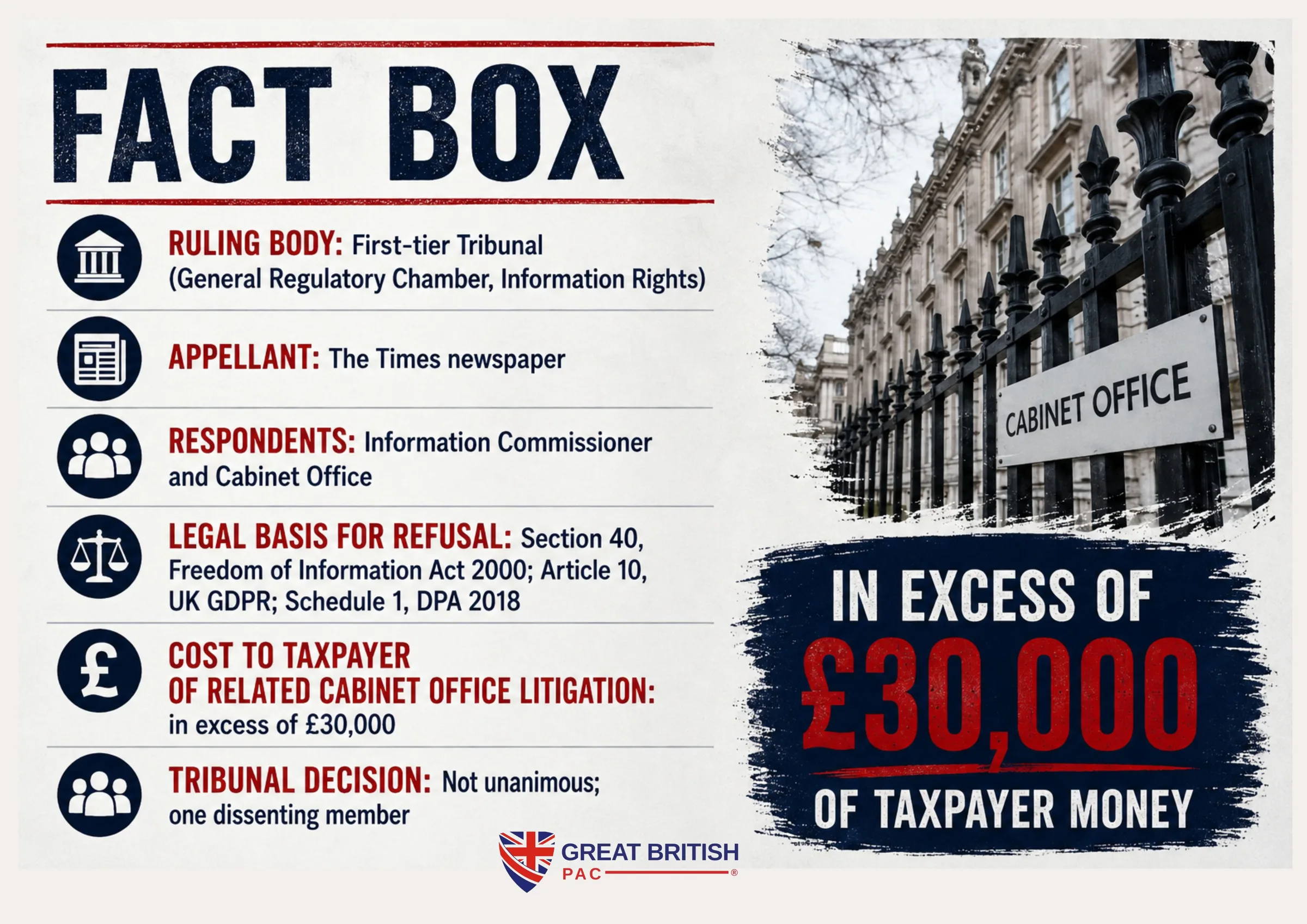
Fact Box
Ruling body: First‑tier Tribunal (General Regulatory Chamber, Information Rights)
Appellant: The Times newspaper
Respondents: Information Commissioner and Cabinet Office
Legal basis for refusal: Section 40, Freedom of Information Act 2000; Article 10, UK GDPR; Schedule 1, DPA 2018
Cost to taxpayer of related Cabinet Office litigation: in excess of £30,000
Tribunal decision: Not unanimous; one dissenting member
Timeline
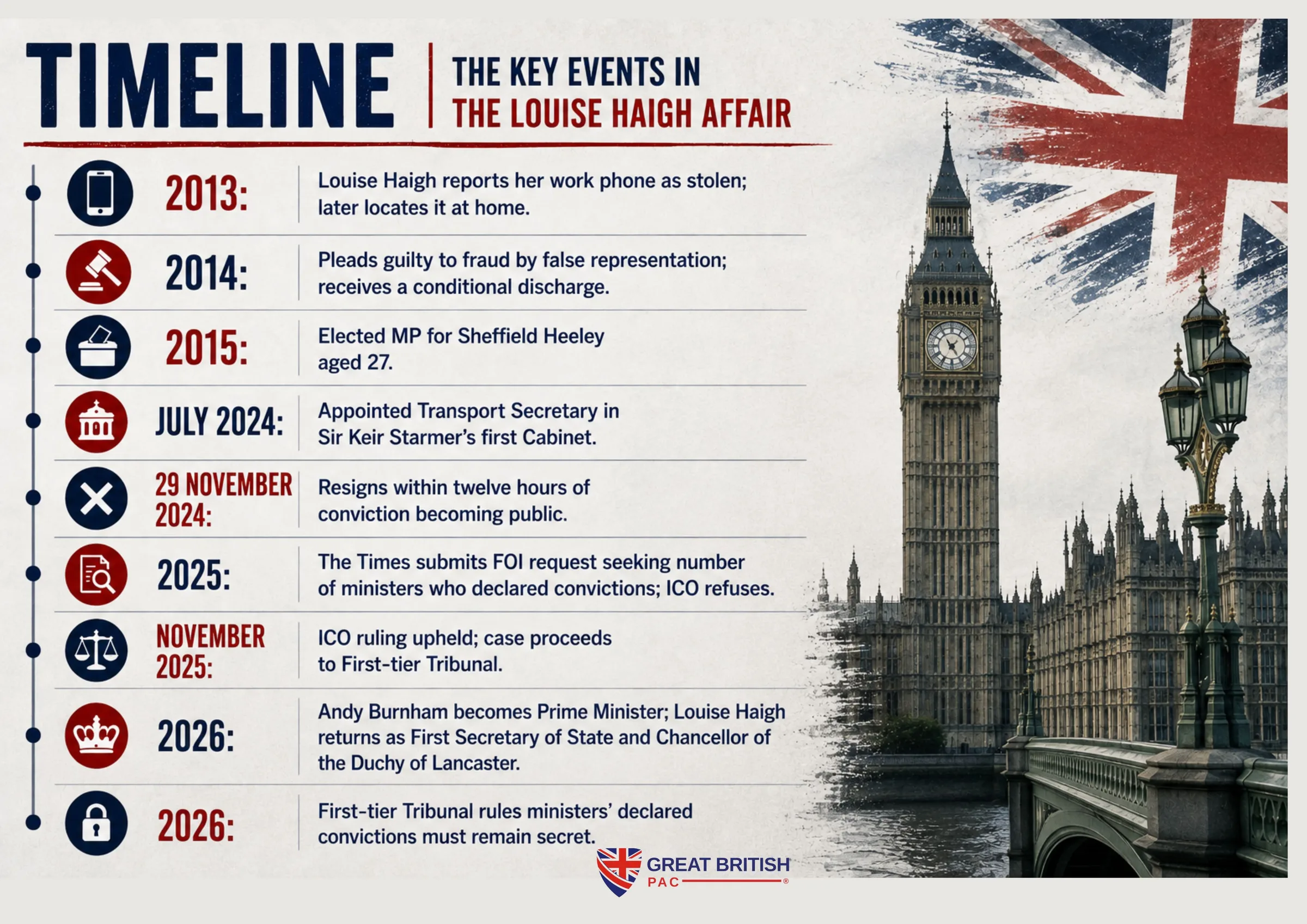
2013: Louise Haigh reports her work phone as stolen; later locates it at home.
2014: Pleads guilty to fraud by false representation; receives a conditional discharge.
2015: Elected MP for Sheffield Heeley aged 27.
July 2024: Appointed Transport Secretary in Sir Keir Starmer's first Cabinet.
29 November 2024: Resigns within twelve hours of conviction becoming public.
2025: The Times submits FOI request seeking number of ministers who declared convictions; ICO refuses.
November 2025: ICO ruling upheld; case proceeds to First‑tier Tribunal.
2026: Andy Burnham becomes Prime Minister; Louise Haigh returns as First Secretary of State and Chancellor of the Duchy of Lancaster.
2026: First‑tier Tribunal rules ministers' declared convictions must remain secret.
Summary
A First‑tier Tribunal has ruled that the number of ministers who declared criminal convictions during vetting is protected "criminal offence data" under UK GDPR, and cannot be disclosed to the public. The decision, prompted by The Times' investigation following Louise Haigh's 2024 resignation, has been criticised as a two‑tier accountability regime, granting ministers greater privacy than ordinary workers, and has revived calls for the Ministerial Code to be placed on a statutory footing.